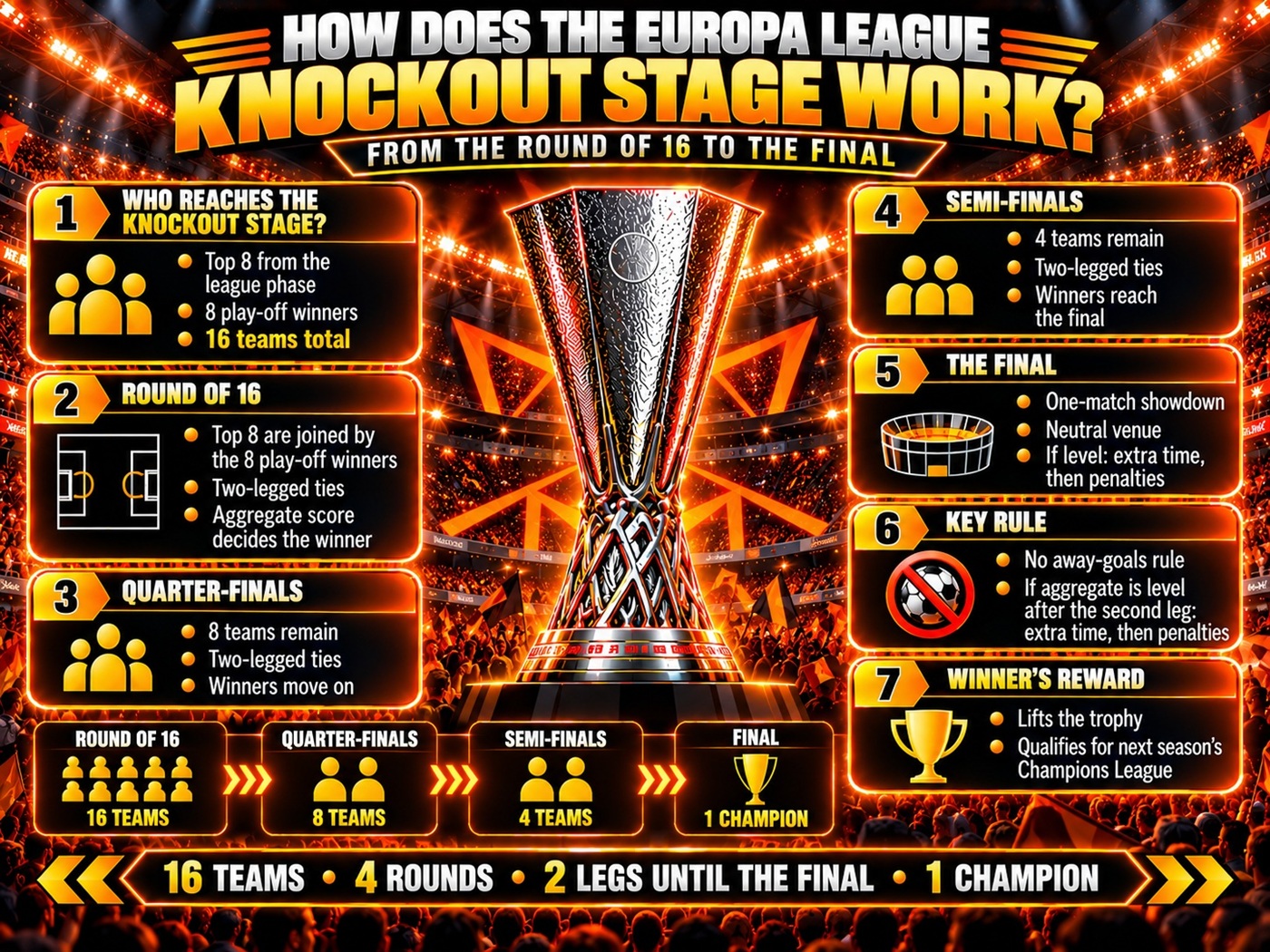
The Europa League knockout stage begins after the 36-team league phase and eventually reduces the competition to two clubs for the final. Twenty-four teams survive the league phase, but they do not all enter the knockout rounds at the same point.
The top eight qualify directly for the round of 16, while teams finishing ninth to 24th must first play in the knockout phase play-offs. From there, the competition continues through the round of 16, quarter-finals and semi-finals before a one-match final.
League-phase position remains important because it helps determine the knockout bracket, seeding, and which teams normally play the second leg at home. In this guide, I will explain the full knockout structure from the play-offs to the final.
Read Also: Champions League vs Europa League vs Conference League: What’s the Difference?
How Many Teams Reach the Europa League Knockout Phase?
Twenty-four teams continue after the league phase.
They are divided into two groups.
Teams finishing 1st to 8th qualify directly for the round of 16.
Teams finishing 9th to 24th enter the knockout phase play-offs.
Clubs finishing 25th to 36th are eliminated from European competition.
The knockout phase therefore begins with 24 clubs, but only 16 remain by the time the round of 16 starts.
What Are the Europa League Knockout Rounds?
The knockout phase consists of:
Knockout phase play-offs
Round of 16
Quarter-finals
Semi-finals
Final
The play-offs, round of 16, quarter-finals and semi-finals are normally played over two legs. The final is one match at a predetermined neutral stadium.
Read Also: How Do Europa League Pots and Seeding Work?
How Do the Knockout Phase Play-Offs Work?
The clubs finishing ninth to 24th compete in eight two-legged play-off ties. Teams ranked 9th to 16th are seeded. Teams ranked 17th to 24th are unseeded. The possible pairings are determined by final league-phase position:
9th or 10th vs 23rd or 24th
11th or 12th vs 21st or 22nd
13th or 14th vs 19th or 20th
15th or 16th vs 17th or 18th
Seeded teams normally play the second leg at home. The eight winners advance to the round of 16. I explain this stage in more detail in What Is the Europa League Knockout Phase Play-Off?
How Does the Round of 16 Work?
The eight play-off winners join the eight clubs that finished at the top of the league-phase table. That gives 16 teams. The league-phase top eight are paired according to their final positions:
1st and 2nd
3rd and 4th
5th and 6th
7th and 8th
Each pair is drawn into predetermined sections of the bracket against the relevant knockout phase play-off winners.
This means the round of 16 is not an unrestricted draw where any top-eight club can face any play-off winner. The final league-phase standings already determine the sections of the bracket available to each club.
Do the Top Eight Normally Play the Second Leg at Home?
Yes. The clubs finishing first to eighth are seeded for the round of 16 and normally host the second leg. That is another benefit of finishing in the top eight.
They avoid the knockout phase play-offs and also receive the second-leg home position in the round of 16. However, UEFA can make scheduling adjustments when necessary.
Read Also: Europa League Tiebreaker Rules Explained
How Are the Quarter-Final Pairings Decided?
The quarter-final routes are built into the knockout bracket. There is no fresh unrestricted draw after the round of 16 that completely resets the competition.
Once the knockout bracket has been established, clubs can see which section leads toward a particular quarter-final and semi-final.
League-phase position also continues to influence second-leg home seeding. Teams originally ranked 1st to 4th are seeded to play the second leg at home in the quarter-finals.
How Do the Semi-Finals Work?
The four quarter-final winners progress to the semi-finals. The semi-final routes are also determined by the established knockout bracket rather than a new open draw.
The clubs originally ranked 1st and 2nd after the league phase carry second-leg home seeding into the semi-finals. If one of those clubs has already been eliminated, the team that eliminated it inherits that seeded position in the bracket.
Read Also: How Do UEFA Coefficients Work?
What Does It Mean to Inherit a Seeded Position?
The knockout seeding is attached to the bracket position, not permanently to the original club. Imagine the first-placed league-phase team receives a seeded route through the bracket but is eliminated in the round of 16.
The team that beats it takes over that seeded bracket position. If that position carries second-leg home status in a later round, the winning club inherits that benefit.
UEFA does not recalculate the seeding after every knockout round based on the remaining clubs. This allows the bracket to remain fixed.
Why Does League-Phase Position Still Matter Deep Into the Knockout Stage?
The league standings do more than decide who qualifies. They also create the structure of the knockout bracket. Finishing higher can provide:
direct qualification to the round of 16
a seeded knockout position
a more defined bracket route
second-leg home status in certain rounds
For example, clubs finishing first to fourth have seeded second-leg positions for the quarter-finals, while the clubs finishing first and second also carry that advantage into the semi-finals.
That gives clubs a reason to keep competing for the highest possible position even after qualification has been secured.
Are Europa League Knockout Ties Played Over Two Legs?
Yes. Every knockout round before the final is normally played over two matches. Each club hosts one leg. UEFA adds the scores from both matches together, and the team with the higher aggregate score advances.
For example, if Club A wins the first leg 2-0 and loses the second leg 1-0, Club A progresses 2-1 on aggregate.
Is the Away-Goals Rule Used?
No. Away goals no longer have extra value in Europa League knockout ties. Suppose Club A loses the first leg 2-1 away but wins the second leg 1-0 at home.
The aggregate score is 2-2. Club A does not advance simply because it scored an away goal. The tie instead goes to extra time.
What Happens If a Knockout Tie Is Level After Two Legs?
If the aggregate score is level after the second leg, the teams play two 15-minute periods of extra time. If one team scores more goals during extra time, it advances.
If the aggregate score is still level after extra time, the tie is decided by a penalty shoot-out. The same system applies to the knockout phase play-offs, round of 16, quarter-finals and semi-finals.
Can Teams From the Same Country Meet in the Knockout Stage?
Yes. The same-association protection used in the league-phase draw no longer prevents clubs from meeting once the knockout phase begins.
So two clubs from the same domestic league can face each other if the bracket places them together. The knockout stage can therefore produce domestic matchups.
Can Teams That Met in the League Phase Play Again?
Yes. A league-phase rematch is possible in the knockout stage. There is no general rule protecting teams from facing a club they already met during their eight league-phase fixtures.
That means the same two clubs could meet once in the league phase and later face each other again over two legs in the knockout stage.
Does UEFA Club Coefficient Affect the Knockout Stage?
Not directly. Club coefficients are important earlier in the competition because they help determine qualifying seeds and league-phase pots. Once the league phase ends, the knockout bracket is based on league-phase finishing positions.
A team with a high historical coefficient receives no special knockout protection if it finishes poorly in the current season. Likewise, a lower-coefficient club can earn a strong knockout position by performing well in the league phase.
Is the Europa League Knockout Draw Open?
No. The current system is built around the final league-phase standings. The play-off teams are paired according to their positions. The top eight are also paired for the round of 16.
The quarter-final and semi-final routes then follow the predetermined bracket. There is still a draw element, but it operates within those fixed position-based possibilities. I explain this separately in How Does the Europa League Knockout Draw Work?
Is There a Fresh Draw After Every Knockout Round?
No. The knockout bracket is not reset after every round. Once the relevant draws establish the bracket, the possible routes through the quarter-finals and semi-finals are already known.
This makes the current system different from formats where clubs repeatedly return to a completely open draw.
How Does the Europa League Final Work?
The final is different from the earlier knockout rounds. It is played as one match at a predetermined neutral stadium. There is no second leg.
If one team is ahead after 90 minutes, it wins the Europa League. If the score is level, the match goes to two 15-minute periods of extra time. If it remains level after extra time, the winner is decided by penalties.
Where Is the 2026/27 Europa League Final?
The 2026/27 Europa League final will be played at Stadion Frankfurt in Frankfurt, Germany, on 26 May 2027. Unlike the earlier knockout rounds, neither finalist receives a true home-leg advantage.
One team is designated as the nominal home club for administrative purposes, but the final itself is played at the predetermined venue.
What Does the Europa League Winner Receive?
The winner lifts the Europa League trophy and also earns a place in the following season's Champions League league phase if it has not already qualified through its domestic competition.
The 2026/27 winner therefore receives access to the 2027/28 Champions League league phase if needed. The Europa League champion also earns a place in the UEFA Super Cup against the Champions League winner.
What Are the 2026/27 Europa League Knockout Dates?
The 2026/27 knockout schedule is:
Knockout phase play-offs: 18 and 25 February 2027
Round of 16: 11 and 18 March 2027
Quarter-finals: 8 and 15 April 2027
Semi-finals: 29 April and 6 May 2027
Final: 26 May 2027
The competition therefore moves from the end of the league phase in January to the final in May.
A Simple Europa League Knockout Example
Imagine Club A finishes fourth in the league phase. It skips the knockout phase play-offs and goes directly into the round of 16. Because it finished in the top eight, it is seeded for that round and normally hosts the second leg.
Suppose Club A wins its round-of-16 tie. Because fourth place also carries seeded second-leg status into the quarter-finals, Club A would normally host the second leg there as well.
If Club A is eliminated before that point, the club that beats it inherits its seeded bracket position. This shows why league-phase ranking can continue to matter several rounds after the league phase has ended.
How Many Matches Can a Team Play in the Knockout Stage?
A team finishing in the top eight can win the Europa League by playing:
two round-of-16 matches
two quarter-final matches
two semi-final matches
one final
That is seven knockout matches. A club finishing ninth to 24th must also play two knockout phase play-off matches. It can therefore need nine knockout matches to win the competition. This is one of the practical advantages of finishing in the top eight.
Common Europa League Knockout Stage Misunderstandings
Not all 24 surviving teams enter the same round. The top eight skip directly to the round of 16.
The knockout phase play-offs involve teams ranked ninth to 24th.
Every knockout round before the final is normally two-legged.
The final is one match at a predetermined neutral venue.
The away-goals rule is not used.
Level aggregate ties go to extra time and then penalties if necessary.
Same-country matchups can occur in the knockout stage.
League-phase rematches are possible.
Club coefficients do not determine knockout seeding. Final league-phase position does.
The quarter-final and semi-final routes are part of the established bracket rather than completely new open draws.
A team that eliminates a seeded club inherits that club's seeded bracket position.
Europa League Knockout Stage at a Glance
Twenty-four clubs survive the league phase. The top eight qualify directly for the round of 16, while teams finishing ninth to 24th compete in the knockout phase play-offs. Eight play-off winners join the top eight to create the round of 16.
The competition then continues through the quarter-finals and semi-finals. All of those rounds are normally played over two legs, with the aggregate score deciding who advances. If the aggregate score is level, extra time and penalties are used. The final is played as one match at a predetermined neutral stadium.
Final Thoughts
The Europa League knockout stage is closely connected to what happens during the league phase. The league standings determine which teams skip the play-offs, who is seeded, and where clubs are placed in the knockout bracket.
The top eight receive the biggest immediate advantage because they move directly into the round of 16. From there, the competition follows a two-legged knockout system through the semi-finals, with the aggregate score deciding each tie.
The final is the exception because it is played as one match at a neutral venue. For me, the most important point is that the knockout stage is not a completely separate tournament that starts from zero. The positions earned during the league phase continue to shape the bracket and second-leg home advantages deep into the competition.