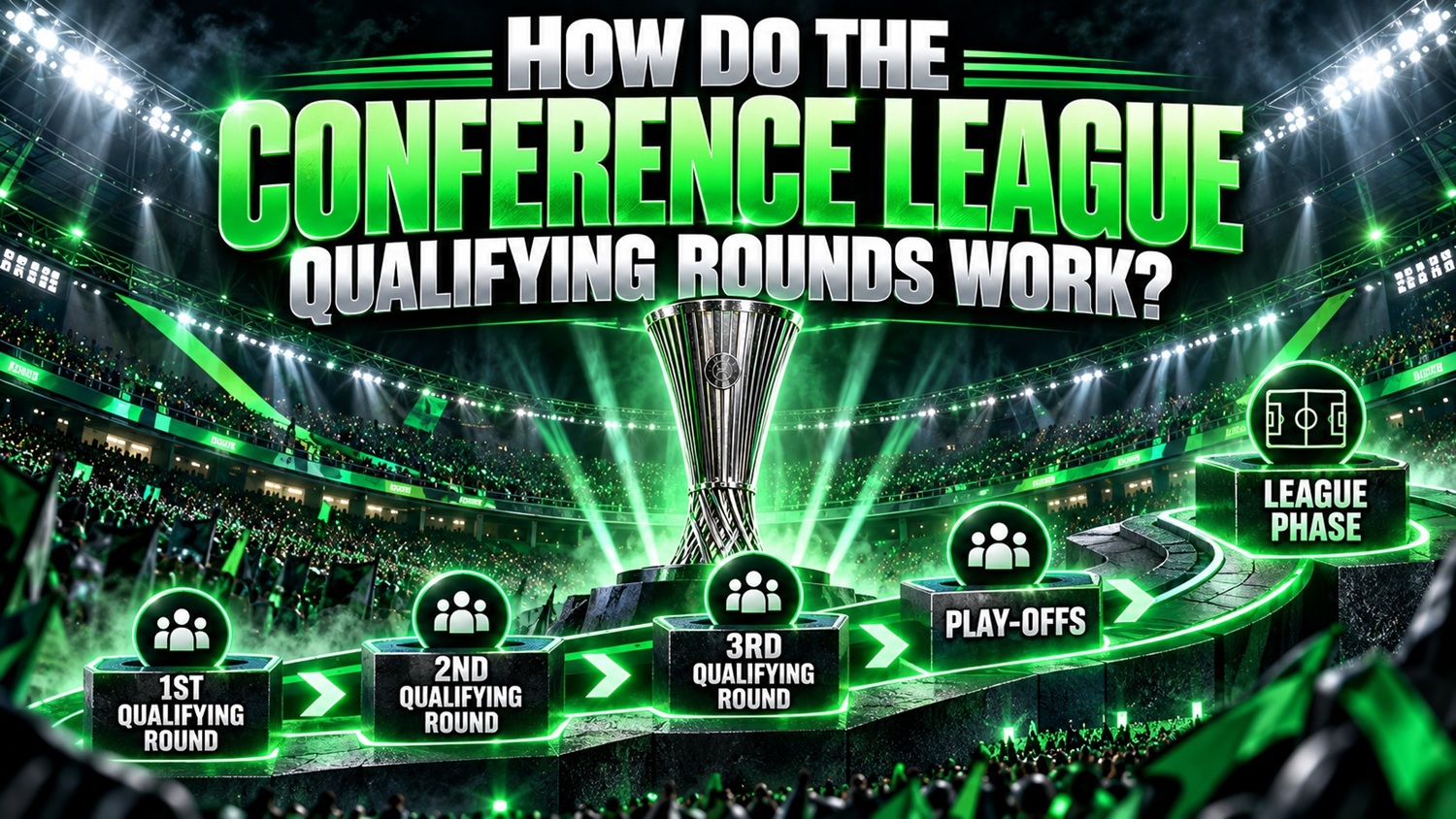
The UEFA Conference League qualifying system contains three qualifying rounds followed by a play-off round. However, not every club begins at the same stage. The competition uses two separate qualifying routes: the Main Path and the Champions Path.
The Main Path begins in the first qualifying round, while the Champions Path starts in the second. Clubs can also enter Conference League qualifying after being eliminated from designated Champions League or Europa League qualifying rounds.
For 2026/27, 24 clubs eventually won Conference League play-off ties and reached the league phase. 12 Europa League play-off losers joined them to complete the 36-team field. In this guide, I will explain each qualifying round and how clubs move through the system.
Read Also: How Do Teams Qualify for the UEFA Conference League?
How Many Conference League Qualifying Rounds Are There?
The Conference League qualifying structure has:
First qualifying round
Second qualifying round
Third qualifying round
Play-off round
The first three rounds make up the qualifying phase. The play-off round is the final step before the league phase. A club entering in the first qualifying round therefore has to win four two-legged ties to reach the league phase. A club entering directly in the play-offs needs to win only one.
What Are the Main Path and Champions Path?
The Conference League separates qualifying clubs into two routes.
Main Path
The Main Path contains most clubs qualifying through domestic competitions, together with designated teams transferred from the Europa League. It operates from the first qualifying round through to the play-offs.
Champions Path
The Champions Path is primarily for domestic champions whose European campaign began higher in UEFA's competition system before they were eliminated.
It starts in the second qualifying round. The two paths remain separate during Conference League qualifying. They both ultimately produce league-phase qualifiers.
Does the Champions Path Start in the First Qualifying Round?
No. The first qualifying round is Main Path only. The Champions Path begins in the second qualifying round. This is an important difference because a domestic champion transferred into the Conference League does not enter the same first-round route as the clubs starting directly in the Main Path.
How Did the 2026/27 First Qualifying Round Work?
The 2026/27 first qualifying round contained 52 Main Path clubs.
That produced 26 two-legged ties.
There was no Champions Path at this stage.
The 26 winners advanced to the second qualifying round.
The 26 losing clubs were eliminated from European competition.
Because the Conference League is UEFA's third men's club competition, there is no lower UEFA competition for those losing teams to enter.
Who Entered the 2026/27 Second Qualifying Round?
The second qualifying round was much larger because new clubs entered alongside the first-round winners. It contained separate Champions and Main Paths.
Champions Path
There were 12 clubs. They were 12 of the clubs eliminated from the 2026/27 Champions League first qualifying round under the season's adapted access system. Those 12 clubs created six ties. The six winners progressed to the Conference League third qualifying round.
Main Path
There were 86 clubs. That field consisted of:
26 first qualifying round winners
60 new entrants
The 60 new entrants included six clubs eliminated from the Europa League first qualifying round. The 86 Main Path clubs created 43 ties. The 43 winners progressed.
Why Do Europa League Losers Enter the Conference League?
UEFA connects the three men's club competitions during qualifying. A club eliminated from the Europa League at a designated stage can receive another opportunity in the Conference League.
For 2026/27:
Europa League first qualifying round losers entered Conference League qualifying round two
Europa League second qualifying round losers entered Conference League qualifying round three
Europa League third qualifying round losers entered Conference League play-offs
Europa League play-off losers entered the Conference League league phase
This movement ends once the league phases begin.
What Happened in the 2026/27 Third Qualifying Round?
The third qualifying round again contained separate Champions and Main Paths.
Champions Path
There were eight clubs. The field consisted of:
six Champions Path second qualifying round winners
two clubs entering directly at this stage
Those eight teams played four ties. The four winners progressed to the play-off round.
Main Path
There were 52 clubs. They consisted of:
43 Main Path second qualifying round winners
nine clubs eliminated from the Europa League second qualifying round
Those 52 clubs played 26 ties. The 26 winners advanced to the play-offs.
What Happens to Teams That Lose in the Conference League Third Qualifying Round?
They are eliminated from European competition. Unlike Champions League and Europa League qualifying, losing a Conference League tie does not provide another competition to drop into. Once a team loses its Conference League qualifying tie, its UEFA campaign ends.
How Did the 2026/27 Conference League Play-Off Round Work?
The play-offs were the final qualifying stage. There were 48 clubs, producing 24 ties. Again, UEFA separated them into Champions and Main Paths.
Champions Path
There were 10 clubs:
four Conference League Champions Path third qualifying round winners
six clubs eliminated from the Europa League third qualifying round through the relevant champions route
They competed in five ties.
Main Path
There were 38 clubs:
26 Conference League Main Path third qualifying round winners
five clubs entering directly in the play-offs
seven clubs eliminated from the Europa League third qualifying round through the relevant Main Path route
They competed in 19 ties. Together, the two paths produced 24 play-off winners.
What Did the Conference League Play-Off Winners Receive?
All 24 play-off winners qualified for the league phase. The 24 losing clubs were eliminated from UEFA competition. However, those 24 winners were not the only clubs entering the Conference League league phase. They were joined by clubs arriving from the Europa League.
How Did the League Phase Reach 36 Teams?
The 2026/27 Conference League league phase was made up of:
24 Conference League play-off winners
12 Europa League play-off losers
That created the 36-team league phase. This means one-third of the final league-phase field reached the competition after losing in the Europa League play-offs rather than winning a Conference League play-off tie.
Can a Club Reach the Conference League League Phase Without Playing a Conference League Qualifying Match?
Yes. A club losing in the Europa League play-off round enters the Conference League league phase. It does not have to play another Conference League qualifying tie.
So a club can appear in the Conference League league phase even though every European match it played before that point was in another UEFA competition.
Can a Team Start in the Champions League and Reach the Conference League?
Yes. The qualifying system allows this. For example, a domestic champion eliminated in the Champions League first qualifying round can enter the Conference League second qualifying round through the Champions Path.
There are also routes where a team first moves from the Champions League into the Europa League before later entering the Conference League. A club can therefore have a European journey such as:
Champions League
Europa League
Conference League
depending on its original route and where it is eliminated.
Are Conference League Qualifying Matches Two-Legged?
Yes. Under the normal system, every qualifying and play-off tie is played over two matches. Each club plays:
one match at home
one match away
The scores are combined. The team with the higher aggregate score advances. UEFA can exceptionally order a one-leg tie if circumstances require it, but two legs are the standard competition format.
What Happens If the Aggregate Score Is Level?
If both clubs score the same total number of goals across the two legs, the second match goes to extra time. Two 15-minute periods are played. If the teams remain level after extra time, the winner is decided by a penalty shoot-out.
Is the Away-Goals Rule Used?
No. Away goals do not have additional value. For example, imagine:
First leg: Club A 2-1 Club B
Second leg: Club B 1-0 Club A
The aggregate score is 2-2. Club B does not advance because it scored an away goal in the first leg. The tie goes to extra time.
How Are Conference League Qualifying Draws Seeded?
UEFA generally divides clubs into equal groups of seeded and unseeded teams. Club coefficients established at the start of the season are used for seeding. A seeded team is then drawn against an unseeded team within the relevant draw structure.
UEFA can also create smaller draw groups where required. The draw determines both the pairing and which club hosts the first leg. I will explain the full seeding system separately in How Do Conference League Pots and Seeding Work?
Can Clubs From the Same Country Meet in Conference League Qualifying?
No. Clubs from the same national association cannot be drawn against each other during the Conference League qualifying phase or play-offs. That restriction changes later. Same-country matchups can occur in the knockout phase after the league phase.
Does Being Seeded Guarantee Qualification?
No. Seeding only structures the draw. It does not give the seeded club goals, points, or any other match advantage. A seeded team can still lose its tie and be eliminated. Club coefficients measure previous European performance, so they do not necessarily tell us which team is stronger at the time the qualifying matches are played.
Why Can a Club Enter Qualifying in a Later Round?
The entry stage is determined by UEFA's access system. Factors include:
the association's position in UEFA's access list
the club's domestic qualification route
rebalancing caused by other UEFA qualification outcomes
transfers from Champions League or Europa League qualifying
That is why one club may have to start in July while another can enter directly in the August play-offs.
What Is Access-List Rebalancing?
UEFA can adjust the original access list when vacancies or qualification overlaps occur. For example, changes can result from:
a UEFA titleholder qualifying through domestic competition
domestic cup and league qualification overlapping
Champions League European Performance Spots
other knock-on changes between UEFA competitions
As a result, a club can be moved into a later qualifying round. This is why the final participant numbers for a season should be checked against UEFA's adapted access list rather than assuming the original access list never changes.
How Many Ties Would a First-Round Club Need to Win?
A club entering the first qualifying round would have to win:
First qualifying round
Second qualifying round
Third qualifying round
Play-off round
That is four ties and eight matches under the normal two-legged system. Only then would it reach the six-match league phase. A club making that full journey could therefore play eight European matches before the league phase even begins.
How Many Ties Does a Direct Play-Off Entrant Need to Win?
Only one. Five Main Path clubs entered directly at the 2026/27 play-off stage. They needed to win one two-legged tie to reach the league phase. This illustrates how different the qualifying journeys can be. One team can require four successful rounds, while another begins only one tie away from the league phase.
What Were the 2026/27 Conference League Qualifying Dates?
The qualifying calendar was:
First qualifying round: 7–9 and 14–16 July 2026
Second qualifying round: 21–23 and 28–30 July 2026
Third qualifying round: 4–6 and 11–13 August 2026
Play-offs: 20 and 26–27 August 2026
The league-phase draw followed on 28 August.
A Simple Main Path Example
Imagine Club A enters in the first qualifying round. It wins its first two-legged tie. It then wins its second qualifying round tie and its third qualifying round tie. Club A reaches the play-offs.
If it wins again, it becomes one of the 24 Conference League play-off winners entering the league phase. If it loses at any Conference League stage, its European campaign ends.
A Simple Champions Path Example
Imagine Club B is a domestic champion. It begins in Champions League qualifying but loses in the first qualifying round. Under the applicable route, it enters the Conference League second qualifying round through the Champions Path.
If Club B then wins:
Conference League second qualifying round
Conference League third qualifying round
Conference League play-off
it reaches the league phase. Its Conference League journey therefore began because it was eliminated from the Champions League.
A Europa League Transfer Example
Imagine Club C reaches the Europa League second qualifying round but loses. The applicable 2026/27 route places it into the Conference League third qualifying round. Club C wins that Conference League tie.
It then wins the Conference League play-off. It reaches the league phase. Now imagine Club D goes one round further and loses only in the Europa League play-offs. Club D does not need to enter a Conference League qualifying tie at all. It goes directly into the Conference League league phase.
Common Conference League Qualifying Misunderstandings
There are three qualifying rounds plus a play-off round.
The Main Path begins in the first qualifying round.
The Champions Path begins in the second qualifying round.
Not every club enters qualifying at the same stage.
Champions League losers can enter the Conference League during qualifying.
Europa League losers can also enter at designated Conference League stages.
Europa League play-off losers go directly into the Conference League league phase.
Conference League qualifying losers are eliminated from Europe. There is no lower UEFA competition.
Qualifying ties are normally played over two legs.
The away-goals rule is not used.
Seeded status does not guarantee progression.
For 2026/27, 24 Conference League play-off winners reached the league phase and were joined by 12 Europa League play-off losers.
Conference League Qualifying at a Glance
The Conference League qualifying phase has a Main Path and a Champions Path. The Main Path begins in the first qualifying round. The Champions Path begins in the second.
For 2026/27:
52 Main Path clubs started in the first qualifying round
The second round contained 12 Champions Path and 86 Main Path clubs
The third round contained eight Champions Path and 52 Main Path clubs
The play-offs contained 10 Champions Path and 38 Main Path clubs
The 48 play-off teams produced 24 winners. Those 24 clubs qualified for the league phase and were joined by 12 Europa League play-off losers to complete the 36-team field.
Final Thoughts
Conference League qualifying is easier to follow when I separate the Main Path from the Champions Path and remember that clubs can enter at different stages. The Main Path starts in the first qualifying round.
The Champions Path begins in the second and provides a route mainly for domestic champions arriving from higher UEFA qualifying competitions. Europa League teams can also enter the Conference League as qualifying progresses.
The closer a club gets to the Europa League league phase, the later it enters the Conference League if eliminated. For me, the key point is that Conference League qualifying is not one straight four-round tournament involving the same clubs from beginning to end.
New teams enter every round, Champions League and Europa League losers feed into the competition, and the process finally produces 24 Conference League play-off winners who join 12 Europa League play-off losers in the 36-team league phase.