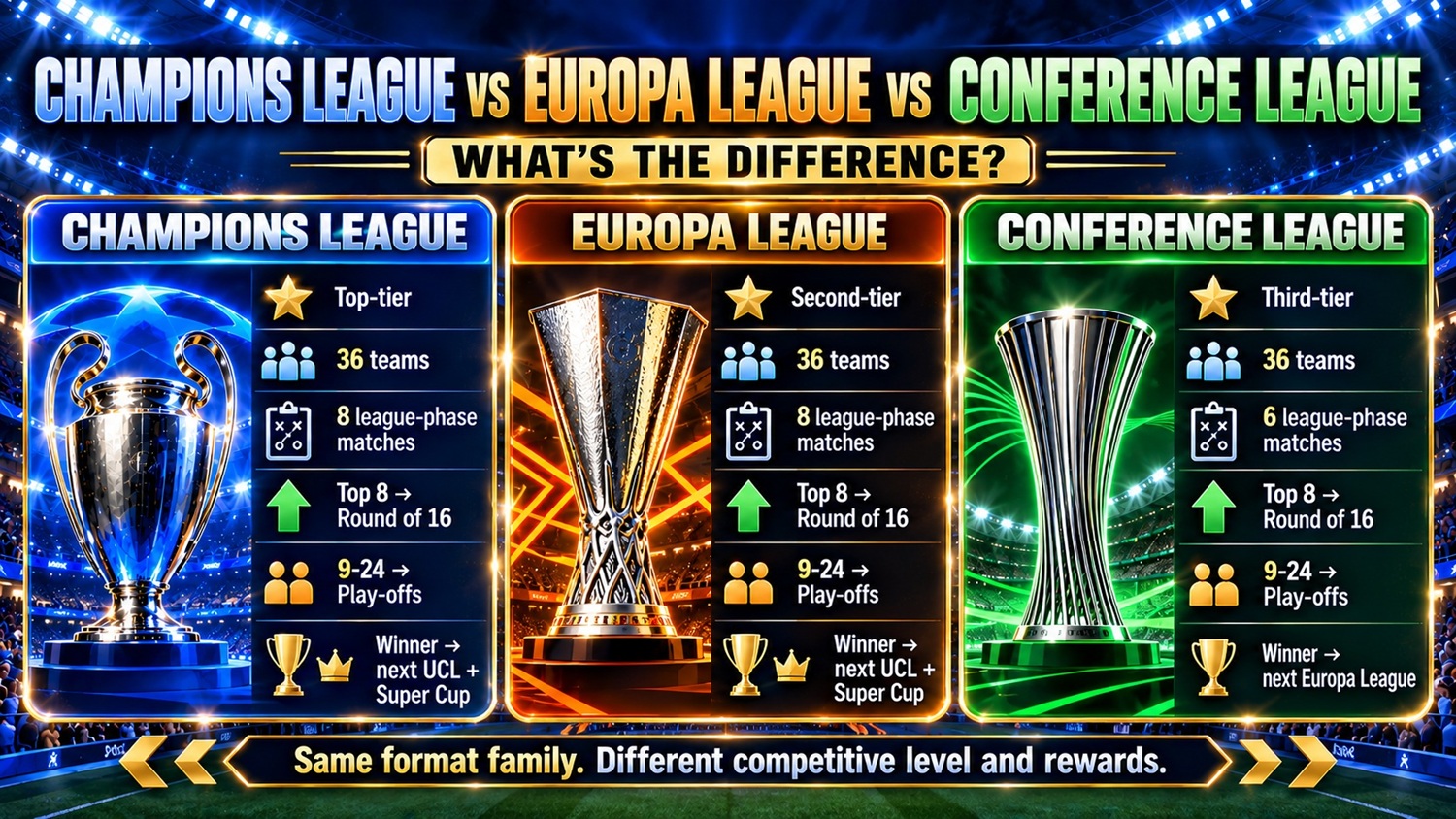
UEFA runs three main men's European club competitions: the Champions League, Europa League and Conference League. They now share several features. All three have 36-team league phases, use a single league table and send the top eight clubs directly to the round of 16.
However, they are not the same competition. They differ in their place within UEFA's competition structure, how clubs qualify, how many league-phase matches they play, how their draws work and what winning each tournament provides for the following season.
In this guide, I will explain those differences and also show where the three competitions work in almost exactly the same way.
Read Also: Champions League Yellow Card and Suspension Rules Explained
What Is the Difference Between the Three UEFA Club Competitions?
The simplest way to separate them is by their position in UEFA's men's club competition structure.
The Champions League is UEFA's top-tier club competition.
The Europa League is the second tier.
The Conference League is the third tier.
That does not mean every club starts in one competition and moves down automatically. Clubs qualify for specific competitions through their domestic results, UEFA titleholder places and the UEFA access system. There are also limited transfers between competitions during qualifying.
How Do Clubs Qualify for the Champions League?
Champions League qualification is mainly based on domestic league performance. Depending on the strength of an association and its place on UEFA's access list, clubs may qualify directly for the league phase or enter qualifying first.
Domestic champions from many associations enter through the Champions Path, while certain non-champions from higher-ranked associations can enter through the League Path.
Other routes include the Champions League titleholder, Europa League titleholder and the two European Performance Spots.
For 2026/27, 29 clubs entered the Champions League league phase directly and seven qualified through the qualifying rounds. I explain these routes in more detail in How Do Teams Qualify for the UEFA Champions League?
How Do Clubs Qualify for the Europa League?
Europa League places are also distributed according to UEFA's access list, but the domestic qualification routes are different. Depending on the association, clubs can qualify through domestic cup competitions or league positions that do not lead to the Champions League.
The Conference League winner is also guaranteed a place in the following season's Europa League league phase, unless it has qualified for the Champions League or Europa League through its domestic competition. Europa League qualifying also receives clubs eliminated from certain stages of Champions League qualifying.
For 2026/27, 13 clubs had direct league-phase places, including the place reserved for the Conference League titleholder. Twelve more qualified through Europa League qualifying, while 11 entered after being eliminated from designated Champions League qualifying rounds.
Read Also: Champions League Squad Registration Rules Explained
How Do Clubs Qualify for the Conference League?
The Conference League gives clubs another route into UEFA competition, particularly clubs that finish below their countries' Champions League and Europa League qualification positions.
Domestic routes depend on each association's UEFA allocation and can involve league position or domestic cup qualification.
The Conference League also receives clubs eliminated from designated Champions League and Europa League qualifying rounds. There is an important difference in 2026/27: No club qualified directly for the Conference League league phase.
All 36 league-phase clubs reached it through qualifying, including teams that entered the Conference League directly and teams transferred from higher UEFA competitions during qualifying.
The Conference League winner itself does not return automatically to the Conference League. It receives a place in the following season's Europa League league phase, subject to its domestic qualification situation.
Do All Three Competitions Have 36 Teams?
Yes. The Champions League, Europa League and Conference League each have 36 clubs in their league phase. The old system of eight groups of four has been replaced by one league table in each competition.
However, the number of matches is not identical. The Champions League and Europa League each give every club eight league-phase matches. The Conference League gives every club six.
Read Also: Champions League Tiebreaker Rules Explained
How Does the Champions League League Phase Work?
The Champions League league phase contains 36 clubs, all ranked together in a single league table rather than being divided into traditional groups. Each club plays eight league-phase matches against eight different opponents. Four of those matches are played at home and four are played away.
For the draw, UEFA divides the 36 clubs into four pots of nine teams. Each club is drawn against two opponents from every pot, including its own. It plays one of those two opponents at home and the other away.
After all eight matches have been played, the 36 clubs are ranked in the same league table. Their final positions determine whether they qualify directly for the round of 16, enter the knockout phase play-offs or are eliminated from the competition.
How Does the Europa League League Phase Work?
The Europa League uses almost the same league-phase system as the Champions League. Each team also plays eight different opponents, with four matches at home and four away.
The 36 clubs are divided into four pots of nine, and each team faces two clubs from each pot. So once the league phase begins, the Champions League and Europa League structures are extremely similar.
The main differences between them are qualification routes and their position within UEFA's competition system.
Read Also: How Do Champions League Pots and Seeding Work?
How Is the Conference League League Phase Different?
The Conference League also has 36 clubs in its league phase, but each team plays fewer matches than in the Champions League and Europa League. Each club plays six matches against six different opponents, with three at home and three away.
The draw uses six pots of six teams. Each club is drawn against one opponent from every pot, giving it six different league-phase opponents in total. This is the main structural difference at this stage. Champions League and Europa League clubs play eight league-phase matches, while Conference League clubs play six.
What Happens After the League Phase?
After the league phase, the qualification system is the same in all three UEFA competitions. Teams finishing 1st to 8th qualify directly for the round of 16. Clubs placed 9th to 24th enter the knockout phase play-offs, while teams finishing 25th to 36th are eliminated from European competition.
The knockout phase play-offs are played over two legs, with the eight winners joining the top eight league-phase teams in the round of 16. From there, the Champions League, Europa League and Conference League all follow the same sequence: round of 16, quarter-finals, semi-finals and final.
The round of 16, quarter-finals and semi-finals are played over two legs, while the final is decided in a single match.
Can a Team Drop Into Another Competition After the League Phase?
No. This is an important difference from older UEFA formats. A team finishing outside the top 24 of the Champions League does not drop into the Europa League. Likewise, an eliminated Europa League team does not enter the Conference League.
In all three competitions, finishing 25th or lower in the league phase means the club's European season is over. Movement between competitions can still happen during qualifying, but not after the league phases have started.
How Does Movement Between Competitions Work During Qualifying?
The three competitions are connected during qualifying. For example, a club eliminated from certain Champions League qualifying rounds can enter the Europa League or Conference League at a designated stage.
Similarly, clubs eliminated from certain Europa League qualifying rounds can continue in the Conference League. This gives some clubs another opportunity to reach a UEFA league phase after failing to qualify for a higher competition.
However, the exact destination depends on the stage and qualification path in which the club was eliminated. A club does not simply choose which competition to enter next. UEFA's access list determines where it goes.
What Does the Champions League Winner Get?
The Champions League winner becomes European champion and receives an automatic place in the following season's Champions League league phase if it has not already qualified through its domestic competition.
The winner also qualifies for the UEFA Super Cup, where it faces the Europa League winner. For the 2026/27 champion, that means a place in the 2027/28 Champions League league phase if required.
What Does the Europa League Winner Get?
The Europa League winner receives an important additional reward: qualification for the following season's Champions League league phase if it has not already qualified there through its domestic competition.
The Europa League champion also faces the Champions League winner in the UEFA Super Cup. So winning the Europa League can move a club directly into UEFA's top club competition for the next season.
What Does the Conference League Winner Get?
The Conference League winner earns a place in the following season's Europa League league phase, provided it has not already qualified for the Champions League or Europa League through its domestic performance.
This creates a clear progression between UEFA's three competitions. Winning the Conference League can move a club into the Europa League the following season, while winning the Europa League can provide a place in the Champions League league phase.
The Champions League winner remains in UEFA's top club competition for the following season if it has not already qualified domestically, and also earns a place in the UEFA Super Cup.
Do Champions League Teams Always Have Bigger Coefficients?
No. The competition a club qualifies for and its UEFA club coefficient are related concepts, but they are not the same thing. A club can have a relatively strong coefficient and still qualify for the Europa League or Conference League because its domestic results did not earn a Champions League place.
Likewise, a domestic champion from a smaller association may qualify for Champions League qualifying despite having a lower coefficient than some Europa League clubs. Coefficients are mainly used for purposes such as seeding.
Domestic results and UEFA's access list determine which competition a club initially qualifies for. I explain the coefficient system fully in How Do UEFA Coefficients Work?
Are the Draws the Same?
Not completely. The Champions League and Europa League league-phase draws both use four pots of nine clubs. Each team faces two opponents from every pot. The Conference League instead uses six pots of six clubs, with each team facing one club from each pot.
The competitions still share several draw principles. Club coefficients are used to establish the pots, and UEFA applies restrictions intended to control how clubs from the same or other associations can be paired. The Champions League has one additional detail: its defending champion is the top seed in Pot 1.
Are the Knockout Formats Different?
The basic knockout structure is largely the same across all three competitions. The top eight league-phase teams skip the knockout phase play-offs. Teams ranked ninth to 24th contest the play-offs. The eight play-off winners then join the top eight in the round of 16.
From there, the competitions progress through the quarter-finals and semi-finals before a one-match final. This means the biggest structural differences between the competitions occur before and during the league phase, rather than in the later knockout rounds.
Which Competition Has More League-Phase Matches?
The Champions League and Europa League each give every club eight league-phase matches, while Conference League clubs play six.
That means a team reaching the Champions League or Europa League league phase is guaranteed eight matches at that stage, compared with six in the Conference League.
These totals apply only to the league phase. Qualifying rounds and knockout matches are additional and are not included in those figures.
Why Does UEFA Have Three Club Competitions?
Having three competitions creates more routes into European football. The Champions League concentrates many of the highest domestic finishers and champions.
The Europa League provides another competition for domestic cup winners, other high league finishers, the Conference League titleholder and clubs progressing through its qualifying system.
The Conference League extends UEFA competition access further across its member associations. The competitions are therefore connected, but each has its own qualification routes and place within the European club system.
Common Misunderstandings About the Three Competitions
All three competitions now have 36-team league phases. The Conference League is not smaller in terms of league-phase team count.
The Conference League has fewer league-phase matches. Clubs play six instead of eight.
There are no traditional four-team groups. All 36 clubs in each competition are ranked together.
Finishing 25th or lower does not send a club into another UEFA competition. It means elimination from Europe.
Dropping between competitions still happens during qualifying. It does not continue after the league phase begins.
Winning the Europa League can provide Champions League qualification for the following season.
Winning the Conference League can provide Europa League qualification for the following season.
A high UEFA coefficient does not decide which competition a club qualifies for by itself. Domestic performance and the UEFA access list remain central.
Champions League, Europa League and Conference League at a Glance
The easiest way to compare the three competitions is by looking at their level, league-phase format and what the winner receives.
Champions League
The Champions League is UEFA's top-tier men's club competition. It has 36 teams in the league phase, with each club playing eight matches.
The top eight teams qualify directly for the round of 16. The winner secures a place in the following season's Champions League league phase if needed and also qualifies for the UEFA Super Cup.
Europa League
The Europa League is UEFA's second-tier men's club competition. Like the Champions League, it has 36 league-phase teams and each club plays eight matches.
The top eight also qualify directly for the round of 16. The Europa League winner earns a place in the following season's Champions League league phase if required and also qualifies for the UEFA Super Cup.
Conference League
The Conference League is UEFA's third-tier men's club competition. It also has 36 teams in the league phase, but each club plays six matches instead of eight.
The top eight qualify directly for the round of 16. The Conference League winner earns a place in the following season's Europa League league phase, subject to its domestic qualification situation.
Final Thoughts
The Champions League, Europa League and Conference League are easier to understand once I separate qualification from competition format. The Champions League is UEFA's top men's club competition, the Europa League sits below it and the Conference League provides a third level of European competition.
Once clubs reach the league phase, however, the formats have a lot in common. All three contain 36 teams, use one league table, send the top eight directly to the round of 16 and place teams ranked ninth to 24th into knockout phase play-offs.
The biggest league-phase difference is the number of matches. Champions League and Europa League clubs play eight, while Conference League clubs play six.
Qualification is where the competitions differ much more. Domestic results determine the starting competition, UEFA's access list determines entry stages, and clubs can move down between competitions during qualifying.
That movement stops once the league phase begins. For me, the simplest way to remember the system is:
Champions League is the top tier, Europa League is the second tier and Conference League is the third tier. Their league phases work similarly, but their qualification routes and winner rewards connect the three competitions together.