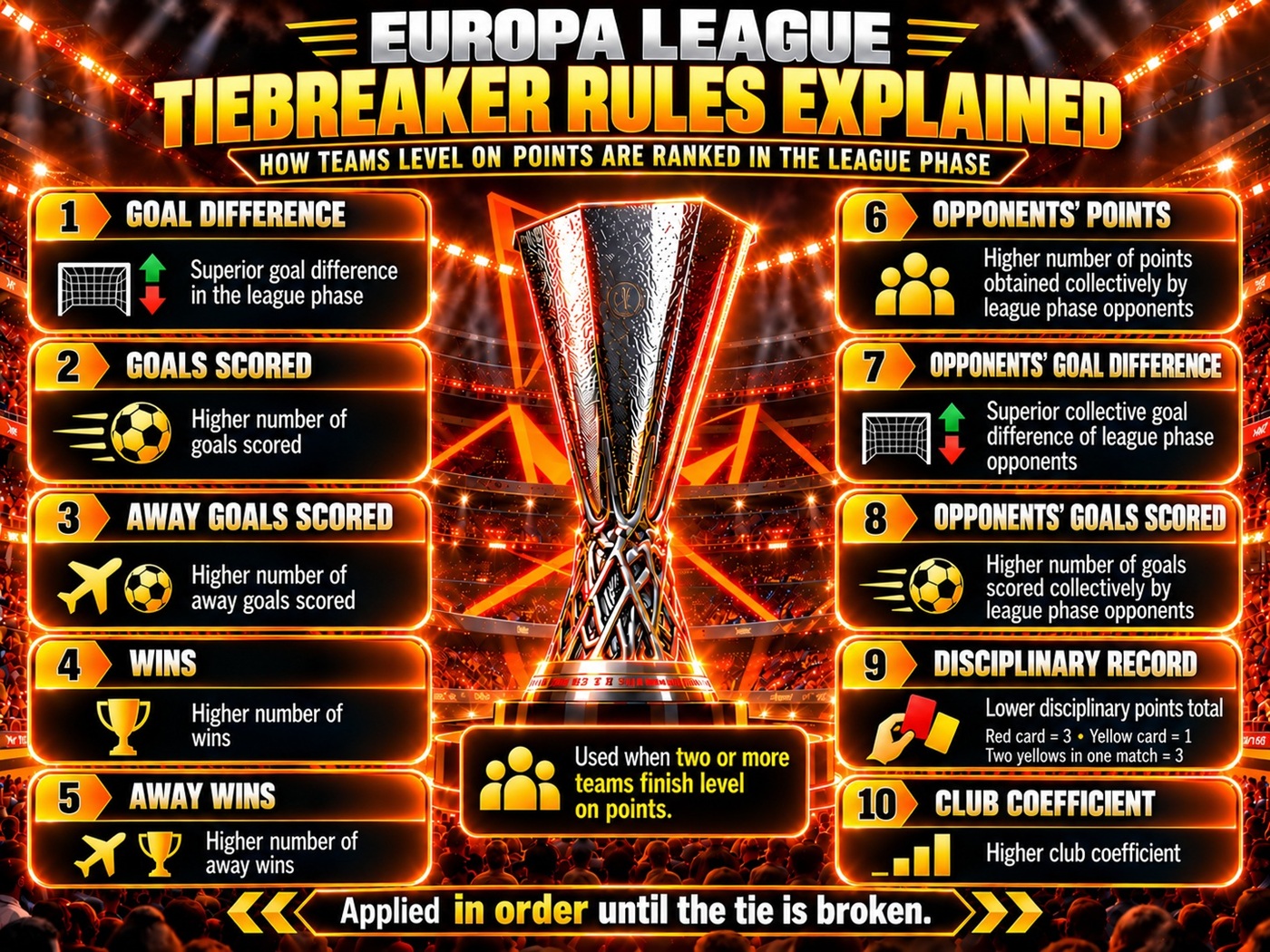
With 36 clubs competing in one Europa League league table, teams can easily finish level on points. When that happens, UEFA uses a specific sequence of tiebreakers to determine their positions.
The first criterion is goal difference, followed by goals scored, away goals, wins, and away wins. If teams are still level after those measures, UEFA begins considering the performance of their league-phase opponents.
The rules also work slightly differently while the league phase is still being played. In this guide, I will explain the full 2026/27 Europa League tiebreaker system and what each criterion means.
Read Also: Champions League Tiebreaker Rules Explained
What Happens If Europa League Teams Finish Level on Points?
If two or more clubs finish the eight-match league phase with the same number of points, UEFA applies the following criteria in order:
Superior goal difference
Higher number of goals scored
Higher number of away goals scored
Higher number of wins
Higher number of away wins
Higher combined points earned by the club's league-phase opponents
Better combined goal difference of those opponents
Higher combined number of goals scored by those opponents
Lower disciplinary-points total
Higher UEFA club coefficient
UEFA moves to the next criterion only when the teams remain level on the previous one.
Is Head-to-Head Used as a Europa League Tiebreaker?
No. Head-to-head results are not part of the Europa League league-phase tiebreaker order. That makes sense under the current format because every team plays only eight of the other 35 clubs.
Two teams finishing level on points may never have played each other. UEFA therefore uses criteria that can be applied consistently across the entire 36-team table.
Read Also: Champions League vs Europa League vs Conference League: What’s the Difference?
Why Is Goal Difference the First Tiebreaker?
Goal difference compares the number of goals a team has scored with the number it has conceded across all eight league-phase matches. For example, if a club scores 15 goals and concedes 10, its goal difference is +5.
Imagine two clubs both finish with 15 points. Club A has a goal difference of +7, while Club B has +4. Club A finishes above Club B without UEFA needing to consider any of the remaining tiebreakers.
What Happens If Goal Difference Is Also Equal?
UEFA next compares the total number of goals scored during the league phase. Imagine two teams both have 14 points and a goal difference of +5.
If one has scored 16 goals and the other has scored 13, the team with 16 goals is ranked higher. Only if their goals scored are also identical does UEFA move to the third criterion.
Read Also: How Do Europa League Pots and Seeding Work?
Why Are Away Goals Still a Tiebreaker?
The third criterion is the number of away goals scored during the league phase. This should not be confused with the old away-goals rule. UEFA no longer uses away goals to decide the winner of a two-legged knockout tie.
In the league-phase table, however, the total number of goals a club scores away from home can still be used as a ranking criterion. For example, if two teams remain level on points, goal difference and total goals scored, the club with more league-phase away goals finishes higher.
What Is the Fourth Tiebreaker?
The fourth criterion is the number of wins. If two teams remain identical on points, goal difference, goals scored, and away goals, UEFA looks at how many of their eight matches they won.
For example, one club could reach 14 points through four wins, two draws and two defeats. Another could reach the same total through a different combination of results. If the earlier criteria are also equal, the club with more victories is ranked higher.
Read Also: How Does the Europa League Draw Work?
What Is the Fifth Tiebreaker?
UEFA next compares away wins. The team with more victories away from home is ranked higher if the first four criteria have not separated them.
At this point, UEFA has used five measures based entirely on the clubs' own league-phase results. If they remain tied, the system changes direction and begins looking at their opponents.
Why Does UEFA Consider Opponent Performance?
Every Europa League club plays a different set of eight opponents. That means two teams can record almost identical results while facing different schedules. If the first five tiebreakers cannot separate them, UEFA uses the collective league-phase performance of their opponents as the next measure.
This is effectively an opponent-strength tiebreaker. It does not change the points the club earned from its matches. It is only used to separate teams that remain level after the earlier criteria.
How Does the Opponents' Points Tiebreaker Work?
UEFA adds together the league-phase points earned by each club's eight opponents. The team whose opponents collected the higher combined points total is ranked higher.
For example, imagine Club A's eight opponents earned a combined 100 points during the league phase, while Club B's opponents earned 94.
If the two clubs are still level after the first five tiebreakers, Club A would rank higher because its opponents collectively earned more points.
This criterion matters only after the clubs' own points, goal difference, goals, away goals, wins and away wins have failed to separate them.
Read Also: How Does the Europa League League Phase Work?
What If Their Opponents' Combined Points Are Also Equal?
UEFA then compares the combined goal difference of the teams' league-phase opponents. The opponents associated with one club may collectively have a stronger goal difference than those faced by the other club. The team whose opponents have the better combined goal difference receives the higher position.
What Is the Eighth Tiebreaker?
If the teams still cannot be separated, UEFA compares the combined goals scored by their league-phase opponents. So the three opponent-based criteria are:
Combined points
Combined goal difference
Combined goals scored
Only after all three fail to separate the clubs does UEFA move to disciplinary records.
How Do Disciplinary Points Work?
The ninth criterion is the club's disciplinary-points total across its eight league-phase matches. Unlike most of the earlier criteria, a lower total is better. UEFA calculates disciplinary points from yellow and red cards received by players and team officials.
The values are:
Yellow card: 1 disciplinary point
Red card: 3 disciplinary points
Sending-off after two yellow cards in the same match: 3 disciplinary points
If two clubs remain tied through the first eight criteria, the club with fewer disciplinary points is ranked higher.
Do Cards Received by Coaches Count?
Yes. For this tiebreaker, UEFA includes yellow and red cards received by both players and team officials during league-phase matches.
A coach's disciplinary record can therefore theoretically contribute to the club's league-phase tiebreaker total. In practice, UEFA would only reach this criterion if eight earlier measures had already failed to separate the teams.
What Is the Final Europa League Tiebreaker?
The final criterion is the UEFA club coefficient. If two or more clubs remain level after all nine previous criteria, the team with the higher club coefficient is ranked higher. The coefficient reflects European performance over a multi-season period.
This means historical European performance can eventually separate clubs, but only as the final league-phase tiebreaker. It does not take priority over current-season results.
What If Two Clubs Also Have the Same UEFA Club Coefficient?
UEFA has separate rules for ranking clubs with identical coefficients. It first compares the clubs' coefficients from the most recent season included in the ranking. If they are still equal, UEFA moves backward through the previous seasons until a difference is found.
If necessary, the association coefficient and then the clubs' positions in their most recent domestic championships can be used. This is an extremely unlikely league-phase edge case, but UEFA's coefficient system still provides a way to produce a final ordering.
Are the Tiebreakers Different Before Matchday 8?
Yes. During Matchdays 1 to 7, the provisional Europa League table uses only the first five criteria:
Goal difference
Goals scored
Away goals scored
Wins
Away wins
The opponent-performance criteria are not used for the provisional table before the league phase has been completed. That is because those opponents still have matches left to play, so their final collective records are not yet known.
What Happens If Teams Are Still Completely Level During Matchdays 1 to 7?
If teams remain equal on points and all five provisional tiebreakers, UEFA gives them an equal ranking. They may be displayed alphabetically according to their abbreviated club names, but the alphabetical order is not an additional sporting tiebreaker.
It is simply a way of displaying teams that remain completely level at that stage. After Matchday 8, UEFA applies the full ten-criterion system to establish the final positions.
Why Can the Table Change After the Final Matchday?
A team's position can depend on more than its own final result. Imagine two clubs finish level through the first five criteria. Their ranking may then depend on the points earned by their eight opponents.
Results elsewhere on Matchday 8 can therefore affect which of the tied clubs finishes higher, even if those clubs are not playing each other. This is one reason the final Europa League standings can take longer to settle when several teams finish with identical records.
Why Are Tiebreakers So Important in the Europa League?
Finishing positions can produce very different outcomes. The major boundaries are:
8th vs 9th: eighth goes directly to the round of 16, while ninth must play a knockout phase play-off.
16th vs 17th: 16th is seeded in the knockout phase play-offs, while 17th is unseeded.
24th vs 25th: 24th stays in the competition, while 25th is eliminated from Europe.
A tiebreaker can therefore determine whether a club skips a knockout round, receives seeded status, or leaves the competition entirely.
A Simple Europa League Tiebreaker Example
Imagine Club A and Club B both finish the league phase with 14 points. Club A has scored 15 goals and conceded 9, giving it a goal difference of +6. Club B has scored 13 and conceded 7, which also gives it a goal difference of +6.
Points cannot separate them. Goal difference cannot separate them either. UEFA then moves to goals scored. Club A has scored 15 compared with Club B's 13, so Club A finishes higher. There is no need to check away goals, wins, or any later criteria.
A More Complicated Example
Imagine two teams finish with:
the same points
the same goal difference
the same goals scored
the same away goals
the same number of wins
the same number of away wins
UEFA then compares their opponents. If Club A's eight opponents collected 96 points and Club B's collected 91, Club A finishes higher. The disciplinary and coefficient tiebreakers would never be reached because the sixth criterion has already separated them.
Common Europa League Tiebreaker Misunderstandings
Head-to-head is not a league-phase tiebreaker. The teams may not even have played each other.
Goal difference is the first criterion after points.
Away goals still appear in the league-phase tiebreakers. This is separate from the abolished away-goals rule for knockout ties.
The performance of a team's opponents can matter. It becomes relevant after the first five criteria.
Opponent-performance criteria are not used in the provisional Matchday 1–7 standings.
Alphabetical order is not a sporting tiebreaker. It is only used to display provisionally equal teams that remain tied through the first five criteria.
A lower disciplinary-points total is better.
Cards shown to team officials can count toward the disciplinary tiebreaker.
Club coefficient is the final league-phase criterion, not the first.
Europa League Tiebreakers at a Glance
If clubs finish level on points after Matchday 8, UEFA first compares their own league-phase performance: goal difference, goals scored, away goals, wins and away wins.
If those criteria cannot separate them, UEFA compares the collective performance of the clubs' eight opponents through points, goal difference and goals scored.
If they are still level, the club with the lower disciplinary-points total ranks higher. The final criterion is the higher UEFA club coefficient. During Matchdays 1 to 7, only the first five criteria are used for the provisional standings.
Final Thoughts
The Europa League tiebreaker system is more detailed than simply comparing goal difference. Goal difference comes first, followed by goals scored, away goals, wins and away wins.
Only when clubs remain completely level does UEFA begin considering the strength of their eight league-phase opponents. Disciplinary points and club coefficient are reserved for the rare cases where all of those earlier measures fail.
The most important distinction for me is between the provisional table and the final table. During the first seven matchdays, UEFA uses only the first five tiebreakers. After Matchday 8, the complete ten-criterion system determines the final ranking.
And because league position decides direct qualification, play-off seeding, and elimination, even a deep tiebreaker can ultimately determine a club's route through the rest of the Europa League.