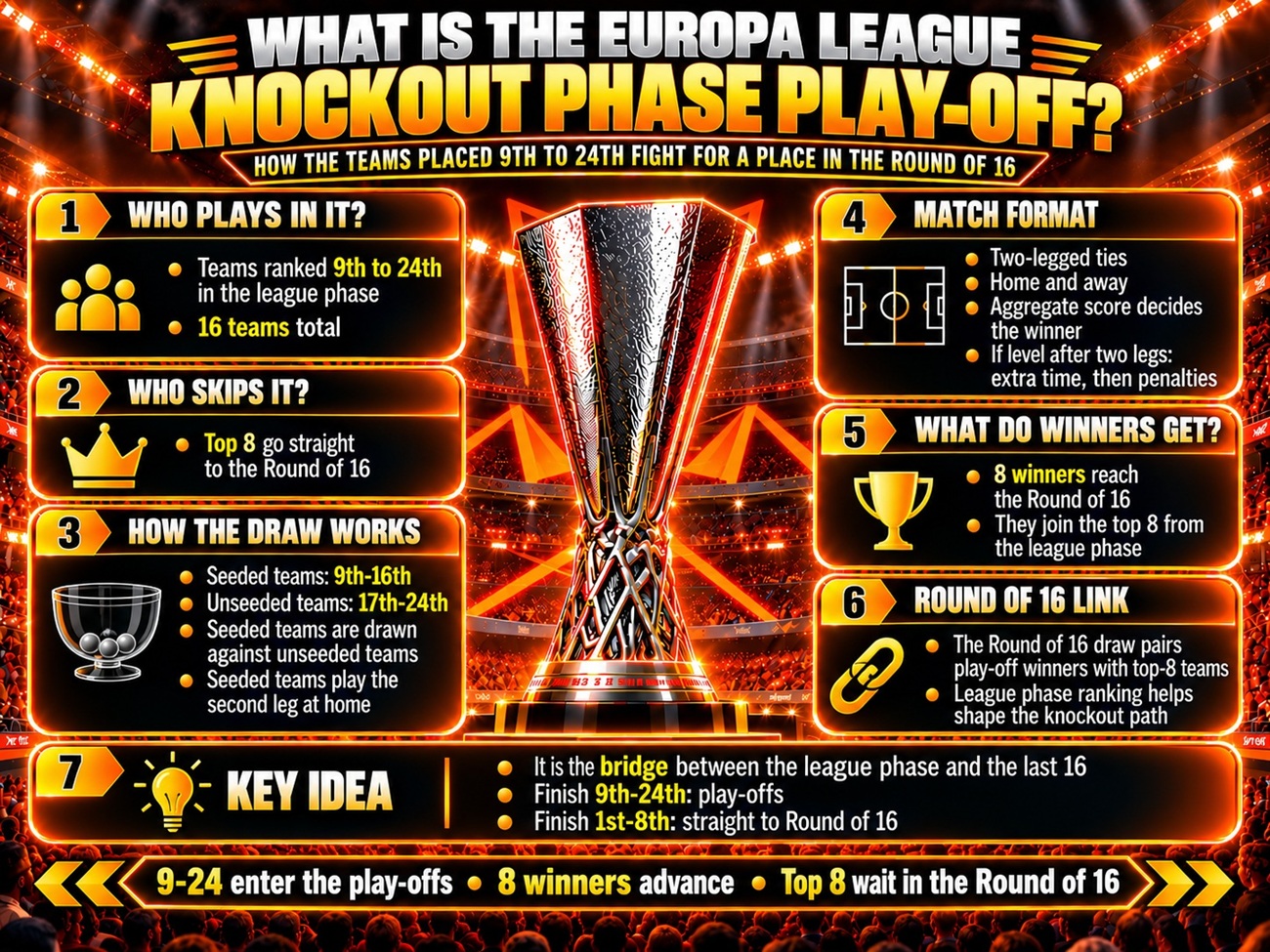
The Europa League knockout phase play-off is an additional two-legged knockout round played between the league phase and the round of 16. It involves the 16 clubs finishing from 9th to 24th in the 36-team league table.
Teams finishing in the top eight skip this round and qualify directly for the round of 16, while clubs placed 25th to 36th are eliminated. The play-offs therefore give teams outside the top eight one final route into the last 16.
In this guide, I will explain how the teams are seeded, how the pairings are decided, and what happens after the two legs.
Read Also: Europa League Tiebreaker Rules Explained
Which Teams Enter the Europa League Knockout Phase Play-Offs?
The clubs finishing 9th to 24th in the league phase enter the knockout phase play-offs. That creates 16 teams competing across eight ties. Their league positions also determine their seeding. Teams finishing:
9th to 16th are seeded
17th to 24th are unseeded
The eight play-off winners advance to the round of 16.
What Happens to the Top Eight?
Clubs finishing 1st to 8th do not play in the knockout phase play-offs. They qualify directly for the round of 16. This is one of the main rewards for finishing high in the league phase because those clubs avoid an extra two-legged tie. The play-off winners later join them in the last 16.
What Happens to Teams Finishing 25th to 36th?
They are eliminated from European competition. There is no transfer into the Conference League. This means the league phase creates three clear outcomes:
1st to 8th: direct round-of-16 qualification
9th to 24th: knockout phase play-offs
25th to 36th: elimination
Once the league phase ends, there is no movement into another UEFA competition.
Read Also: How Do Europa League Pots and Seeding Work?
How Are the Play-Off Teams Seeded?
The teams are seeded entirely according to their final Europa League league-phase positions.
The clubs ranked ninth to 16th are seeded.
Those finishing 17th to 24th are unseeded.
UEFA club coefficients and the original league-phase pots are no longer used to determine this seeding. A club could therefore begin the league phase in Pot 4 but become seeded for the play-offs by finishing 16th or higher.
How Are the Europa League Play-Off Pairings Decided?
The draw is not completely open. UEFA pairs the clubs according to where they finished in the league phase. The possible matchups are:
9th or 10th vs 23rd or 24th
11th or 12th vs 21st or 22nd
13th or 14th vs 19th or 20th
15th or 16th vs 17th or 18th
The draw then determines the exact matchup within those position pairs. For example, the ninth-placed team cannot be drawn against the 17th-placed team. Its possible opponents come from positions 23 and 24.
Read Also: Champions League vs Europa League vs Conference League: What’s the Difference?
Why Does Finishing Higher Matter?
A higher league-phase position can narrow a club's possible opponents toward teams that finished lower in the table. For example, ninth and tenth are paired with 23rd and 24th, while 15th and 16th are paired with 17th and 18th.
The system therefore gives greater value to finishing higher within the play-off positions. It also determines whether the club is seeded and, in principle, which team hosts the second leg.
Who Plays the Second Leg at Home?
The seeded teams normally play the second leg at home. That means clubs finishing ninth to 16th generally host the return match. The unseeded club normally hosts the first leg.
UEFA can make fixture adjustments when necessary because of stadium or scheduling constraints, but this is the normal format.
Are the Europa League Knockout Phase Play-Offs Two-Legged?
Yes. Each tie is played over two matches:
one first leg
one second leg
Each club plays one match at home and one away. UEFA adds the goals from both matches together. The club with the higher aggregate score qualifies for the round of 16.
Read Also: How Does the Europa League League Phase Work?
Is the Away-Goals Rule Used?
No. Away goals do not have extra value. For example, if the first leg finishes 2-1 and the second leg finishes 1-0 to the other team, the aggregate score is 2-2. The team that scored more away goals does not automatically advance. The tie instead goes to extra time.
What Happens If the Aggregate Score Is Level?
If the teams are level after the two legs, the second leg continues into extra time. Two 15-minute periods are played. If one club is ahead after extra time, it advances. If the aggregate score is still level, the tie is decided by a penalty shoot-out.
Can Teams From the Same Country Meet in the Play-Offs?
Yes. The same-country restriction used during the league-phase draw does not apply in the knockout phase. Two clubs from the same national association can therefore meet in the knockout phase play-offs if their league positions place them in compatible pairing slots.
Can Teams That Already Met in the League Phase Play Again?
Yes. A club can face an opponent it already played during the league phase. There is no rule preventing a league-phase rematch in the knockout phase play-offs. So the position-based bracket can create both domestic matchups and repeat fixtures.
Read Also: How Do the Europa League Qualifying Rounds Work?
Does Club Coefficient Matter in the Play-Off Draw?
No. Club coefficient helped determine qualifying seeding and the league-phase pots. It does not determine the knockout phase play-off seeds. At this stage, the important factor is where the club finished in the league phase.
A historically successful club that finishes 20th is unseeded, while a lower-coefficient club finishing 12th is seeded. Current-season performance takes priority.
Does Finishing Ninth Give a Club the Same Position as Finishing 16th?
Both are seeded, but their possible opponents are different. The ninth or tenth-placed clubs can face teams ranked 23rd or 24th. The 15th or 16th-placed teams can face 17th or 18th-placed teams.
So finishing higher still affects the bracket even after a club has secured seeded status. This is why league-phase position continues to matter all the way through Matchday 8.
What Happens to the Eight Play-Off Winners?
They advance to the round of 16. There, they join the eight clubs that qualified directly by finishing in the league-phase top eight. The round-of-16 draw is also linked to league-phase positions.
The top-eight teams are paired according to their final rankings, and the relevant play-off winners are placed into corresponding sections of the knockout bracket. So the play-off draw is part of a larger predetermined knockout structure.
What Happens to the Eight Play-Off Losers?
They are eliminated from Europe. There is no move into the Conference League. Once the Europa League league phase has started, UEFA no longer transfers eliminated clubs between its three competitions. A defeat in the knockout phase play-offs therefore ends the club's European season.
Does the Winner Inherit a Bracket Position?
Yes. The knockout phase is built around positions established from the league-phase standings. The winner of each play-off tie progresses into the corresponding place in the round-of-16 bracket.
This means teams can already see the section of the bracket they are competing to enter. The entire knockout structure becomes increasingly predetermined from this point.
When Are the 2026/27 Europa League Knockout Phase Play-Offs?
The 2026/27 ties are scheduled for:
First legs: 18 February 2027
Second legs: 25 February 2027
The eight winners then advance to the round of 16, which is scheduled for 11 and 18 March 2027.
A Simple Knockout Phase Play-Off Example
Imagine Club A finishes 10th in the league phase. Club A is seeded. Its possible opponents are the clubs finishing 23rd and 24th. Suppose the draw pairs Club A with the 24th-placed team.
The unseeded team normally hosts the first leg, while Club A hosts the second. If Club A wins 2-1 away and draws 1-1 at home, it wins the tie 3-2 on aggregate and advances to the round of 16. Its original coefficient and league-phase pot no longer affect the result.
Why Is the Knockout Phase Play-Off Important?
The play-off creates a major difference between finishing inside and outside the league-phase top eight. A top-eight club goes directly to the round of 16.
A team finishing ninth must play two additional matches despite missing direct qualification by only one position. That extra tie brings:
another elimination risk
two additional matches
extra travel
additional fixture congestion
This makes the race for the top eight particularly valuable during the league phase.
Common Europa League Knockout Phase Play-Off Misunderstandings
The top eight do not play in the knockout phase play-offs. They go directly to the round of 16.
Only teams finishing ninth to 24th enter the play-offs.
Teams ranked ninth to 16th are seeded.
Teams ranked 17th to 24th are unseeded.
The draw is not completely open. Possible opponents are determined by league-phase finishing positions.
Seeded clubs normally host the second leg.
Club coefficients do not determine play-off seeding. League-phase position does.
Teams from the same country can meet.
League-phase rematches are possible.
The ties are played over two legs.
The away-goals rule is not used.
Play-off losers do not enter the Conference League. They are eliminated.
Europa League Knockout Phase Play-Off at a Glance
The knockout phase play-offs involve the 16 teams finishing ninth to 24th in the Europa League league phase. Clubs ranked ninth to 16th are seeded, while those ranked 17th to 24th are unseeded.
The pairings are based on league position, with ninth or tenth facing 23rd or 24th and the pattern continuing toward 15th or 16th facing 17th or 18th.
Each tie is played over two legs, with seeded teams normally hosting the second leg. The eight winners advance to the round of 16. The eight losers are eliminated from European competition.
Final Thoughts
The Europa League knockout phase play-off is best understood as the price of finishing outside the league-phase top eight. The teams ranked ninth to 24th remain in the competition, but they must survive another two-legged tie before reaching the round of 16.
League position is central to the system. It decides who is seeded, which opponents a club can face, and who normally hosts the second leg. The draw is therefore not open or based on club coefficients.
For me, the simplest way to remember it is: 9th to 16th are seeded, 17th to 24th are unseeded, eight ties are played, and eight winners join the league-phase top eight in the round of 16.