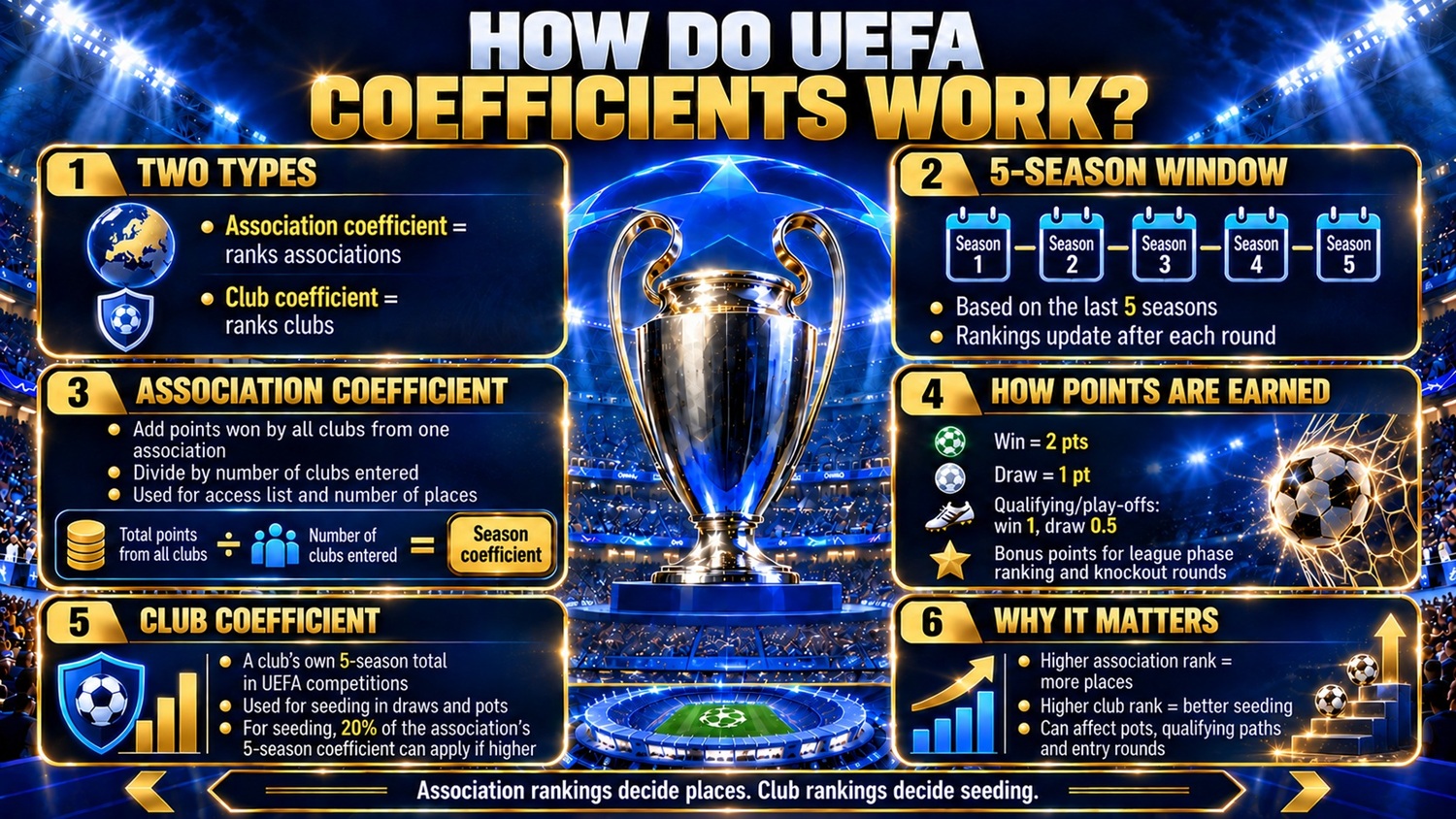
UEFA coefficients are ranking systems used to measure how clubs and national associations perform in European competitions. They affect important parts of the Champions League, Europa League and Conference League, including:
how many European places an association receives
which qualifying rounds clubs enter
how clubs are seeded in draws
which teams receive European Performance Spots
The main thing to understand is that there is not just one UEFA coefficient. There are club coefficients and association coefficients, and they serve different purposes. In this guide, I will explain how both work and why they matter.
Read Also: Champions League Yellow Card and Suspension Rules Explained
What Is a UEFA Club Coefficient?
A UEFA club coefficient measures a club's European performance over several seasons. For sporting purposes, UEFA normally uses a five-season coefficient. For the 2026/27 season, that ranking is based on performances from:
2021/22
2022/23
2023/24
2024/25
2025/26
The points earned across those five seasons are added together. That produces the club's coefficient used for purposes such as draw seeding. I explain how this affects Champions League pots in How Do Champions League Pots and Seeding Work?
How Does a Club Earn Coefficient Points?
Clubs earn coefficient points through their results and progress in UEFA competitions. From the league phase onward, the basic match points are generally:
Win → 2 coefficient points
Draw → 1 coefficient point
Defeat → 0 points
UEFA also awards bonus points for league-phase finishing position and for reaching later rounds. This means a club that consistently reaches the knockout stages can build its coefficient much faster than one that regularly exits early.
The exact number of bonus points depends on the competition and the stage reached. Champions League performance carries larger bonuses than the equivalent stages in the Europa League or Conference League.
Read Also: Champions League Squad Registration Rules Explained
Are Coefficient Points the Same as Champions League Table Points?
No. Champions League table points and UEFA coefficient points are two separate systems.
During the league phase, clubs receive three points for a win, one for a draw and none for a defeat. These points determine where the club finishes in the 36-team Champions League table.
Coefficient points are calculated differently. A win from the league phase onward is generally worth two coefficient points, while a draw is worth one.
This means the same Champions League victory can give a club three points toward its league-phase position but two points toward its UEFA coefficient.
The difference is their purpose: league points determine a club's position in the current Champions League season, while coefficient points contribute to its European ranking over several seasons.
Do Clubs Get Bonus Coefficient Points?
Yes. UEFA awards bonus points according to where clubs finish in the league phase and how far they progress. In the Champions League, a higher league-phase finish earns more coefficient points.
For example, under the current system, first place receives more league-phase bonus points than second, second receives more than third, and so on. Teams also receive additional bonus points for reaching:
round of 16
quarter-finals
semi-finals
final
This means the coefficient system rewards both individual match results and overall progress in the competition. A club does not need to win the Champions League to earn a strong coefficient. Consistently reaching the later rounds over several seasons can also build a high ranking.
Read Also: How Does the Champions League Knockout Draw Work?
Why Does UEFA Use Five Seasons?
Using five seasons prevents one unusually good or bad campaign from completely defining a club's European standing. Imagine Club A reaches one Champions League semi-final but has almost no European success during the other four seasons.
Club B consistently reaches the Champions League knockout rounds every year. The five-season system recognizes that longer-term consistency. At the same time, performances do not remain in the coefficient forever.
Each season, the oldest year drops out and the newest completed season enters the five-year calculation. That means a club's coefficient can fall even after a decent season if a particularly successful older campaign disappears from the calculation.
Can a Club's Coefficient Drop?
Yes. This sometimes confuses people because a club may earn points during the current season but still have a lower five-year coefficient when the next ranking is established.
Imagine a club earned 25 coefficient points five seasons ago but earns only 10 in the season replacing it. When the old 25-point season drops out, the five-year total falls. So coefficient rankings are not simply cumulative forever. They operate on a rolling five-season window.
Read Also: How Does the Champions League Knockout Stage Work?
What Is the 20% Association Rule?
A club's five-season sporting coefficient is normally its own five-season total. However, UEFA compares that figure with 20% of its association's five-season coefficient. The club uses whichever figure is higher.
This mainly helps clubs with little recent European history. For example, a club making its first European appearance may have almost no individual coefficient points. It can still receive a minimum coefficient based on 20% of its national association's ranking.
This does not mean the club receives 20% of every other club's European points directly. It is simply a minimum value used when that number is higher than the club's own five-season coefficient.
What Is an Association Coefficient?
An association coefficient measures the collective European performance of clubs from one national association. For example:
England
Spain
Germany
Italy
France
Portugal
each has an association coefficient. UEFA calculates a season's association coefficient by adding the coefficient points earned by all clubs from that association and dividing the total by the number of participating clubs. So it is based on an average, not simply the total number of points earned.
How Is an Association Coefficient Calculated?
UEFA calculates an association's season coefficient by adding together the coefficient points earned by all of its clubs in UEFA competitions and dividing that total by the number of clubs representing the association.
For example, imagine a country has four clubs competing in Europe and those clubs earn a combined 32 coefficient points during the season. The calculation would be 32 points divided by 4 clubs, giving the association a season coefficient of 8.000.
Now imagine another country has six clubs that earn a combined 45 coefficient points. Its calculation would be 45 divided by 6, giving it an association coefficient of 7.500.
Although the second country earned more points overall, its coefficient is lower because those points are divided among more participating clubs.
This means UEFA's association coefficient measures the average performance of a country's clubs, rather than simply rewarding associations that have more teams competing in Europe.
Do Qualifying Matches Count Toward Association Coefficients?
Yes. Results from qualifying rounds and qualifying play-offs also contribute to an association's UEFA coefficient, although they are worth fewer points than results in the main competition stages.
During qualifying, a win is worth 1 coefficient point, a draw is worth 0.5 points, and a defeat earns no points. Once clubs reach the main stage of a UEFA competition, the standard match values increase. A win is generally worth 2 coefficient points, while a draw is worth 1 point.
Bonus points earned for league-phase position and progress into later rounds are also included in the association's coefficient calculation. This means every club representing an association can contribute to its country's ranking, including teams that begin their European campaign in qualifying.
Why Does the Association Coefficient Matter?
The five-season association ranking helps determine the UEFA access list. That affects:
how many clubs an association can enter in European competitions
which competitions those clubs enter
which qualifying rounds they start in
how many clubs can qualify directly for certain stages
In simple terms, strong European performances by a country's clubs can improve that association's future access to UEFA competitions. Poor results over several seasons can have the opposite effect.
Is the Association Ranking Based on the Latest Five Seasons?
Yes, but there is an important timing detail. The access list has to be established in advance. For example, the 2026/27 UEFA competition access list uses association results from:
2020/21
2021/22
2022/23
2023/24
2024/25
So results from 2025/26 do not change the main five-year access ranking used to build the 2026/27 access list. By comparison, the club coefficients used for 2026/27 seeding include 2025/26.
That difference exists because the two rankings are being used for different purposes and have different reference periods.
What Are European Performance Spots?
European Performance Spots, often shortened to EPS, are additional Champions League places awarded to the two associations whose clubs performed best collectively in UEFA competitions during the previous season.
This uses a single-season association coefficient rather than the normal five-season access ranking. For the 2026/27 Champions League, the EPS places therefore come from associations with the strongest collective European performance in 2025/26.
Each qualifying association receives one additional Champions League league-phase place. The place goes to the highest-finishing club in that association's domestic league that has not already qualified for the Champions League league phase. I explain this qualification route in How Do Teams Qualify for the UEFA Champions League?
Five-Year Ranking vs European Performance Spots
These two ideas are easy to confuse. The five-year association coefficient helps determine the normal long-term UEFA access list. The single-season association coefficient decides the two European Performance Spots.
So a country does not need to be one of Europe's two highest-ranked associations over five years to earn an EPS. It needs to have one of the two strongest collective European seasons in the relevant year. That rewards recent performance rather than long-term standing.
How Do Club Coefficients Affect the Champions League Draw?
Club coefficients are important for seeding. For the Champions League league phase, UEFA places clubs into four pots. Apart from the Champions League titleholder being the top seed in Pot 1, those pots are based on club coefficients.
A club with a stronger coefficient is therefore more likely to appear in a higher pot. However, the current Champions League format means being in Pot 1 does not allow a club to avoid all other Pot 1 teams.
Every club receives two opponents from each pot. So the coefficient still determines seeding, but the meaning of that seeding has changed compared with the old group-stage format.
Do Coefficients Determine Champions League Qualification?
Not directly in the way domestic league position does. A club cannot usually qualify for the Champions League simply because it has a high coefficient. Qualification mainly comes through routes such as:
domestic league position
winning the Champions League
winning the Europa League
European Performance Spots
Champions League qualifying
However, coefficients can determine seeding once a club has qualified for a particular stage. They can therefore affect which opponents a club may face in qualifying and which pot it enters later. A high coefficient helps with positioning. It does not replace the need to qualify.
How Are Coefficients Used in Champions League Qualifying?
Qualifying draws commonly divide clubs into seeded and unseeded groups using club coefficients. A higher coefficient can therefore give a club seeded status.
That normally prevents it from facing certain other highly seeded clubs at that stage. However, being seeded does not guarantee an easy opponent or qualification. The coefficient affects the draw structure, not the result on the pitch.
What Happens If Two Clubs Have the Same Coefficient?
UEFA has tiebreaking rules. If two or more clubs have the same five-season coefficient, UEFA first compares their coefficient from the most recent season.
If they are still equal, UEFA moves backward through the seasons until it finds one where their totals differ. If they remain level, UEFA can then use:
their association coefficient
their most recent domestic league position
So even identical five-year totals can ultimately be separated.
What Is the UEFA Revenue Coefficient?
UEFA also calculates a ten-season revenue coefficient. For 2026/27, it uses results from 2016/17 through 2025/26. This coefficient is used for revenue distribution purposes. It should not be confused with the five-season sporting coefficient used for seeding.
For understanding draws and qualification, the five-season sporting coefficient is normally the more relevant number. The ten-season figure matters primarily for how UEFA distributes certain competition revenue.
A Simple Club Coefficient Example
Imagine FC Example earns season coefficients of 8, 12, 6, 14 and 10 points across five consecutive seasons. Adding those together gives the club a five-season total of 50 coefficient points. UEFA then compares that total with 20% of the club's association coefficient.
If the club's own 50-point total is higher, UEFA uses 50 as its coefficient. If 20% of the association coefficient is higher, UEFA uses that figure instead. The final coefficient can then influence the club's seeding in UEFA competition draws.
Common UEFA Coefficient Misunderstandings
There are several points I think are especially useful to remember.
There is not one single UEFA coefficient. Clubs and associations have separate rankings.
Champions League standings points and coefficient points are different. A league-phase win is worth three table points but normally two coefficient points.
Club coefficients normally use five seasons.
The five-season window moves every year. Older results eventually disappear.
A club's coefficient can fall even after it earns points in the current season.
Association coefficients are averages. UEFA divides the points earned by the association's clubs by the number of participating clubs.
The normal access ranking and European Performance Spots are not the same thing. The access list uses a five-season ranking, while EPS rewards the two best associations from the previous single season.
A high club coefficient does not automatically qualify a team for the Champions League. It mainly affects seeding once the club has earned a place.
The ten-season revenue coefficient is not the normal sporting seeding coefficient.
UEFA Coefficients at a Glance
The easiest way to understand UEFA coefficients is to separate them by purpose. A club coefficient measures an individual club's performance in UEFA competitions over a five-season period. Its main sporting use is seeding clubs in qualifying rounds and competition draws.
An association coefficient measures the combined European performance of clubs from the same national association. UEFA calculates each season's figure by dividing the total coefficient points earned by those clubs by the number of participating clubs. The five-season association ranking helps determine UEFA's competition access list.
European Performance Spots are different because they are based on a single season rather than five seasons. The two associations with the strongest collective European performance in the previous season each receive one additional Champions League league-phase place.
UEFA also uses a ten-season revenue coefficient for certain revenue-distribution purposes. This is separate from the five-season sporting coefficient used for seeding.
Final Thoughts
UEFA coefficients become much easier to understand once I separate the club ranking from the association ranking. A club coefficient tracks a team's European results over five seasons and is mainly important for seeding.
An association coefficient combines the performances of clubs from the same country and helps determine how that association is positioned in UEFA's competition access system.
There is also a single-season association ranking that decides the two European Performance Spots and a separate ten-season coefficient used for revenue distribution.
For me, the most important distinction is simple:
Club coefficients help determine where a club is seeded. Association coefficients help determine the strength of a country's European access. Single-season association performance can earn an extra Champions League place.
Once those three ideas are separated, UEFA's coefficient system becomes much less confusing.