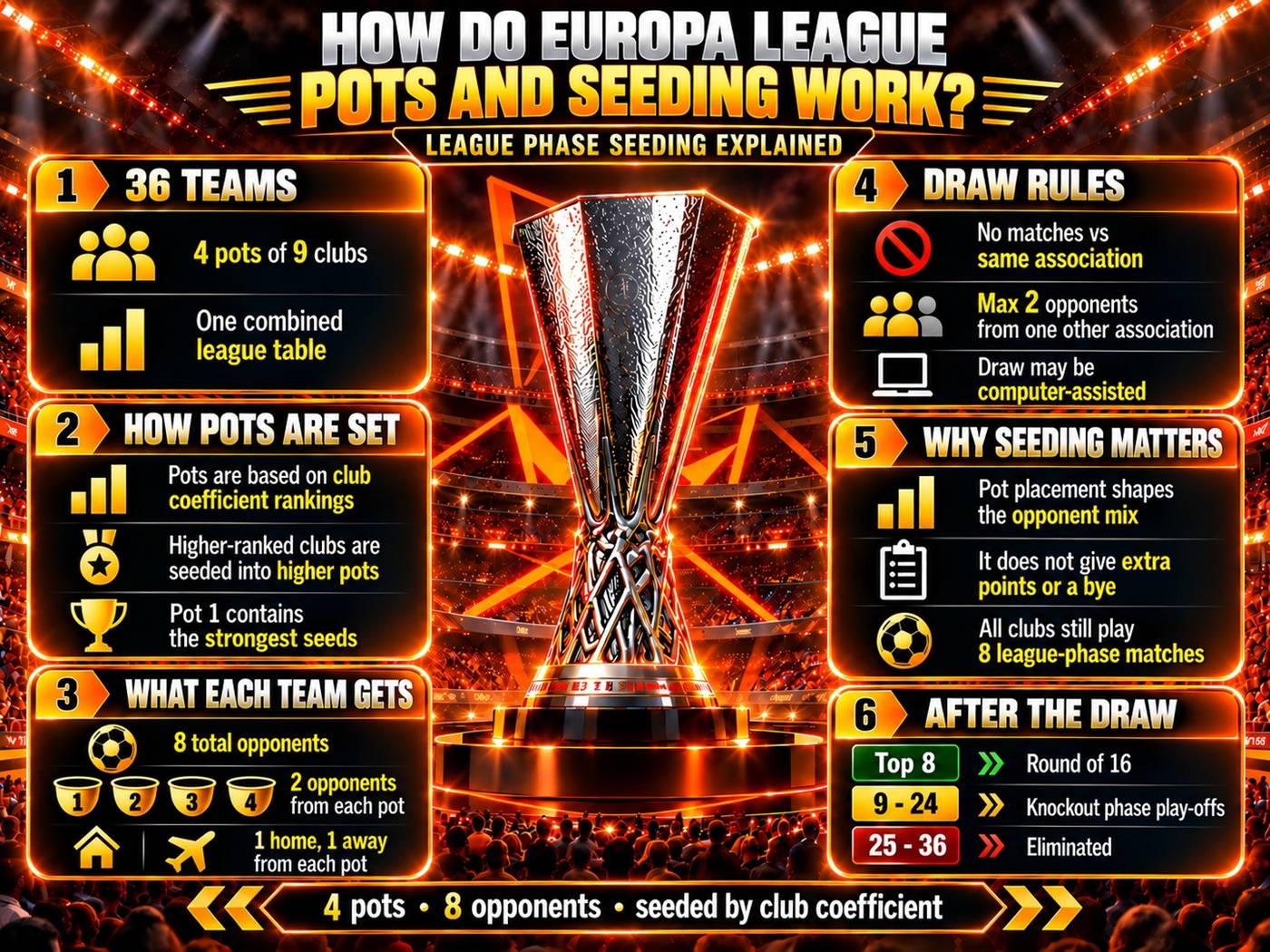
Europa League pots and seeding are used to organise the competition's draws, but they do not work the same way at every stage. During qualifying, UEFA generally divides clubs into seeded and unseeded teams.
For the league phase, the 36 clubs are divided into four pots of nine according to their UEFA club coefficients. Once the league phase is finished, however, coefficients and draw pots stop determining seeding.
A club's final position in the 36-team table becomes the important factor. In this guide, I will explain how those systems connect and what being seeded actually means.
Read Also: How Does the Europa League Draw Work?
What Does Seeding Mean in the Europa League?
Seeding is UEFA's way of using previous European performance to organise certain draws. The main sporting measure is the UEFA club coefficient. A club with a higher coefficient can receive seeded status in qualifying or be placed in a higher league-phase pot.
However, seeding does not give a team extra points or an automatic advantage on the pitch. It mainly affects the structure of the draw and the opponents a club can receive.
What Is a UEFA Club Coefficient?
A UEFA club coefficient measures a club's European performance over several seasons. For the 2026/27 Europa League, the five-season club coefficient is based on results from:
2021/22
2022/23
2023/24
2024/25
2025/26
UEFA adds the relevant season coefficients across that period. A club's five-season coefficient is either its own cumulative total or 20% of its association's five-season coefficient, whichever is higher.
That coefficient ranking is established before the new European season begins and is then used for sporting purposes such as seeding. I explain the wider system in How Do UEFA Coefficients Work?
Why Do Club Coefficients Matter for Europa League Seeding?
The coefficient gives UEFA a ranking that can be used before the current competition has produced any results. This matters during qualifying and the league-phase draw.
A club with a strong recent European record will normally have a higher coefficient than a club with little or no recent UEFA competition experience.
That can result in:
seeded status during qualifying
placement in a higher league-phase pot
However, coefficients do not determine whether a club qualifies for the Europa League in the first place. Qualification comes through domestic results, titleholder routes, or movement from Champions League qualifying.
Read Also: How Does the Europa League League Phase Work?
How Does Seeding Work in Europa League Qualifying?
During Europa League qualifying, UEFA generally creates an equal number of seeded and unseeded clubs for each draw. The seeded teams are determined using the club coefficient rankings established at the beginning of the season.
A seeded club is then drawn against an unseeded club. This prevents the highest-ranked teams in that particular draw from being paired against each other. The draw also determines which club hosts the first leg.
Does Being Seeded Guarantee an Easier Qualifying Tie?
No. Being seeded only affects the pool of possible opponents. UEFA does not guarantee that every seeded team is stronger than every unseeded team. A club may have a relatively low coefficient because it has little recent European experience while still being strong domestically.
Similarly, a historically successful European club may carry a strong coefficient even if its current team is less competitive. The tie itself is still decided over two legs.
Read Also: How Do the Europa League Qualifying Rounds Work?
Can Two Seeded Clubs Meet in Europa League Qualifying?
Normally, no. Within the relevant qualifying draw, seeded teams are paired with unseeded teams. Clubs from the same national association also cannot be drawn against each other at this stage.
UEFA can divide teams into smaller draw groups before conducting the draw, but those groups must still follow the applicable seeding principles.
What Happens When a Qualifying Team Is Not Yet Known?
This is an important edge case. UEFA sometimes conducts the next qualifying-round draw before the previous round has been completed. The draw may therefore contain a placeholder such as the winner of Club A vs Club B rather than a confirmed team.
For a place that will be taken by the winner of an unresolved tie, UEFA uses the higher coefficient of the two clubs for the next draw.
For a club that will enter the Europa League after losing a tie in another UEFA competition, UEFA uses the lower coefficient of the two clubs in that unresolved pairing for the relevant draw procedure. This allows UEFA to establish the seeding before the earlier matches have finished.
Why Can an Unresolved Tie Use the Higher Coefficient?
Imagine Club A has a coefficient of 40 and Club B has 10. Their qualifying tie has not yet been played, but UEFA needs to draw the next round. The next-round place belongs to whichever club wins that tie.
UEFA therefore treats that unresolved winner as having the higher coefficient of 40 for draw purposes. If Club B eventually wins, it inherits the draw position that was already established.
This does not permanently change Club B's own coefficient. It is simply the method UEFA uses to conduct an early draw.
How Do the Europa League League-Phase Pots Work?
Once the 36 league-phase clubs are known, UEFA ranks them according to their club coefficients. They are then divided into four pots of nine clubs:
Pot 1: nine highest-ranked clubs
Pot 2: next nine
Pot 3: next nine
Pot 4: remaining nine
For 2026/27, for example, clubs such as Bayer Leverkusen, Benfica, Juventus and AC Milan were among the teams in Pot 1. The pots establish the framework for the league-phase draw.
Does the Europa League Winner Automatically Go Into Pot 1?
There is no special Europa League titleholder position in the following season's Europa League league-phase pots. The previous Europa League winner normally qualifies for the Champions League, not the Europa League, through its titleholder place.
For the clubs actually taking part in the Europa League league phase, the four pots are formed according to the UEFA club coefficient rankings. This is different from the Champions League, where its defending champion receives the designated top-seed position in Pot 1.
How Many Opponents Does a Club Get From Each Pot?
Every club receives two opponents from each of the four pots. That means:
two opponents from Pot 1
two from Pot 2
two from Pot 3
two from Pot 4
One opponent from each pot is played at home and the other away. The result is eight different opponents and eight league-phase matches.
Can Pot 1 Teams Play Other Pot 1 Teams?
Yes. This is one of the most important things to understand about the current format. A Pot 1 team still receives two Pot 1 opponents. Likewise, a Pot 4 team plays two other Pot 4 teams.
The pots no longer work like the old group-stage seeding system, where one team from each pot was placed into a group and clubs from the same pot could not meet. Under the current league phase, the pots are used to give every club opponents from across the coefficient ranking.
Does Pot 1 Mean a Club Has an Easier Europa League Schedule?
Not necessarily. Every club faces two opponents from every pot. A Pot 1 club therefore still plays two other Pot 1 teams, while a Pot 4 club also receives two Pot 4 opponents.
The specific difficulty of an eight-match schedule depends on which clubs are drawn and which fixtures are played at home or away. Pot placement is better understood as a way of structuring the draw rather than giving the highest-ranked clubs a completely protected schedule.
Can a Pot 4 Club Draw Another Pot 4 Club?
Yes. Every club receives opponents from its own pot. For a Pot 4 team, its eight opponents still consist of two clubs from each of the four pots. This means pot placement describes where a club sits in the coefficient ranking; it does not create a barrier between clubs in the same pot.
Does a Higher Pot Give a Club More Home Matches?
No. Every Europa League league-phase club plays four home matches and four away matches, regardless of its pot. Each club plays one opponent from each pot at home and one opponent from each pot away. A Pot 1 club therefore receives the same home-and-away balance as a Pot 4 club.
Are the Pots Based on Domestic League Position?
No. Domestic league position can help a club qualify for the Europa League, but it does not determine its league-phase pot. Once the 36 participants are known, the pots are based on UEFA club coefficients.
This means two clubs that finished in similar domestic league positions can appear in very different pots because their recent European records are different. Likewise, a club arriving from Champions League qualifying can have a higher Europa League pot than a direct domestic qualifier.
Are the Pots Based Only on Europa League Results?
No. UEFA club coefficients can include results earned across UEFA's three main men's club competitions:
Champions League
Europa League
Conference League
A club's recent European record therefore follows it even when it changes competitions. For example, points earned during previous Champions League campaigns can contribute to the coefficient later used to seed that club in the Europa League.
What Happens If Two Clubs Have the Same Coefficient?
UEFA has additional ranking criteria. If two or more clubs have identical five-season coefficients, UEFA first compares their coefficients from the most recent season included in the calculation.
If they remain level, UEFA works backward to the next most recent season in which their coefficients differ. If the clubs are still tied, UEFA then considers their respective association coefficients.
If necessary, their positions in the most recent domestic championship can also be used. This ensures UEFA can produce a complete coefficient ranking even when clubs have identical five-season totals.
Does the 20% Association Rule Affect Pot Placement?
It can. A club's five-season coefficient is the higher of:
its own five-season coefficient total
20% of its association's five-season coefficient
This can be particularly relevant for clubs with little recent European participation. If the 20% association figure is higher than the club's own total, that figure becomes its five-season club coefficient.
Because the coefficient is then used for seeding, the association floor can indirectly affect qualifying seed status or league-phase pot placement.
Does Pot Placement Affect the Europa League Table?
No. Once the matches begin, pot labels do not affect league standings. A win against a Pot 1 opponent is worth the same number of league points as a win against a Pot 4 opponent (three points). A draw against any opponent is worth one point. The pots determine the draw structure, not how match results are valued.
Does Beating a Pot 1 Club Give More League Points?
No. There is no strength-of-opponent bonus in the Europa League table. A club receives three points for any win, regardless of its opponent's coefficient or pot.
However, the performance of a club's opponents can become relevant much later in the league-phase tiebreaking process if teams remain level after several other criteria. That is separate from the pot system itself.
Do the Pots Matter After the League Phase?
No. Once the league phase has been completed, the four draw pots no longer determine knockout seeding. Instead, the final league-phase standings take over. Teams finishing:
1st to 8th qualify directly for the round of 16
9th to 16th are seeded in the knockout phase play-offs
17th to 24th are unseeded in the play-offs
25th to 36th are eliminated
A club can therefore begin the competition in Pot 4 and still earn a strong knockout seed by finishing high in the league phase. Likewise, a Pot 1 club receives no special knockout protection if it performs poorly.
Is Knockout Seeding Based on Club Coefficients?
No. This is an important distinction. Once the league phase ends, UEFA uses league-phase finishing position, not the five-season club coefficient, to build the knockout bracket.
For the knockout phase play-offs:
9th and 10th are paired as seeds against 23rd or 24th.
11th and 12th can face 21st or 22nd.
13th and 14th can face 19th or 20th.
15th and 16th can face 17th or 18th.
So the team's performance in the current Europa League season replaces its historical coefficient as the key seeding measure.
What About the Top Eight?
The top eight are also paired according to final league position for the round of 16. They are grouped as:
1st and 2nd
3rd and 4th
5th and 6th
7th and 8th
Their bracket positions determine which knockout phase play-off winners they can face. The exact league-phase ranking therefore continues to matter even after a club has secured direct qualification to the round of 16.
Why Is League-Phase Position More Important Than the Original Pot?
Imagine a club begins the league phase in Pot 4 but finishes fourth overall. Another club begins in Pot 1 but finishes 18th. The Pot 4 club goes directly to the round of 16 and receives the knockout benefits attached to fourth place.
The Pot 1 club must play in the knockout phase play-offs and is unseeded because it finished 18th. The original pots no longer matter. That is why pot placement should not be confused with a permanent competition seed.
Europa League Pots vs Knockout Seeding
The distinction can be summarised simply.
Before and during the league-phase draw: UEFA club coefficients determine the four pots.
After the league phase: current-season league position determines knockout seeding and bracket placement.
A club's historical European results therefore help organise its starting draw, while its current Europa League results determine its later route.
Common Europa League Pots and Seeding Misunderstandings
Pot 1 clubs do not avoid other Pot 1 clubs. Every team faces two opponents from each pot.
Pot 4 clubs can play other Pot 4 clubs.
Being in a higher pot does not give a club more home matches. Every team plays four at home and four away.
Domestic league position does not determine the league-phase pot. UEFA club coefficients do.
Coefficient points from the Champions League and Conference League can contribute to Europa League seeding.
A high coefficient does not automatically qualify a club for the Europa League.
Pot placement does not affect how many league points a match is worth.
The four pots stop determining seeding after the league phase.
Knockout seeding comes from final league-phase position rather than club coefficient.
Europa League Pots and Seeding at a Glance
During qualifying, clubs are generally divided into seeded and unseeded teams according to UEFA club coefficients. For the league phase, the 36 clubs are ranked and divided into four pots of nine.
Every club then faces two opponents from each pot, including its own, with one home and one away opponent from every pot. The pots are based on the five-season UEFA club coefficient established before the season.
Once all eight league-phase matches have been played, those pots no longer determine a club's position. The final 36-team standings decide which clubs are seeded in the knockout phase and where they enter the bracket.
Final Thoughts
Europa League pots and seeding serve different purposes depending on the stage of the competition. During qualifying, UEFA uses club coefficients to separate seeded and unseeded teams.
For the league phase, those same coefficient rankings divide the 36 clubs into four pots of nine. But the current format has changed what those pots mean. Being in Pot 1 does not protect a club from other Pot 1 teams. Every club faces two opponents from every pot, including its own.
Most importantly, the pots do not follow teams into the knockout phase. Once the eight league-phase matches are complete, a club's performance in the current competition becomes more important than its historical coefficient.
For me, the easiest way to remember the system is: coefficients determine qualifying seeds and league-phase pots; league-phase results determine knockout seeding.