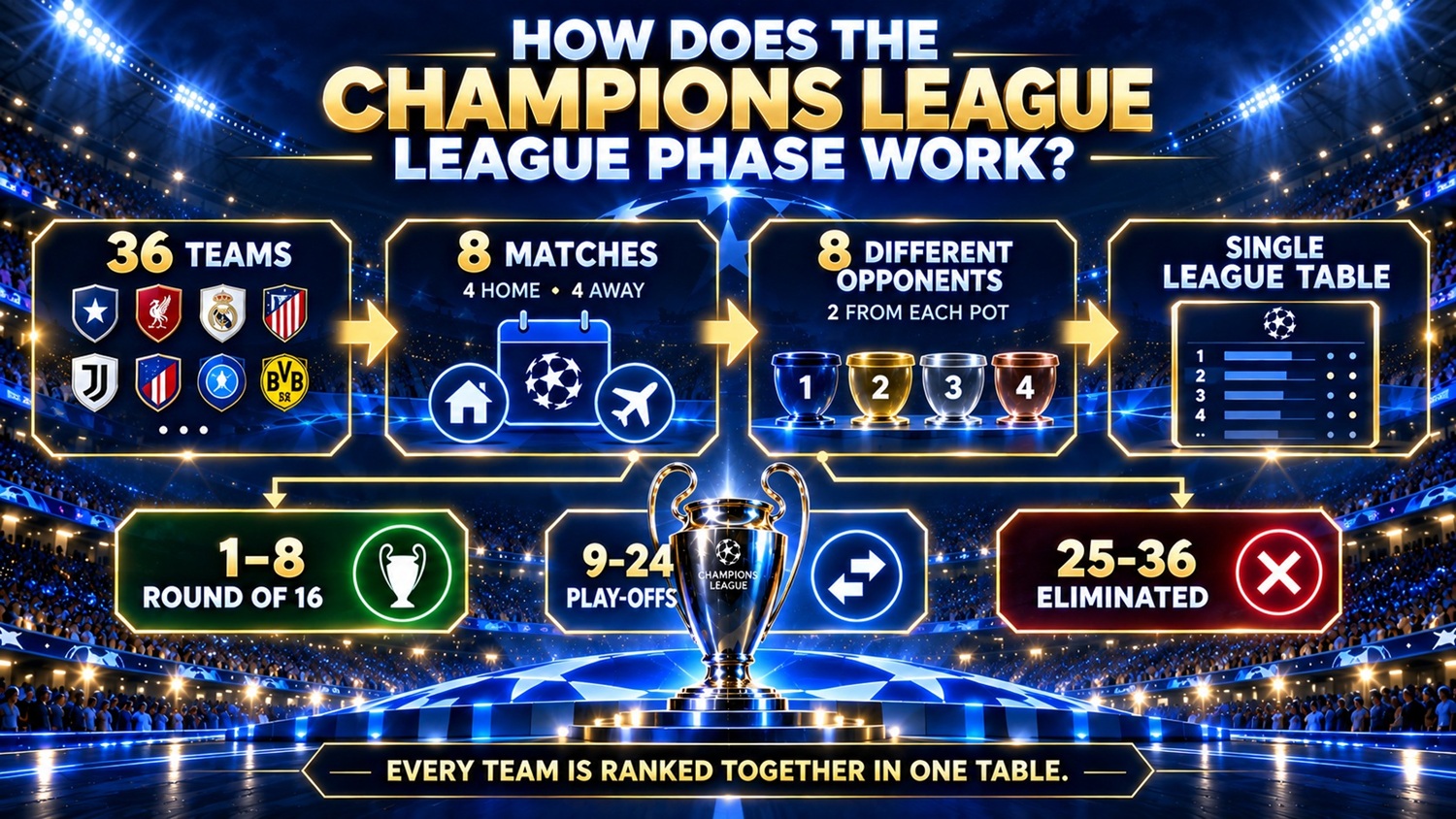
The UEFA Champions League league phase contains 36 clubs competing in one overall standings table, but it does not work like a normal domestic league. Each club plays only eight of the other 35 teams. Those eight matches are against eight different opponents, with four played at home and four away.
After all eight matchdays, every club is ranked from first to 36th. The top eight qualify directly for the round of 16, teams finishing ninth to 24th enter the knockout phase play-offs, and teams ranked 25th to 36th are eliminated from Europe.
That is the basic structure. In this guide, I will explain how the league phase works, why clubs face different opponents, and why finishing as high as possible matters even after qualification has been secured.
Read Also: How Do Champions League Pots and Seeding Work?
How Many Teams Are in the Champions League League Phase?
There are 36 clubs in the Champions League league phase. This format replaced the old 32-team group stage beginning with the 2024/25 season. Instead of dividing the competition into eight groups of four teams, UEFA places all 36 clubs into one overall league ranking.
That does not mean every club plays 35 matches. Each team plays only eight league-phase games. The standings therefore combine results from clubs that have faced different opponents.
How Many Matches Does Each Team Play?
Each club plays eight league-phase matches:
four at home
four away
Every match is against a different opponent. For example, if Club A faces Club B at home during the league phase, there is no return league-phase fixture at Club B's stadium.
This is different from the previous group-stage system, where clubs played the same three opponents home and away. The current league phase gives every club eight separate opponents instead.
How Are the Eight Opponents Selected?
UEFA divides the 36 clubs into four pots of nine teams before the league-phase draw.
Each club receives:
two opponents from Pot 1
two opponents from Pot 2
two opponents from Pot 3
two opponents from Pot 4
For each pot, the club plays one opponent at home and one away. That produces eight different matches. One detail I think is especially useful to understand is that a club's own pot does not protect it from teams in that same pot.
A Pot 1 club still faces two Pot 1 opponents. The pots are used to create a balanced set of opponents rather than separate groups. I explain the selection process, country restrictions and draw procedure in How Does the Champions League Draw Work?
Do All 36 Teams Play the Same Opponents?
No. This is one of the biggest differences between the Champions League league phase and a normal domestic league. Every club receives its own set of eight opponents.
For example, two clubs can both finish the league phase with 15 points even though they played completely different schedules. Their results are still placed into the same 36-team standings. This is why the draw is such an important part of the competition. The table is shared, but the fixtures are not identical.
How Are Points Awarded?
The Champions League uses the normal football points system:
3 points for a win
1 point for a draw
0 points for a defeat
After eight matches, those points determine each club's position in the overall table. Imagine a club records:
four wins
two draws
two defeats
It earns:
4 wins × 3 points = 12 points
2 draws × 1 point = 2 points
That gives the club 14 points from its eight matches. Whether 14 points puts that club inside the top eight, in the play-off positions or somewhere else depends on the results of the other 35 clubs.
Is There a Fixed Number of Points Needed to Qualify?
No. There is no rule saying that a club automatically qualifies for the round of 16 after reaching a specific number of points. Qualification is determined by league position, not by reaching a fixed points target.
The important cut-offs are:
8th place
24th place
A particular points total may be enough for eighth place in one season but not another because the standings depend on how all 36 teams perform.
This is why predictions such as "15 points should be enough" are estimates rather than qualification rules. A club is officially safe only when its position can no longer fall outside the required range.
What Happens to the Top Eight?
Clubs finishing first through eighth qualify directly for the round of 16. They skip the knockout phase play-offs entirely. That gives the top eight a major advantage. A team finishing eighth can wait for the round of 16, while the team immediately below it in ninth must play another two-legged knockout tie.
So the difference between eighth and ninth is much bigger than simply moving one position in the standings. It can mean two additional Champions League matches and the risk of elimination before the round of 16.
What Happens to Teams Finishing 9th to 24th?
Teams ranked ninth through 24th qualify for the knockout phase play-offs. That creates 16 clubs competing for eight remaining places in the round of 16. The play-offs are played over two legs.
However, the league positions of those 16 clubs still matter. Teams finishing ninth to 16th are seeded for the play-off draw, while teams ranked 17th to 24th are unseeded. The pairings are also linked to finishing positions.
For example:
9th or 10th can face 23rd or 24th
11th or 12th can face 21st or 22nd
13th or 14th can face 19th or 20th
15th or 16th can face 17th or 18th
In principle, the seeded club plays the second leg at home. This means finishing ninth instead of 16th can still affect a team's potential route even though both clubs enter the same play-off round. I explain this stage fully in What Is the Champions League Knockout Phase Play-Off?
What Happens to Teams Finishing 25th to 36th?
They are eliminated. Clubs ranked 25th through 36th do not continue in the Champions League and do not transfer into the Europa League. Their European campaign is over. This is an important difference from older Champions League formats.
Under the previous group-stage system, some eliminated Champions League teams could continue in the Europa League. There is no such drop-down from the current Champions League league phase. If a club finishes 25th, it is eliminated just as surely as the club finishing 36th.
Why Is Eighth Place So Important?
Eighth is arguably the most obvious dividing line in the league phase. The club finishing eighth goes directly into the round of 16. The club finishing ninth enters the knockout phase play-offs.
Consider two clubs separated by one position:
Club A — 8th: Round of 16
Club B — 9th: Two-legged play-off before the round of 16
Club B therefore has to survive an additional knockout tie simply to reach the stage Club A has already qualified for. That makes the battle around eighth place particularly important during the final matchdays.
Why Is 24th Place So Important?
The other major cut-off is 24th. The club finishing 24th reaches the knockout phase play-offs. The club finishing 25th is eliminated from Europe.
Again, one position completely changes the outcome of a club's Champions League campaign.
This creates two major races within the table:
Top-eight race: direct qualification versus play-offs.
Top-24 race: play-offs versus elimination.
But those are not the only positions that matter.
Does Finishing First Matter More Than Finishing Eighth?
Yes. Both first and eighth qualify directly for the round of 16, but their final league positions affect where they are placed in the knockout bracket. UEFA pairs the top eight according to league-phase ranking:
1st and 2nd
3rd and 4th
5th and 6th
7th and 8th
Those pairs occupy predetermined areas of the knockout bracket. Higher league-phase positions can also provide second-leg home advantages deeper into the competition.
Under the current 2026/27 rules:
teams ranked 1st to 8th are, in principle, at home in the second leg of the round of 16
teams ranked 1st to 4th receive that advantage in the quarter-finals if their seeding position remains in the bracket
teams ranked 1st and 2nd also receive it in the semi-finals
If a higher-seeded club is eliminated, the club that beats it takes over that bracket position. So finishing first rather than eighth can still carry a meaningful advantage even though both teams avoid the play-offs. I explain this structure in detail in How Does the Champions League Knockout Draw Work?
What Happens If Teams Finish Level on Points?
With 36 teams in one table, several clubs can finish with the same number of points. UEFA therefore uses a series of tiebreakers to determine their positions. Goal difference and goals scored are among the first criteria, followed by additional criteria if teams remain level.
This can become extremely important around eighth and 24th place. Imagine two clubs finish with the same number of points but occupy eighth and ninth after the tiebreakers. One advances directly to the round of 16.
The other has to play the knockout play-offs. That is why goal difference can matter even when a match result already appears decided. I explain the complete order of the criteria in Champions League Tiebreaker Rules Explained.
Can Teams From the Same Country Play Each Other in the League Phase?
In principle, no. During the league-phase draw, clubs cannot normally be drawn against another club from their own national association. A club can also face a maximum of two opponents from any one other association, subject to UEFA's draw provisions.
For example, an English club would not normally receive another English club among its eight league-phase opponents. That restriction applies to the league-phase draw. The rules change once the competition reaches the knockout stage, where clubs from the same association can potentially meet.
Can a Club Play More Than Two Home or Away Matches in a Row?
UEFA's scheduling principles are designed to create some balance. In principle, a club should not play more than two consecutive league-phase matches at home or more than two consecutive matches away.
UEFA also aims for each club to have one home match and one away match across the first two matchdays and again across the final two matchdays. Scheduling requirements can require exceptions, but the intention is to avoid extremely unbalanced sequences.
Why Is the Final League-Phase Matchday Different?
All matches on the final league-phase matchday are scheduled to kick off simultaneously, subject to exceptional circumstances. This matters because all 36 clubs share one standings table.
If some teams completed their final matches before others even started, those later clubs could know exactly what result or goal difference they needed. Simultaneous kick-offs reduce that advantage.
With top-eight places, play-off seeding and elimination potentially being decided at the same time, the final matchday can produce major changes throughout the standings.
When Is the 2026/27 Champions League League Phase?
For the 2026/27 season, UEFA scheduled the eight matchdays as follows:
Matchday 1: 8–10 September 2026
Matchday 2: 13–14 October 2026
Matchday 3: 20–21 October 2026
Matchday 4: 3–4 November 2026
Matchday 5: 24–25 November 2026
Matchday 6: 8–9 December 2026
Matchday 7: 19–20 January 2027
Matchday 8: 27 January 2027
The first matchday is unusual because Champions League matches can be played across Tuesday, Wednesday and Thursday. The final matchday is played on Wednesday with simultaneous kick-offs. After Matchday 8, the final standings determine the 24 clubs that continue into the knockout phase.
A Simple League-Phase Example
Imagine a fictional club called FC Example plays its eight matches and finishes with:
five wins
one draw
two defeats
That gives it 16 points. Now suppose those 16 points place FC Example seventh. It qualifies directly for the round of 16. If the same 16 points instead placed it ninth because other clubs had stronger records or tiebreakers, FC Example would have to enter the knockout phase play-offs.
The points have not changed. The club's position relative to everyone else has. That is why I think league position is more important than focusing on a supposed qualification points target.
How Is the League Phase Different From the Old Group Stage?
Under the old system, 32 clubs were split into eight groups containing four teams each. Every club played six matches:
three opponents
each opponent home and away
The top two in each group reached the round of 16. The current system is different:
36 clubs instead of 32
one overall table instead of eight groups
eight matches instead of six
eight different opponents instead of three
four home matches and four away matches
top eight directly into the round of 16
positions 9–24 into knockout play-offs
The competition therefore has more league-phase matches and a wider range of opponents. It also gives league position a role in shaping the knockout bracket.
Common Champions League League-Phase Misunderstandings
There are several points I think are particularly useful to remember.
The 36 clubs do not play a full round-robin league. Each club plays only eight opponents.
Teams do not play the same eight opponents. Every club receives its own schedule through the draw.
Clubs do not play home and away against the same opponent. Each league-phase opponent is faced once.
Pot 1 teams do not avoid Pot 1 opponents. Every club receives two opponents from every pot.
There is no fixed points total that guarantees eighth or 24th place before the standings make it mathematically certain. Qualification is based on position.
Ninth place is not direct qualification for the round of 16. Positions nine to 24 enter the play-offs.
Teams finishing 25th to 36th do not drop into the Europa League. They are eliminated from Europe.
Finishing higher still matters after qualification is secured. League position influences the knockout bracket and potential second-leg home advantages.
Champions League League Phase at a Glance
The simplest way I understand the league phase is:
36 teams
8 matches per club
8 different opponents
4 home + 4 away
3 points for a win
1 point for a draw
0 points for a defeat
Then:
1st–8th → Round of 16
9th–24th → Knockout phase play-offs
25th–36th → Eliminated
The higher a club finishes, the better its potential position in the knockout structure.
Final Thoughts
The Champions League league phase becomes much easier to understand once I stop thinking of it as a normal domestic league. The 36 clubs share one standings table, but they do not all play each other. Each team receives eight different opponents and plays four home matches and four away.
Those eight results determine where the club finishes. The top eight avoid the knockout phase play-offs. Positions nine to 24 get another opportunity to reach the round of 16. Positions 25 to 36 are eliminated.
But qualification is only part of the story. Finishing higher can improve a club's knockout position and provide advantages later in the competition, which means teams still have something meaningful to play for even after securing a place in the top 24 or top eight.
Once I understand that, the 36-team table stops looking like a complicated collection of unrelated fixtures. Every result contributes to a club's position, and that position helps determine both whether it survives and what route it may face next.