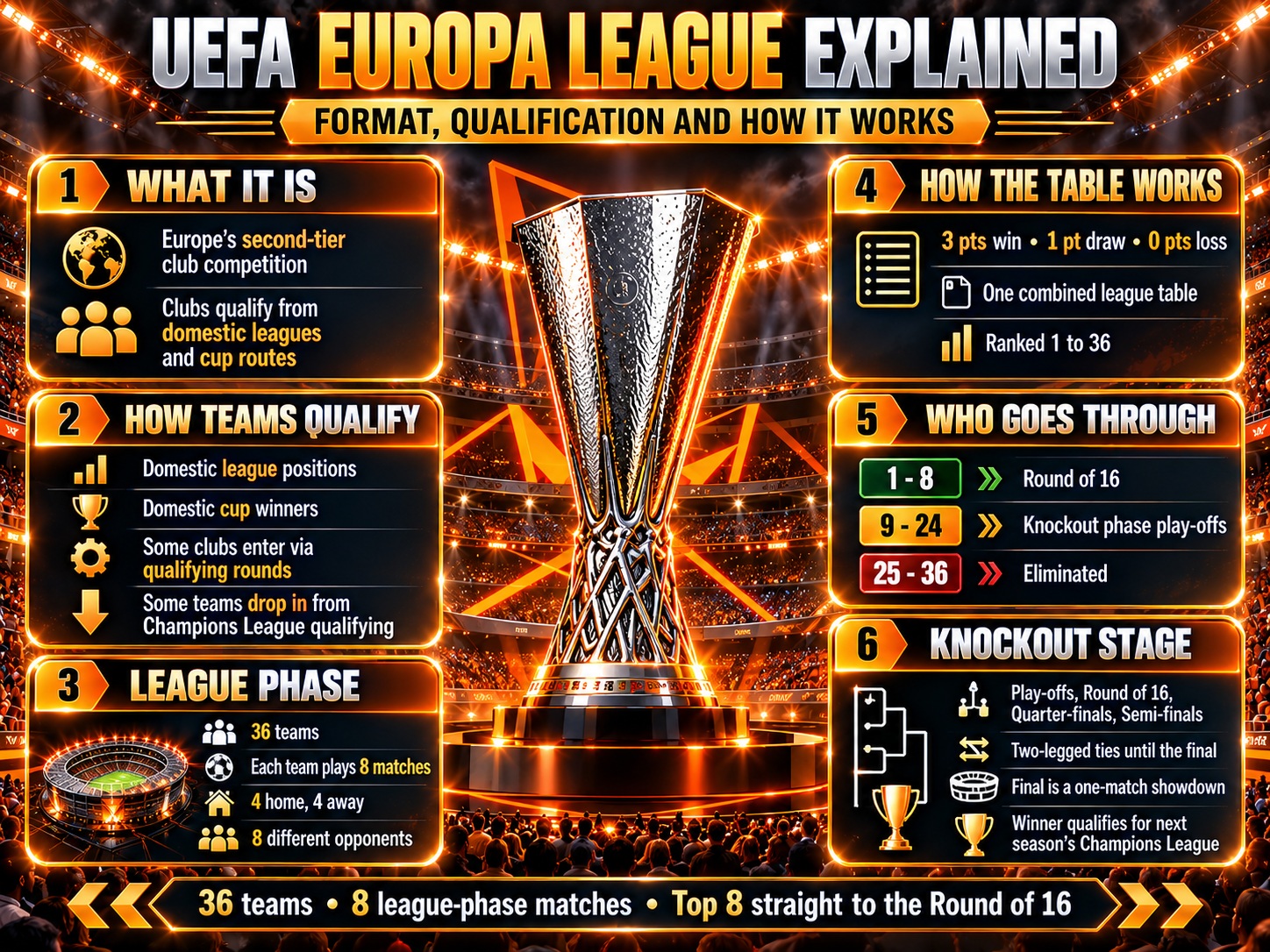
The UEFA Europa League is UEFA's second-tier men's club competition, sitting below the Champions League and above the Conference League. Its format has changed significantly from the old group-stage system.
The competition now has a 36-team league phase, with each club playing eight different opponents before the knockout rounds begin. However, understanding the Europa League requires more than knowing how the league phase works.
Clubs can reach the competition through domestic results, Europa League qualifying, the Conference League titleholder route or by dropping into the competition from certain stages of Champions League qualifying. In this guide, I will explain the complete structure, from qualification to the final.
What Is the UEFA Europa League?
The Europa League is one of UEFA's three main men's European club competitions. The hierarchy is:
Champions League
Europa League
Conference League
The competition was previously known as the UEFA Cup before becoming the UEFA Europa League. Although it sits below the Champions League in UEFA's competition structure, it has its own qualification system, league phase and knockout tournament. Winning it also provides a route into the following season's Champions League.
How Do Teams Qualify for the Europa League?
There is no single route into the Europa League. Clubs can reach the competition through several paths.
Domestic competitions
UEFA member associations receive Europa League places according to the UEFA access list. Depending on the association, those places can go to:
domestic cup winners
clubs finishing in designated domestic league positions
The exact number of Europa League representatives and where they enter the competition depend on the association's UEFA ranking.
Conference League titleholder
The previous season's Conference League winner is guaranteed a place in the Europa League league phase. If that club qualifies for a higher competition through its domestic results, UEFA applies its access-list rules to fill or rebalance the vacant place.
Europa League qualifying
Many clubs must progress through Europa League qualifying before reaching the league phase. Where a club starts depends on the UEFA access list and how it qualified domestically.
Clubs eliminated from Champions League qualifying
The Europa League also receives clubs eliminated from designated stages of Champions League qualifying. This is an important part of the competition structure.
A club can therefore begin its European season trying to qualify for the Champions League but later enter the Europa League after elimination.
How Many Teams Are in the Europa League League Phase?
There are 36 clubs in the Europa League league phase. For 2026/27, those 36 places were filled through three broad routes. Thirteen clubs entered through direct league-phase routes, including the place reserved for the Conference League titleholder.
Another 12 clubs qualified through the Europa League qualifying system. The remaining 11 places were filled by clubs transferring from designated stages of Champions League qualifying.
The exact balance can be affected by UEFA's access-list adjustments, but the league phase itself always contains 36 clubs under the current format.
How Does Europa League Qualifying Work?
Europa League qualifying takes place before the 36-team league phase. The competition includes a Main Path and, at the third qualifying round, a Champions Path for designated clubs transferring from Champions League qualifying.
The qualifying structure includes:
first qualifying round
second qualifying round
third qualifying round
play-offs
Not every club enters in the first round. Some begin later depending on their association's position in UEFA's access list, their domestic qualification route and whether they have transferred from Champions League qualifying.
Are Europa League Qualifying Ties Played Over Two Legs?
Yes. Qualifying rounds and the play-offs are normally played over two legs, with each club playing once at home and once away. The team with the higher aggregate score across the two matches advances.
If the aggregate score is level after the second leg, extra time is played. If the teams are still level after extra time, the tie is decided by a penalty shoot-out. The away-goals rule is no longer used.
What Happens If a Team Loses in Europa League Qualifying?
It depends on the stage. Certain clubs eliminated from Europa League qualifying enter the Conference League at a designated round. The exact destination depends on where the club entered and the round in which it was eliminated.
So during qualifying, there is still movement between UEFA's competitions. That movement stops once the league phases begin. A club eliminated from the Europa League league phase does not drop into the Conference League.
How Does the Europa League League Phase Work?
The Europa League league phase contains 36 clubs in one league table. There are no traditional four-team groups. Each club plays eight matches against eight different opponents. Four are played at home and four away. Teams receive:
three points for a win
one point for a draw
zero points for a defeat
After all eight matches have been completed, the 36 clubs are ranked together according to their results.
How Does the Europa League League-Phase Draw Work?
UEFA divides the 36 clubs into four pots of nine teams based on their club coefficients. Each club is drawn against two opponents from every pot, including its own pot. Against each pot, the club plays one opponent at home and the other away.
That produces eight opponents in total:
two from Pot 1
two from Pot 2
two from Pot 3
two from Pot 4
A club therefore does not play every other team in the league phase. The single table combines the results of clubs that have faced different sets of opponents.
Can Clubs From the Same Country Face Each Other in the League Phase?
In principle, clubs from the same association are kept apart during the Europa League league-phase draw. UEFA also normally limits a club to facing no more than two opponents from any other single association.
However, UEFA's regulations allow the administration to adapt draw conditions where necessary to avoid a deadlock or deal with relevant competition constraints.
What Happens After the Eight League-Phase Matches?
A club's final position determines what happens next.
Teams finishing 1st to 8th qualify directly for the round of 16.
Teams finishing 9th to 24th enter the knockout phase play-offs.
Teams finishing 25th to 36th are eliminated from European competition.
There is no transfer from the Europa League into the Conference League at this stage.
That means finishing 25th or lower ends the club's European campaign for the season.
What Is the Advantage of Finishing in the Top Eight?
Finishing in the top eight allows a club to skip the knockout phase play-offs. Instead of playing an additional two-legged tie in February, the club moves directly into the round of 16.
League-phase position also matters beyond simply finishing inside the top 24. UEFA uses the final standings to build the knockout bracket and determine seeded positions. So finishing higher can influence a club's path through the knockout rounds.
How Do the Europa League Knockout Phase Play-Offs Work?
The clubs finishing from ninth to 24th enter the knockout phase play-offs.
Teams ranked 9th to 16th are seeded.
Teams ranked 17th to 24th are unseeded.
The pairings are based on league-phase positions.
Clubs ranked ninth or tenth can face clubs ranked 23rd or 24th.
Clubs ranked 11th or 12th can face clubs ranked 21st or 22nd.
Clubs ranked 13th or 14th can face clubs ranked 19th or 20th.
Clubs ranked 15th or 16th can face clubs ranked 17th or 18th.
The winners advance to the round of 16.
How Does the Europa League Knockout Stage Work?
Twenty-four clubs survive the league phase. Eight go directly to the round of 16, while the other 16 contest the knockout phase play-offs. The knockout rounds are:
knockout phase play-offs
round of 16
quarter-finals
semi-finals
final
Every knockout round before the final is normally played over two legs. The team with the higher aggregate score advances. If the aggregate score is level after the second leg, the teams play extra time and, if necessary, penalties.
Can Teams From the Same Country Meet in the Knockout Stage?
Yes. Once the Europa League reaches the knockout phase, clubs from the same association can be drawn against each other. A club can also meet a team it already faced during the league phase.
The country restrictions that apply to the league-phase draw therefore do not prevent those meetings later in the competition.
What Happens If Teams Finish Level on Points?
Goal difference is the first tiebreaker when clubs finish the league phase level on points. UEFA then moves through additional criteria if teams remain level, including goals scored, away goals scored, number of wins and away wins.
If necessary, UEFA also considers the combined performance of each club's league-phase opponents, disciplinary points and finally the UEFA club coefficient.
This is different from the old four-team group system because traditional head-to-head results are not the main tiebreaker. I will cover the full order separately in the Europa League Tiebreaker Rules Explained guide.
Does Europa League League-Phase Position Matter After Qualification?
Yes. A club that finishes eighth and one that finishes 24th both remain in the competition, but their routes are very different. The eighth-placed team moves directly into the round of 16.
The 24th-placed team must first survive the knockout phase play-offs. The standings also help determine knockout pairings and seeding. So the objective is not simply to finish inside the top 24. Finishing as high as possible can provide a more favourable structural position.
How Is the Europa League Final Played?
The Europa League final is different from the earlier knockout rounds because it is played as one match at a predetermined neutral stadium.
If the score is level after 90 minutes, the teams play two 15-minute periods of extra time. If the score remains level, the winner is decided by a penalty shoot-out. There is no second leg.
Where Is the 2026/27 Europa League Final?
The 2026/27 Europa League final will be played at Stadion Frankfurt in Frankfurt, Germany, on 26 May 2027. That match will decide the Europa League champion for the season.
What Does the Europa League Winner Get?
The Europa League winner receives the trophy and qualifies for the following season's Champions League league phase if it has not already qualified there through its domestic competition.
For the 2026/27 champion, that means a place in the 2027/28 Champions League league phase if required. The Europa League winner also qualifies for the UEFA Super Cup, where it faces the Champions League winner.
This makes winning the competition important beyond the trophy itself because it can provide direct access to the next Champions League.
Can a Club Win the Europa League and Already Be Qualified for the Champions League?
Yes. A club may win the Europa League while also qualifying for the Champions League through its domestic league. In that situation, it does not need the Europa League titleholder place for itself.
UEFA then applies its access-list rebalancing rules rather than simply giving the same club two Champions League places. The exact knock-on effect depends on the access list and other qualification results.
Does the Europa League Winner Defend Its Title the Following Season?
Not necessarily. The Europa League titleholder is admitted to the following season's Champions League league phase, not automatically back into the Europa League.
So a Europa League champion can move directly into the Champions League for the next campaign. This is different from the Conference League winner, which is guaranteed a Europa League league-phase place.
What Are the Main 2026/27 Europa League Dates?
The 2026/27 league phase runs across eight matchdays from September 2026 to January 2027. The knockout schedule is:
Knockout phase play-offs: 18 and 25 February 2027
Round of 16: 11 and 18 March 2027
Quarter-finals: 8 and 15 April 2027
Semi-finals: 29 April and 6 May 2027
Final: 26 May 2027
The league phase concludes on 28 January 2027 before the knockout phase begins in February.
Europa League Format at a Glance
The current Europa League can be understood in four main stages.
Qualification
Clubs qualify through domestic competitions, Europa League qualifying, the Conference League titleholder route or transfer from designated Champions League qualifying rounds.
League phase
There are 36 clubs. Each plays eight different opponents, with four matches at home and four away.
Qualification from the league phase
Teams finishing 1st to 8th go directly to the round of 16.
Teams finishing 9th to 24th enter the knockout phase play-offs.
Teams finishing 25th to 36th are eliminated.
Knockout phase
The competition continues through the knockout phase play-offs, round of 16, quarter-finals and semi-finals before a one-match final.
Common Europa League Misunderstandings
The Europa League no longer has traditional four-team groups. All 36 league-phase clubs are ranked together.
A club does not play all 35 other teams. Each team has only eight league-phase opponents.
Pot 1 teams can face other Pot 1 teams. Every club faces two teams from each pot.
Finishing 25th does not send a club into the Conference League. It means elimination from Europe.
Teams can still move from the Champions League into the Europa League during qualifying. That movement does not continue after the league phase begins.
The Europa League winner does not automatically return to the Europa League. It receives a Champions League league-phase place for the following season if needed.
Finishing inside the top 24 is not the same as finishing inside the top eight. The top eight avoid the knockout phase play-offs.
Final Thoughts
The current Europa League becomes much easier to understand once I separate qualification, the league phase and the knockout stage.
Clubs can enter through domestic results, the Conference League titleholder route, Europa League qualifying or by transferring from designated Champions League qualifying rounds.
Once the league phase begins, 36 clubs compete in one table. Each plays eight different opponents, with four matches at home and four away. The top eight advance directly to the round of 16. Teams ranked ninth to 24th must go through the knockout phase play-offs, while clubs finishing 25th or lower are eliminated.
From there, the competition follows a two-legged knockout format until the one-match final. And there is an important reward at the end: winning the Europa League can send a club directly into the following season's Champions League league phase.
That connection between domestic qualification, Champions League qualifying, the Europa League itself and the following season's Champions League is one of the most important things to understand about how the competition works.