The UEFA Europa League uses different draw systems depending on the stage of the competition. During qualifying, clubs are generally divided into seeded and unseeded teams and drawn into two-legged ties.
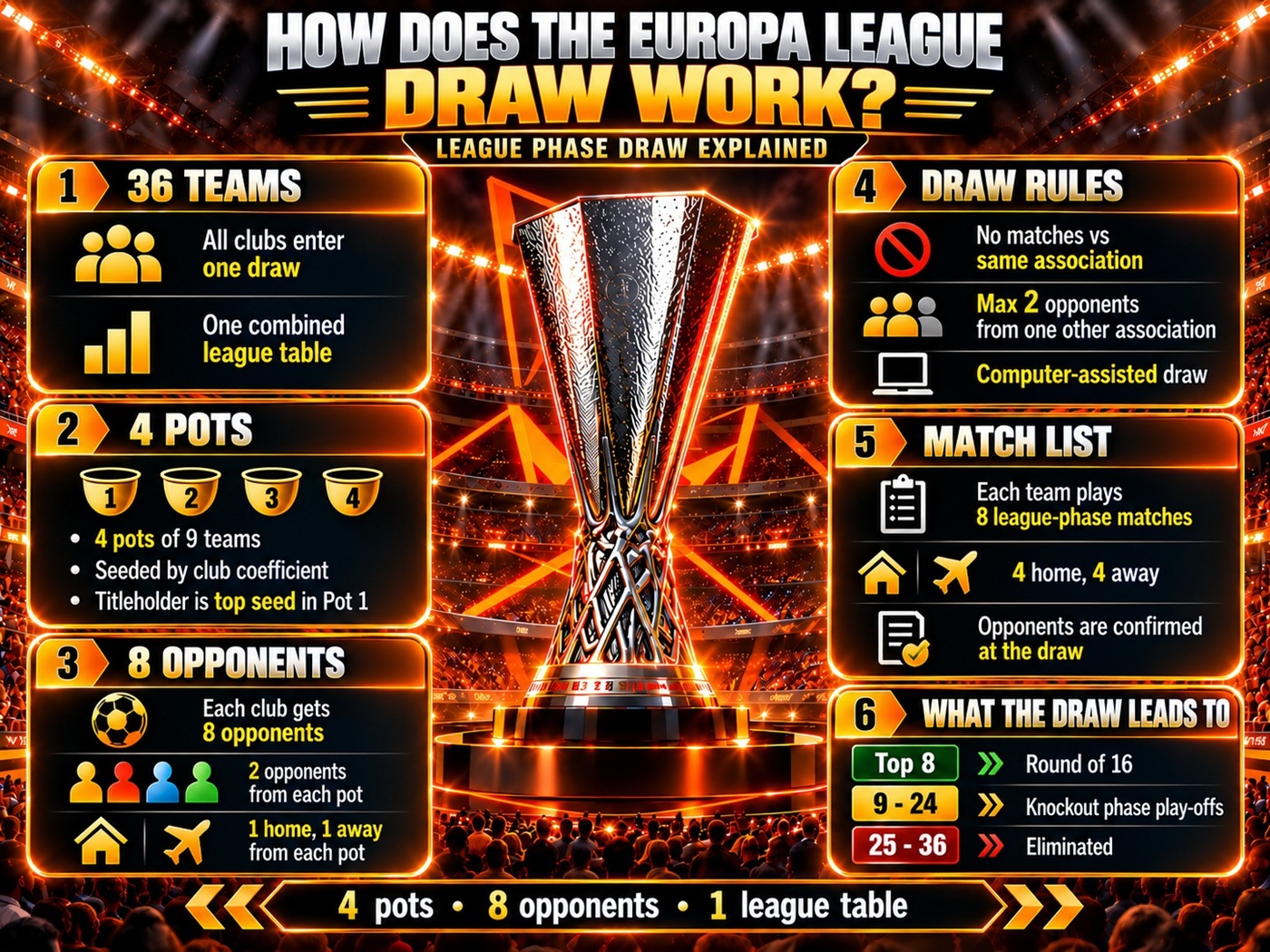
The league-phase draw works differently. The 36 clubs are divided into four pots, and each team receives eight different opponents through a digital draw.
After the league phase, the standings become the basis for the knockout bracket, so the later draws are no longer completely open. In this guide, I will explain what UEFA actually draws at each stage and how the restrictions work.
Read Also: Champions League vs Europa League vs Conference League: What’s the Difference?
Are There Different Europa League Draws?
Yes. It is easier to understand the Europa League draw by separating it into three stages:
Qualifying and play-off draws
League-phase draw
Knockout-phase draws
Each uses different rules. The qualifying draw relies heavily on seeded and unseeded clubs. The league-phase draw uses four coefficient-based pots and assigns eight opponents to every club. The knockout draws are tied closely to each team's final league-phase position.
How Does the Europa League Qualifying Draw Work?
During Europa League qualifying, UEFA generally divides the participating clubs into equal groups of seeded and unseeded teams. A seeded club is drawn against an unseeded club.
UEFA club coefficients are used to determine which clubs are seeded. The draw also decides which team hosts the first leg of the tie. Because qualifying ties are played over two legs, the other club then hosts the second leg.
Read Also: How Does the Europa League League Phase Work?
Can Two Seeded Clubs Face Each Other in Qualifying?
Normally, no. The purpose of qualifying seeding is to separate the seeded clubs from each other within the relevant draw. A seeded team is paired with an unseeded team. However, seeding affects only how the draw is structured.
It does not provide any advantage once the matches begin. The winner is still decided by the aggregate score across the two legs. I explain the qualifying structure in more detail in How Do the Europa League Qualifying Rounds Work?
Can Clubs From the Same Country Meet in the Qualifying Draw?
No. Clubs from the same national association cannot be drawn against each other during Europa League qualifying. UEFA can also divide the participating teams into smaller draw groups before conducting the draw.
Those groups can make the draw easier to manage while maintaining the required seeding and association restrictions.
What Happens If a Qualifying Draw Takes Place Before the Previous Round Is Finished?
This can happen because UEFA sometimes conducts the next draw while clubs are still playing the previous round. In that situation, the identity of the next participant may not yet be known.
For a place that will be taken by the winner of an unresolved Europa League tie, UEFA uses the higher club coefficient of the two teams involved for draw purposes.
For a club that will enter the Europa League as the loser of a tie in another UEFA competition, UEFA uses the lower coefficient of the two clubs involved under the relevant procedure. This allows UEFA to conduct the next-round draw without waiting for every earlier tie to finish.
How Does the Europa League League-Phase Draw Work?
Once the 36 league-phase clubs are known, UEFA divides them into four pots of nine teams. The pots are based on the UEFA club coefficient ranking established at the beginning of the season. Every team must then receive eight different opponents:
two from Pot 1
two from Pot 2
two from Pot 3
two from Pot 4
Against each pot, the club plays one opponent at home and the other away. This gives every club four home matches and four away matches.
Can a Team Draw a Club From Its Own Pot?
Yes. This is one of the biggest differences from the old Europa League group stage. Under the previous format, clubs from the same seeding pot did not meet during the group stage. Under the current league-phase system, every club receives two opponents from its own pot.
A Pot 1 club therefore faces two Pot 1 clubs, just as a Pot 4 club faces two Pot 4 clubs. The pots help distribute opponents across coefficient levels rather than completely separating teams of similar ranking.
Is the Europa League League-Phase Draw Manual or Computerised?
For 2026/27, the Europa League league-phase draw was conducted fully digitally using designated automated software. The software randomly selected each team's opponents while ensuring that all of UEFA's draw conditions could still be satisfied.
For each club, the system determined:
its eight opponents
which four would be played at home
which four would be played away
The process started with Pot 1 and continued through Pots 2, 3 and 4. UEFA also had the digital draw process reviewed and checked by an external auditor.
Why Does UEFA Use Software for the League-Phase Draw?
The league-phase draw has far more combinations than the old group-stage system. Each of the 36 teams needs eight opponents while several conditions have to be respected at the same time. The system must ensure that each club:
faces two teams from every pot
plays one opponent from each pot at home and one away
respects association restrictions
fits into a complete 144-match league-phase schedule
Using software allows those conditions to be checked while the draw is being completed. The software is therefore not simply creating an eight-team list independently for each club. Every selection affects the opponents that remain available to other teams.
Can Europa League Teams Draw Clubs From the Same Country?
In principle, no. During the league-phase draw, clubs from the same national association cannot normally face each other. For example, two English clubs in the league phase would normally not be drawn together.
However, that restriction applies to the league-phase draw rather than the entire competition. Teams from the same country can meet later in the knockout rounds.
How Many Teams From Another Country Can One Club Face?
A club can normally face a maximum of two opponents from any one other association during the league phase. For example, a Spanish club could potentially face two English teams among its eight opponents, but it would not normally be given three English opponents.
This rule helps spread a club's schedule across different national associations. UEFA can adjust draw conditions if necessary to avoid a deadlock or deal with other relevant competition constraints.
Can Two Clubs Be Drawn Against Each Other Repeatedly in Different Seasons?
They can meet again, but UEFA introduced an additional condition for the 2026/27 league-phase draw. An individual fixture between the same two clubs cannot be repeated with the same home team for three consecutive seasons.
For example, if Club A has hosted Club B in each of the previous two league phases, UEFA's 2026/27 draw procedure prevents the same fixture from being drawn with Club A at home for a third straight season.
The clubs could still potentially meet with Club B hosting instead. This rule relates to the home-and-away allocation rather than permanently preventing repeat opponents.
Does the Draw Decide the Matchdays?
Not completely. The league-phase draw determines:
the eight opponents
which matches are at home
which are away
UEFA then prepares the detailed match calendar. That process assigns the fixtures to specific matchdays and kick-off times while considering scheduling requirements, stadium availability, city clashes and broadcasting needs.
So knowing a club's eight opponents immediately after the draw does not necessarily tell supporters the exact order in which those matches will be played.
How Were the 2026/27 Europa League Draw Pots Decided?
For 2026/27, the 36 teams were placed into four pots of nine according to their UEFA club coefficients. A higher club coefficient generally places a team in a higher pot. However, being in Pot 1 no longer means avoiding all of the other Pot 1 clubs.
Because each team faces two opponents from every pot, seeding now helps structure the schedule rather than creating completely separated groups. I will explain the coefficient and pot system in more detail in How Do Europa League Pots and Seeding Work?
Does Being in Pot 1 Guarantee an Easier Draw?
No. Every club faces opponents from all four pots. A Pot 1 club still has to play two other Pot 1 teams. Likewise, a Pot 4 club also receives two Pot 4 opponents.
The exact difficulty of a club's eight-match schedule depends on which specific teams it draws, where those matches are played, and how those opponents perform during the season. The pots structure the draw, but they do not guarantee a particular level of difficulty.
What Happens After the League-Phase Draw?
Once every club has been assigned eight opponents, UEFA produces the full fixture calendar. The 36 teams then play eight matchdays. After Matchday 8, the final standings become the basis for the knockout phase. Teams finishing:
1st to 8th advance directly to the round of 16
9th to 24th enter the knockout phase play-offs
25th to 36th are eliminated
This is where the nature of the draw changes. From the knockout phase onward, a club's league position determines which part of the bracket it can enter.
Is the Europa League Knockout Draw Completely Random?
No. The knockout draws are heavily structured by the final league-phase standings. The teams finishing ninth to 24th enter the knockout phase play-offs. They are placed into paired positions:
9th or 10th can face 23rd or 24th
11th or 12th can face 21st or 22nd
13th or 14th can face 19th or 20th
15th or 16th can face 17th or 18th
The draw determines which team from one pair faces which team from the corresponding pair. So a club knows the small group of possible opponents before the draw takes place.
How Does the Round of 16 Draw Work?
The top eight league-phase teams enter at the round of 16. They are also placed into pairs according to their final positions:
1st and 2nd
3rd and 4th
5th and 6th
7th and 8th
The draw places each club into one of the two available positions in its section of the bracket. Each top-eight club then faces the relevant winner from the knockout phase play-offs.
This means the round of 16 is not an open draw where any top-eight club can face any play-off winner. The league-phase standings have already narrowed the possible matchups.
Does Finishing Higher Affect the Knockout Draw?
Yes. League-phase position determines where a club enters the knockout bracket. It can also affect which team hosts the second leg. In principle:
teams ranked 9th to 16th host the second leg of the knockout phase play-offs
teams ranked 1st to 8th host the second leg in the round of 16
teams ranked 1st to 4th have second-leg home seeding for the quarter-finals
Teams ranked 1st and 2nd have second-leg home seeding for the semi-finals
If a seeded club is eliminated, the club that beats it inherits that seeded position in the bracket. So the benefit attached to a high league-phase finish can continue deeper into the competition.
Are the Quarter-Final and Semi-Final Draws Open?
No. Once the knockout bracket has been established, the quarter-final and semi-final routes are predetermined. UEFA does not conduct a fresh unrestricted draw after every knockout round. A club can therefore see its possible route toward the final once the knockout bracket has been completed.
The higher league-phase seeds also retain certain second-leg home advantages within that bracket. I will explain this system fully in How Does the Europa League Knockout Draw Work?
Can Teams From the Same Country Meet in the Knockout Phase?
Yes. The same-association restriction used in the league-phase draw no longer prevents clubs from meeting in the knockout phase.
Teams can also face an opponent they already played during the league phase. This means a domestic matchup or league-phase rematch is possible once the knockout stage begins.
Is the Europa League Draw Really Random?
Parts of it are random, but the competition has restrictions. During qualifying, random pairings are made within the seeded and unseeded structure. During the league phase, the software randomly selects opponents but must obey conditions such as pot distribution and association limits.
During the knockout phase, the random element becomes narrower because league-phase positions predetermine the possible pairings and bracket sections. So the Europa League draw is not simply "36 names placed into a hat." Random selection operates within a set of competition rules.
Common Europa League Draw Misunderstandings
The Europa League league-phase draw does not create groups. It gives every club eight individual opponents.
Clubs can face teams from their own pot. Every club receives two opponents from each of the four pots.
Pot 1 does not mean avoiding Pot 1 opponents.
The 2026/27 league-phase draw was fully digital. Software selected opponents and home-or-away status while respecting UEFA's restrictions.
Clubs from the same association normally cannot meet during the league phase.
A club can normally face no more than two teams from another single association.
The draw does not immediately determine the complete matchday order. UEFA prepares the fixture calendar afterward.
The knockout draw is not completely open. Final league-phase positions determine the possible opponents and bracket positions.
Same-country matchups can happen in the knockout phase.
Europa League Draw at a Glance
During qualifying, clubs are generally divided into seeded and unseeded teams. A draw determines the two-legged ties and which club hosts the first leg.
For the league phase, the 36 clubs are divided into four pots of nine according to club coefficients. Every team receives two opponents from each pot, with one played at home and the other away.
The 2026/27 league-phase draw was conducted digitally, with software ensuring the full set of opponents complied with UEFA's restrictions.
After the league phase, the knockout draw is based on final league positions. Clubs are placed into predetermined pairs and sections of the bracket rather than entering a completely open draw.
Final Thoughts
The Europa League uses the word "draw" for several processes that work quite differently. Qualifying uses the traditional seeded-versus-unseeded system.
The league phase uses four pots, but those pots do not separate clubs into groups. Instead, every team receives eight opponents: two from each pot, with four matches at home and four away.
For 2026/27, UEFA used a fully digital system to make those selections while enforcing restrictions such as same-association protection and limits on opponents from another association.
After the league phase, the draw becomes much more dependent on sporting performance. A club's final position determines its possible knockout opponents, bracket location, and some second-leg home advantages.
For me, the main point is simple: the qualifying draw determines ties, the league-phase draw determines eight opponents, and the knockout draw places clubs into a bracket shaped by where they finished in the 36-team table.