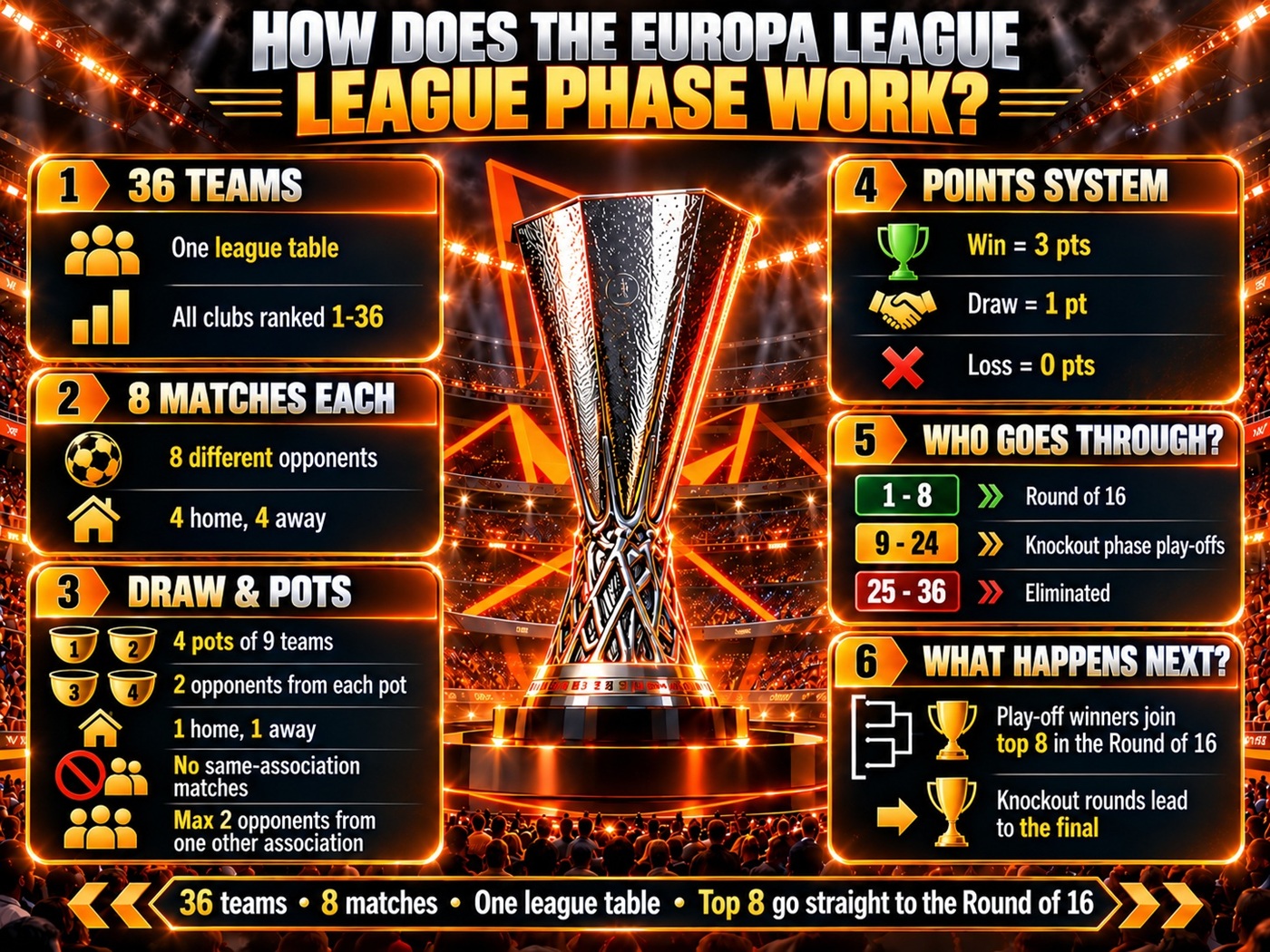
The UEFA Europa League league phase has 36 clubs competing in one league table. There are no traditional groups. Instead, each club plays eight different opponents: four matches at home and four away. After all eight matchdays, every club is ranked in the same 36-team standings.
Where a team finishes determines whether it goes directly to the round of 16, enters the knockout phase play-offs, or is eliminated. In this guide, I will explain how the league phase works from the draw to the final standings.
Read Also: How Do the Europa League Qualifying Rounds Work?
How Many Teams Are in the Europa League League Phase?
There are 36 teams. Those clubs can reach the league phase through several routes, including:
direct qualification through domestic competitions
winning Europa League qualifying
entering from designated Champions League qualifying stages
the Conference League titleholder place
Once all 36 places are filled, every club joins the same league-phase competition regardless of how it qualified. I explain the entry routes separately in How Do Teams Qualify for the UEFA Europa League?
Does the Europa League Still Have Groups?
No. The old Europa League group stage has been replaced by a single league phase. Previously, clubs were placed into small groups and played the other teams in their group home and away.
Under the current system, all 36 clubs appear in one league table, even though they do not all play each other. Each team has its own set of eight opponents.
How Many Matches Does Each Team Play?
Every club plays eight league-phase matches against eight different opponents. Four matches are at home, and four are away. A club therefore does not play the same opponent twice during the league phase.
This is different from the old group format, where teams played each group opponent once at home and once away. Across the entire league phase, 144 matches are played over eight matchdays.
Read Also: Champions League vs Europa League vs Conference League: What’s the Difference?
How Are the Eight Opponents Decided?
Before the league phase, UEFA divides the 36 clubs into four pots of nine teams. The pots are based on UEFA club coefficients. Each team is drawn against:
two clubs from Pot 1
two clubs from Pot 2
two clubs from Pot 3
two clubs from Pot 4
From each pot, one opponent is played at home and the other away. This gives every club eight different opponents and four home matches plus four away matches.
Can a Pot 1 Team Face Another Pot 1 Team?
Yes. Being in Pot 1 does not prevent a club from playing other Pot 1 teams. Every club faces two opponents from its own pot as part of the eight-match schedule.
For example, a Pot 1 club receives two Pot 1 opponents, two from Pot 2, two from Pot 3, and two from Pot 4. This is different from the old group-stage system, where teams from the same seeding pot were kept apart.
Does Being in a Higher Pot Mean an Easier Schedule?
Not necessarily. A higher pot reflects a stronger UEFA club coefficient, but every club still faces two teams from each pot. A Pot 1 team does not avoid the other highly ranked clubs completely, and a Pot 4 team does not face only stronger-pot opponents.
The pot system is mainly used to distribute opponents across different coefficient levels. Because each club faces only eight of the other 35 teams, schedules will still differ from one club to another.
Can Teams From the Same Country Play Each Other?
In principle, no. During the league-phase draw, clubs from the same national association are kept apart. A club is also normally limited to facing no more than two opponents from any one other association.
UEFA can adjust the draw conditions if necessary to avoid a deadlock or deal with competition constraints, but the normal system is designed around those restrictions. The same-country restriction does not continue throughout the entire competition. Clubs from the same association can meet later in the knockout stage.
How Are Home and Away Matches Decided?
The draw determines not only a club's eight opponents but also which four it faces at home and which four it faces away. For every pot, a club receives one home opponent and one away opponent.
UEFA also tries to balance the sequence of fixtures. In principle, a club should not play more than two consecutive league-phase matches at home or more than two consecutive matches away.
Each club should also have one home match and one away match across its first two matchdays, and the same balance across the final two matchdays. UEFA can make exceptions when scheduling constraints require them.
How Are Points Awarded?
The Europa League uses the normal football points system for the league table. A club receives three points for a win, one point for a draw, and no points for a defeat. Those points from all eight matches are added together. After Matchday 8, the clubs are ranked from first to 36th.
What Happens After the League Phase?
The final standings divide the 36 clubs into three groups.
Teams finishing 1st to 8th qualify directly for the round of 16.
Teams finishing 9th to 24th qualify for the knockout phase play-offs.
Teams finishing 25th to 36th are eliminated from European competition.
So 24 of the 36 clubs continue beyond the league phase, while 12 are eliminated.
Why Is Finishing in the Top Eight Important?
The top eight avoid the knockout phase play-offs entirely. Instead, they advance directly to the round of 16. This saves them from playing an additional two-legged knockout tie and also gives them a seeded position for the round of 16.
Their exact finishing positions also help determine where they are placed in the knockout bracket. So finishing first and finishing eighth both provide direct qualification, but league position still matters for the later knockout structure.
What Happens to Teams Finishing 9th to 24th?
They enter the knockout phase play-offs. The 16 teams are divided according to league-phase position. Clubs finishing 9th to 16th are seeded, while those finishing 17th to 24th are unseeded.
The play-off pairings are linked to final league positions rather than being completely open. The eight winners then join the league-phase top eight in the round of 16.
What Happens to Teams Finishing 25th to 36th?
They are eliminated. There is no second opportunity in the Conference League. This is different from older UEFA formats, when clubs could move from one competition into another after a group stage.
Under the current system, movement between UEFA competitions happens during qualifying, but it stops once the league phases begin. A Europa League club finishing 25th or lower is out of Europe for that season.
What Happens If Teams Finish Level on Points?
UEFA uses a series of tiebreakers. The first is goal difference across the league phase. If teams remain level, UEFA then considers criteria such as:
goals scored
away goals scored
number of wins
away wins
the combined performance of league-phase opponents
disciplinary record
UEFA club coefficient
Head-to-head results are not the main tiebreaker because tied clubs may not have played each other. I will explain the complete order separately in Europa League Tiebreaker Rules Explained.
Why Does the Performance of a Team's Opponents Matter?
Because every club faces a different set of eight opponents, UEFA has additional tiebreakers based on the collective results of those opponents. If two clubs remain tied after the first five criteria, UEFA can compare how many points their league-phase opponents earned collectively.
If necessary, the collective goal difference and goals scored by those opponents are also considered. This provides an additional way to separate clubs whose own results remain almost identical.
Is There a Fixed Number of Points Needed to Reach the Top Eight?
No. There is no official points target that guarantees a top-eight finish. The required total depends on how results are distributed across all 36 clubs during that particular season. The same applies to finishing inside the top 24.
A points total that is enough in one season might not produce the same finishing position in another. What matters is the club's final ranking after all eight matches, not reaching a predetermined points threshold.
Do All 36 Teams Play the Same Opponents?
No. Each club faces only eight of the other 35 teams. For example, two clubs can finish level on points despite having played completely different sets of opponents.
The pot system provides some balance by ensuring everyone faces two opponents from each pot, but there is no identical schedule for every team. This is one of the biggest differences between a traditional round-robin league and the Europa League league phase.
Do All Clubs Play on the Same Matchdays?
The league phase has eight matchdays, but not every match is necessarily played at the same time. Europa League matches are generally played on Thursdays. For 2026/27, the opening matchday was spread across Wednesday and Thursday.
The final matchday is different because all 18 matches are scheduled together, which limits the ability of teams to react to results elsewhere before their own final position is decided.
What Are the 2026/27 Europa League League-Phase Dates?
The eight matchdays are:
Matchday 1: 16–17 September 2026
Matchday 2: 15 October 2026
Matchday 3: 22 October 2026
Matchday 4: 5 November 2026
Matchday 5: 26 November 2026
Matchday 6: 10 December 2026
Matchday 7: 21 January 2027
Matchday 8: 28 January 2027
The league phase therefore stretches from September into January. The knockout phase play-offs begin in February.
Why Are Matchdays 7 and 8 Played in January?
The eight-match format extends beyond the traditional end of the calendar-year European schedule. After six matchdays between September and December, the Europa League pauses before returning for the final two league-phase rounds in January.
Those final matches can be particularly important because clubs may still be competing for a top-eight finish, a play-off place or survival in the competition.
Does League Position Affect More Than Qualification?
Yes. The league table does more than decide who survives. It also helps shape the knockout bracket. Finishing in the top eight provides direct entry to the round of 16, while teams ranked ninth to 16th receive seeded status in the knockout phase play-offs.
Higher league positions also determine the sections of the knockout bracket into which teams are placed. This means there is still value in climbing the table even after a club has mathematically secured a place in the top 24.
A Simple Europa League League-Phase Example
Imagine a club completes its eight matches with four wins, two draws and two defeats. The four wins give it 12 points, while the two draws add another two. It therefore finishes with 14 points.
That total does not automatically tell us whether the club finishes in the top eight or in the play-off positions. Its final ranking depends on the points earned by the other 35 teams and, if necessary, UEFA's tiebreakers.
The important figure is therefore not just the points total but the team's final position in the 36-team table.
Common Europa League League-Phase Misunderstandings
There are no traditional groups. All 36 clubs appear in one league table.
Each club plays only eight opponents. It does not face all 35 other teams.
Every team plays eight different opponents. There are no home-and-away rematches during the league phase.
Pot 1 clubs can face other Pot 1 clubs. Every team faces two opponents from every pot.
Being in Pot 1 does not guarantee an easier schedule. Every club receives opponents from all four pots.
There is no fixed points total for reaching the top eight or top 24. Qualification depends on the final standings.
The top eight go directly to the round of 16.
Teams ranked ninth to 24th enter the knockout phase play-offs.
Teams finishing 25th or lower do not drop into the Conference League. They are eliminated from Europe.
Head-to-head is not the first league-phase tiebreaker. Goal difference comes first.
Europa League League Phase at a Glance
The Europa League league phase contains 36 clubs in one table. Each club plays eight different opponents, with four matches at home and four away. The draw places the teams into four pots of nine, and every club faces two opponents from each pot. A win is worth three points, a draw one and a defeat zero.
After eight matchdays, teams finishing first to eighth advance directly to the round of 16. Clubs finishing ninth to 24th enter the knockout phase play-offs, while those ranked 25th to 36th are eliminated. There is no transfer to the Conference League after the league phase.
Final Thoughts
The Europa League league phase is easier to understand once I stop thinking of it as a traditional domestic league or the old UEFA group stage. There are 36 clubs in one table, but each team plays only eight different opponents.
The draw creates that schedule by giving every club two opponents from each of four seeding pots, with one home and one away match against opponents from every pot. After the eight matches, league position becomes crucial.
The top eight go directly to the round of 16, teams ranked ninth to 24th must play an additional knockout tie, and the bottom 12 are eliminated. There is also no fixed number of points that guarantees a particular outcome.
For me, the key rule is simple: eight matches determine where each club finishes in the 36-team table, and that position determines its route through the rest of the Europa League.