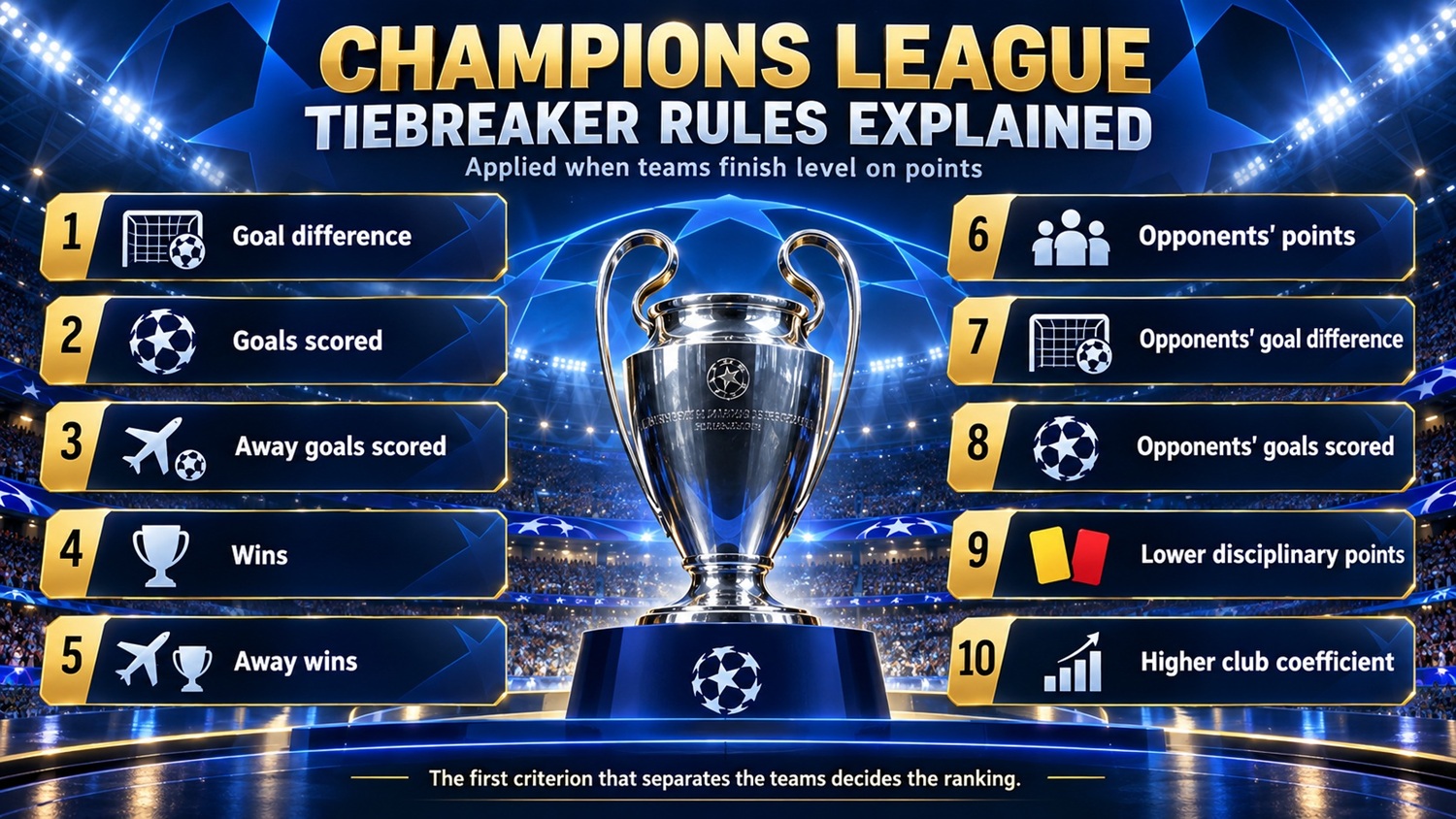
With 36 clubs sharing one Champions League league-phase table, it is common for several teams to have the same number of points. When that happens, UEFA uses a specific sequence of tiebreakers to determine their positions.
The first tiebreaker is goal difference, followed by goals scored, away goals, wins and away wins. If clubs are still level when the league phase is complete, UEFA then considers the combined performance of their eight opponents, disciplinary records and, finally, club coefficient.
These rules can decide whether a club finishes eighth or ninth, 24th or 25th, or receives a better position in the knockout bracket. In this guide, I will explain the Champions League tiebreakers in order and what each one actually means.
Read Also: UEFA Champions League Explained: Format, Qualification and How It Works
Why Do Champions League Tiebreakers Matter?
Every Champions League league-phase club plays eight matches and earns:
three points for a win
one point for a draw
zero points for a defeat
At the end of the league phase, all 36 clubs are placed in one standings table. The important finishing positions are:
1st–8th: direct qualification for the round of 16
9th–24th: knockout phase play-offs
25th–36th: eliminated from Europe
League position also affects seeding and the knockout bracket. That means two teams can finish with the same number of points but have very different outcomes once UEFA applies the tiebreakers.
For example, if two clubs are level on points in eighth and ninth, one goes directly to the round of 16 while the other must play an additional two-legged tie. I explain the overall standings system in How Does the Champions League League Phase Work?
What Is the First Champions League Tiebreaker?
The first tiebreaker is goal difference. Goal difference is calculated by subtracting the number of goals a club has conceded from the number it has scored.
For example:
Club A scores 15 goals and concedes 8. Its goal difference is: 15 - 8 = +7
Club B scores 12 and concedes 8. Its goal difference is: 12 - 8 = +4
If both clubs finish on the same number of points, Club A ranks higher because +7 is better than +4. This makes every goal potentially important. A third or fourth goal in a comfortable victory may seem unnecessary at the time, but it can affect a club's final Champions League position months later.
Read Also: How Do Champions League Pots and Seeding Work?
What If Goal Difference Is Also Equal?
UEFA moves to the second tiebreaker which is Goals scored in the league phase. Suppose two clubs finish with:
16 points
+6 goal difference
Club A has scored 16 goals and Club B has scored 14. Club A finishes higher because it scored more goals. This means UEFA first looks at the balance between goals scored and conceded, then at attacking output if that balance is identical.
What Is the Full Champions League Tiebreaker Order?
When the league phase is complete, UEFA applies the following criteria in this order:
Superior goal difference
Higher number of goals scored
Higher number of away goals scored
Higher number of wins
Higher number of away wins
Higher combined points total of the club's league-phase opponents
Superior combined goal difference of the club's league-phase opponents
Higher combined number of goals scored by the club's league-phase opponents
Lower disciplinary points total
Higher UEFA club coefficient
UEFA works down the list until the clubs can be separated. The later criteria become more unusual, so I will explain them individually.
Tiebreaker 1: Goal Difference
As I explained above, UEFA first compares each club's total league-phase goal difference. A team that scores 14 and concedes 7 has a goal difference of +7.
A team that scores 18 and concedes 12 has +6. The first team ranks higher despite scoring fewer goals because its goal difference is better.
Read Also: How Does the Champions League Draw Work?
Tiebreaker 2: Goals Scored
If the clubs have the same points and goal difference, UEFA compares their total goals scored across the eight league-phase matches. The club with more goals ranks higher.
For example:
Club A: 15 scored, 9 conceded = +6
Club B: 13 scored, 7 conceded = +6
Both have the same goal difference. Club A ranks higher because it scored 15 goals compared with Club B's 13.
Tiebreaker 3: Away Goals Scored
If points, goal difference and total goals scored are all equal, UEFA compares the number of goals scored away from home. The club with more away goals ranks higher. This should not be confused with the old away-goals rule used in knockout ties.
Away goals no longer decide a level two-legged knockout tie. Here, UEFA is simply using total away goals as one of several league-phase ranking criteria. For example, if two clubs have identical points, goal difference and goals scored but:
Club A scored seven away goals.
Club B scored five.
Club A ranks higher.
Read Also: How Do the Champions League Qualifying Rounds Work?
Tiebreaker 4: Number of Wins
If the teams still cannot be separated, UEFA looks at total league-phase victories. The club with more wins ranks higher. For example, two teams could reach 14 points differently.
Club A might record:
four wins
two draws
two defeats
Club B might record:
three wins
five draws
no defeats
Both have 14 points. If all the earlier tiebreakers were also identical, Club A would rank higher at this stage because it recorded four wins compared with Club B's three.
Tiebreaker 5: Away Wins
Next, UEFA compares how many matches each club won away from home. The club with more away victories ranks higher. So if two teams remain identical after points, goal difference, goals scored, away goals and total wins, their number of away wins becomes the next deciding factor.
After this point, the criteria change significantly. Instead of looking only at what the two clubs themselves achieved, UEFA begins considering the performance of the opponents they faced.
Read Also: Champions Path vs League Path: What's the Difference?
Tiebreaker 6: Combined Points of League-Phase Opponents
If the teams remain level after the first five criteria, UEFA compares the total points collected by their league-phase opponents. This is effectively a strength-of-opposition tiebreaker. Remember that Champions League clubs do not all play the same eight opponents.
Suppose Club A's eight opponents collectively earned 110 points during the league phase. Club B's opponents collectively earned 102. If the two clubs remain equal through the first five tiebreakers, Club A ranks higher.
Why? Because the results suggest Club A faced opponents who collectively performed better during the league phase. This is one of the consequences of having all 36 clubs in one standings table while giving each team a different schedule.
Tiebreaker 7: Combined Goal Difference of Opponents
If the opponents' combined points are also equal, UEFA looks at their combined goal difference.
Imagine the eight opponents faced by Club A collectively finish with a goal difference of +18. Club B's opponents collectively finish at +11. Club A ranks higher.
Again, UEFA is using the performance of each club's schedule to separate teams that have otherwise produced identical records.
Read Also: How Do Teams Qualify for the UEFA Champions League?
Tiebreaker 8: Combined Goals Scored by Opponents
If that still does not separate them, UEFA compares the total number of goals scored by each club's eight opponents. The club whose opponents collectively scored more goals receives the higher ranking.
By this stage, the two clubs being compared would have to be remarkably similar across several different measurements. That is why these later criteria are unlikely to be needed frequently, but UEFA still requires a complete system capable of separating all 36 clubs.
Tiebreaker 9: Disciplinary Points
If the clubs remain tied, UEFA considers their disciplinary record. The club with the lower disciplinary points total ranks higher. For this calculation:
yellow card = 1 disciplinary point
red card = 3 disciplinary points
dismissal after two yellow cards in the same match = 3 disciplinary points
The calculation includes cards received by both players and team officials during league-phase matches. This means better discipline can theoretically decide a Champions League league position. Unlike most of the earlier tiebreakers, lower is better here.
Tiebreaker 10: UEFA Club Coefficient
If every previous criterion still fails to separate the clubs, UEFA uses the club coefficient. The club with the higher UEFA club coefficient receives the higher position.
Club coefficients are based on European performance across several seasons. This is the final tiebreaker rather than one of the first because the league standings are designed to prioritize what clubs have achieved during the current Champions League campaign.
Only after all nine earlier criteria fail does historical European ranking become decisive. I explain how those rankings are calculated in How Do UEFA Coefficients Work?
Is Head-to-Head Record a Champions League League-Phase Tiebreaker?
No. Head-to-head record is not one of the current league-phase tiebreakers. That makes sense under the current format because clubs do not all play each other. Two teams level on points may never have met during the league phase.
Even if they did play each other, that result does not become the first tiebreaker. UEFA starts with overall goal difference. This is different from some domestic leagues and competitions where head-to-head results are given greater importance.
So if two Champions League teams finish level on points, I would not immediately look at the result between them. I would first look at their overall goal difference.
Are the Tiebreakers the Same Before the Final Matchday?
Not completely. This is an important detail. During the league phase, from Matchday 1 through Matchday 7, UEFA uses the first five criteria to order teams that are level on points:
Goal difference
Goals scored
Away goals scored
Wins
Away wins
If clubs are still completely equal after those five criteria, UEFA gives them an equal ranking for the time being and displays them alphabetically according to their abbreviated names.
The opponent-performance criteria are used once all league-phase matches have been completed. There is a practical reason for this.
Before the league phase is finished, the collective record of each club's opponents is still changing. The final opponent-strength calculations therefore make most sense after Matchday 8 has been completed.
Why Does Opponent Strength Matter?
The current Champions League format creates a unique problem. All 36 teams are ranked together, but they do not play the same schedules. Each club plays only eight of the other 35 teams.
That means two clubs can finish with identical records against very different sets of opponents. UEFA's later tiebreakers partly account for that by considering how those opponents performed.
Suppose Clubs A and B have identical:
points
goal difference
goals scored
away goals
wins
away wins
If Club A's eight opponents collectively earned considerably more points than Club B's opponents, UEFA ranks Club A higher. The logic is that Club A achieved the same statistical record against a stronger-performing schedule.
Can Goal Difference Decide Champions League Qualification?
Yes. It can decide much more than a minor change in league position. Imagine two teams finish Matchday 8 on the same points. One is ranked eighth. The other is ninth.
If goal difference separates them, then goal difference has effectively determined which club goes directly to the round of 16 and which club must enter the knockout phase play-offs.
The same can happen around 24th and 25th. One team continues in Europe. The other is eliminated. This is why running up the score or avoiding unnecessary late concessions can have genuine competitive value during the league phase.
Can Tiebreakers Affect the Knockout Draw Even If Both Teams Qualify?
Yes. Finishing positions matter beyond the major cut-offs. For example, ninth and 16th both enter the knockout phase play-offs, but they do not receive the same bracket position.
Similarly, first and eighth both qualify directly for the round of 16, but their positions affect where they enter the knockout bracket and the possible advantages available later.
So even if two level teams have both already secured qualification, their final ordering can still matter. I explain how those rankings feed into the bracket in How Does the Champions League Knockout Draw Work?
A Simple Tiebreaker Example
Imagine Club A and Club B both finish the league phase with 16 points.
Their records are:
Club A:
Goals scored: 15
Goals conceded: 8
Goal difference: +7
Club B:
Goals scored: 17
Goals conceded: 11
Goal difference: +6
Club B scored more goals. But UEFA does not reach the goals-scored tiebreaker because goal difference comes first. Club A ranks higher because +7 is better than +6.
Now imagine both clubs instead have a +7 goal difference. Club B's 17 goals would then become relevant. Because the first criterion no longer separates them, UEFA moves to the second, and Club B would rank higher.
The order matters. UEFA does not choose whichever statistic makes one club look better. It works through the criteria sequentially.
What If Three or More Teams Finish Level?
The same ordered criteria apply when more than two clubs finish with the same number of points. UEFA compares the relevant statistics and establishes their positions.
With 36 clubs in the league phase, it is entirely possible for several teams to finish on identical points totals. That makes the tiebreaking system essential for producing a final ranking from first to 36th.
Common Champions League Tiebreaker Misunderstandings
There are several points I think are worth remembering.
Head-to-head record is not the first tiebreaker. In fact, it is not part of the current league-phase tiebreaker list.
Goal difference comes first. Goals scored only matter if goal difference is also equal.
Away goals are still relevant as a league-phase tiebreaker. That does not mean the old knockout away-goals rule has returned.
The strength of a club's opponents can matter. Opponent points, goal difference and goals scored are used among the later final tiebreakers.
Disciplinary record can affect league position. The lower disciplinary points total wins that comparison.
Club coefficient is the final criterion. UEFA does not immediately use historical ranking when teams finish level on points.
The live table before Matchday 8 uses fewer criteria. The full opponent-based tiebreakers apply after the league phase is completed.
Champions League Tiebreakers at a Glance
If teams finish the league phase level on points, I work down this list:
Goal difference
Goals scored
Away goals scored
Wins
Away wins
Opponents' combined points
Opponents' combined goal difference
Opponents' combined goals scored
Lower disciplinary points
Higher UEFA club coefficient
The first criterion that separates the clubs determines their order.
Final Thoughts
Champions League tiebreakers are more important than they may initially appear. With only eight matches determining positions across a 36-team table, several clubs can finish with the same number of points.
UEFA therefore begins with the most familiar measures: goal difference, goals scored, away goals and victories. Only when those fail does the system move into more unusual criteria, including the combined performance of each club's opponents, disciplinary records and finally UEFA club coefficient.
The most useful point for me is that the tiebreaker order is fixed. UEFA does not simply compare every statistic and decide which team had the stronger campaign. It starts with goal difference and moves down the list only when the previous criterion cannot separate the clubs.
That makes every goal, every away performance and potentially even every card relevant in a league phase where one position can be the difference between direct qualification, an extra knockout tie or elimination.