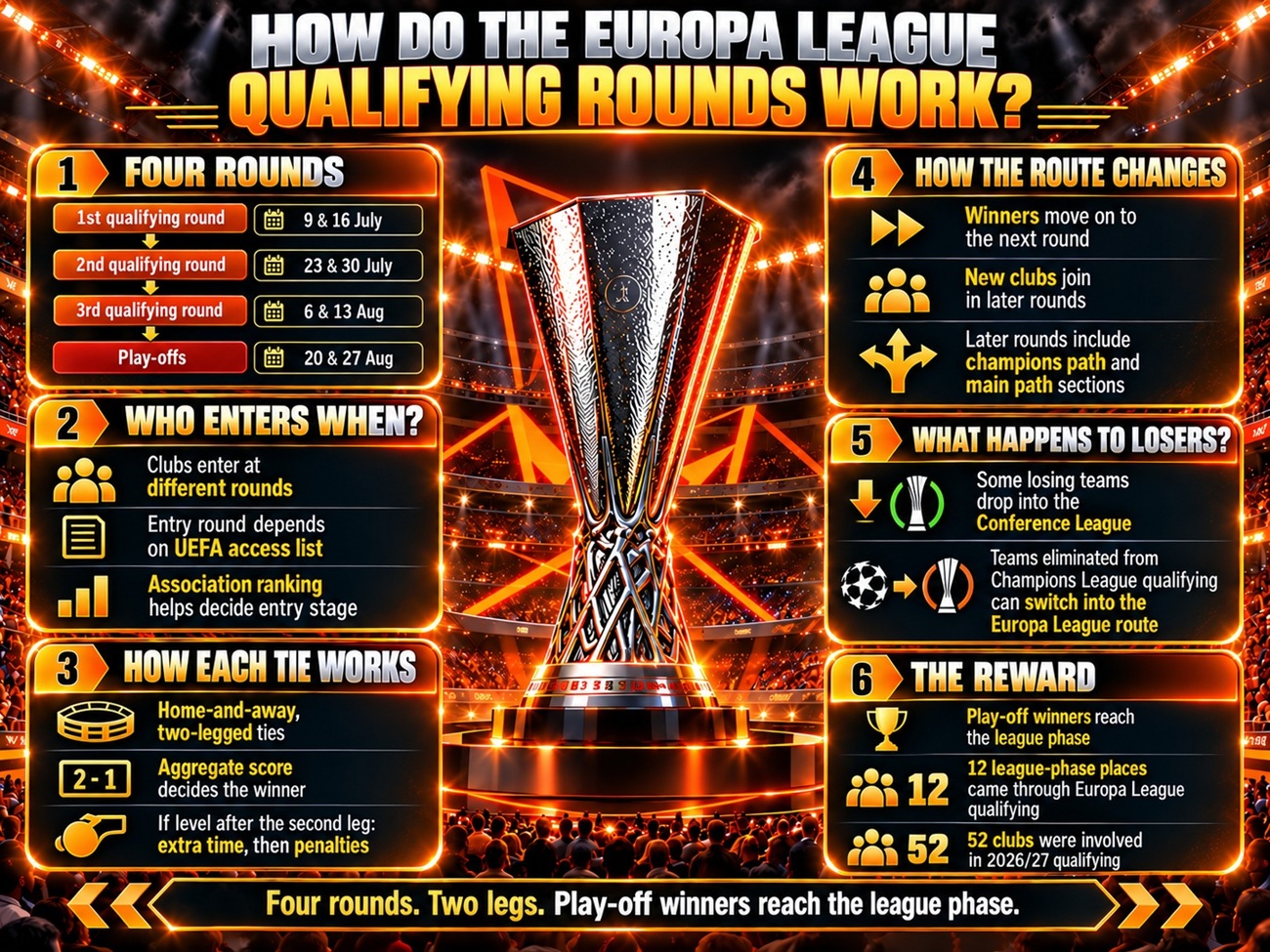
The UEFA Europa League qualifying rounds determine some of the clubs that reach the competition's 36-team league phase. For 2026/27, 52 clubs took part in Europa League qualifying, with 12 eventually winning places in the league phase.
However, not every team starts at the same point. Some clubs enter in the first qualifying round, others join later, and teams eliminated from certain Champions League qualifying rounds can also enter the Europa League.
There are also two qualifying routes at the third qualifying round: the Main Path and Champions Path. In this guide, I will explain how the rounds connect and what happens when a club wins or loses a qualifying tie.
Read Also: Champions League vs Europa League vs Conference League: What’s the Difference?
How Many Europa League Qualifying Rounds Are There?
The Europa League qualifying system contains four stages:
First qualifying round
Second qualifying round
Third qualifying round
Play-off round
A club does not necessarily have to play all four. Where it enters depends on UEFA's access list, its domestic qualification route and, in some cases, the stage at which it was eliminated from Champions League qualifying.
For example, one club may need to win four ties to reach the league phase, while another may enter directly in the play-offs and need to win only one.
What Is the Europa League Main Path?
The Main Path is the regular qualifying route for clubs entering the Europa League through domestic qualification and certain teams transferred from Champions League qualifying. It operates in the:
first qualifying round
second qualifying round
third qualifying round
Clubs enter at different stages according to UEFA's access list. For 2026/27, the first qualifying round consisted entirely of Main Path clubs. The second qualifying round was also Main Path only. The Champions Path was introduced at the third qualifying round.
What Is the Europa League Champions Path?
The Champions Path is a separate section of the third qualifying round for domestic champions eliminated from designated stages of Champions League qualifying. These clubs originally qualified for Europe as national champions and began their campaigns in the Champions League.
After elimination, UEFA transfers them into the Europa League Champions Path rather than placing them directly against Main Path clubs at that stage. For 2026/27, 12 clubs entered the Europa League third qualifying round Champions Path after being eliminated from the Champions League second qualifying round.
How Does the First Qualifying Round Work?
The first qualifying round is part of the Main Path. For 2026/27, 12 clubs entered at this stage, creating six two-legged ties. The six winners progressed to the second qualifying round.
The six losing teams were not immediately eliminated from European competition. They transferred into the Conference League second qualifying round. This is an important feature of UEFA qualifying: losing an Europa League tie can still leave a club with another route into Europe.
How Does the Second Qualifying Round Work?
The second qualifying round is also part of the Main Path. For 2026/27, it contained 18 clubs: the six winners from the first qualifying round and 12 clubs entering at this stage. That produced nine ties.
The nine winners advanced to the Europa League third qualifying round Main Path. The losing clubs transferred into the Conference League third qualifying round. At this point, there was still no Europa League Champions Path. That separate route began in the next round.
How Does the Third Qualifying Round Work?
The third qualifying round is where the Europa League qualifying system splits into two paths. For 2026/27, there were:
14 clubs in the Main Path
12 clubs in the Champions Path
The Main Path included three clubs entering at that stage, nine winners from the Europa League second qualifying round and two clubs transferred from the Champions League second qualifying round.
The Champions Path contained 12 domestic champions eliminated from the Champions League second qualifying round.
Although the two paths were separate for the draw, the objective was the same: win the two-legged tie and reach the Europa League play-offs. Teams eliminated from either path moved into the Conference League play-offs.
How Do the Europa League Play-Offs Work?
The play-off round is the final qualifying stage before the Europa League league phase. For 2026/27, 24 clubs competed in 12 play-off ties. Those clubs came from three sources:
five clubs entering directly in the play-offs
six clubs eliminated from the Champions League third qualifying round Champions Path
13 winners from the Europa League third qualifying round
Each play-off winner qualified for the Europa League league phase. Each losing team moved into the Conference League league phase.
That means reaching the Europa League play-offs guarantees a club a league-phase place in one of UEFA's competitions: the winner enters the Europa League, while the loser enters the Conference League.
How Many Europa League Qualifying Winners Reach the League Phase?
Twelve. The Europa League play-offs contain 12 ties, so the 12 winners earn places in the league phase. However, these are not the only clubs entering the Europa League league phase. For 2026/27, the 36 places consisted of:
13 direct entrants
12 Europa League qualifying winners
11 clubs transferred from Champions League qualifying
So Europa League qualifying provides one-third of the 36-team league-phase field.
Are Europa League Qualifying Matches Played Over Two Legs?
Yes. Each qualifying tie is normally played over two legs. One club hosts the first match and the other hosts the second. UEFA adds the scores from both matches together, and the team with the higher aggregate score advances.
For example, if a club wins the first leg 2-0 but loses the second leg 1-0, it wins the tie 2-1 on aggregate. The result of each individual match matters, but qualification is decided by the combined score.
What Happens If the Aggregate Score Is Level?
If the teams have scored the same number of goals after both legs, the second leg goes to extra time. Two 15-minute periods are played. If one team leads after extra time, it advances.
If the aggregate score remains level, the tie is decided by a penalty shoot-out. The old away-goals rule is not used. A goal scored away from home therefore has no extra value when determining the winner of a tied aggregate score.
How Does Seeding Work in Europa League Qualifying?
UEFA normally divides clubs into seeded and unseeded teams for qualifying draws. Seeding is based primarily on UEFA club coefficients established at the beginning of the season.
A seeded club is drawn against an unseeded club rather than another seeded team within the relevant draw group. This is intended to use clubs' previous European performance to structure the qualifying draws.
However, being seeded does not provide any advantage once the matches begin. Both clubs still have to win the tie on aggregate.
What Happens When the Next-Round Teams Are Not Yet Known?
Europa League qualifying draws can take place before the previous round has finished. In that situation, UEFA may not yet know which club will advance from a particular tie.
For draw and seeding purposes, UEFA uses the coefficients attached to the unresolved pairing according to its regulations. For the club that will advance as the winner of the tie, the higher coefficient of the two clubs can be used for the next-round draw.
For a club that will enter the Europa League after losing a tie in another UEFA competition, UEFA applies the lower coefficient under the relevant draw procedure. This allows the next draw to take place without waiting for every previous tie to be completed.
Can Clubs From the Same Country Meet in Europa League Qualifying?
Normally, no. UEFA's qualifying draw rules prevent clubs from the same national association from being drawn against each other.
UEFA can also divide teams into smaller draw groups for practical purposes before conducting the draw. The draw determines both the opponent and which team hosts the first leg.
How Do Champions League Teams Enter Europa League Qualifying?
The Champions League and Europa League qualifying systems are connected. Clubs eliminated from designated Champions League rounds are transferred into the Europa League at predetermined stages. Under the current structure, examples include:
Champions League second qualifying round Champions Path losers entering the Europa League third qualifying round Champions Path
certain Champions League second qualifying round League Path losers entering the Europa League third qualifying round Main Path
Champions League third qualifying round Champions Path losers entering the Europa League play-offs
clubs eliminated at designated later Champions League stages moving directly into the Europa League league phase
The exact route depends on both the Champions League path and the round in which the club loses.
Can a Club Move Through All Three UEFA Competitions in One Season?
During qualifying, yes. A club can begin in Champions League qualifying, lose and transfer into the Europa League, then lose another qualifying tie and move into the Conference League.
For example, a club could start in the Champions League second qualifying round, enter the Europa League third qualifying round after elimination and then move into the Conference League play-offs if it loses again.
This movement only happens during qualifying. Once the league phases begin, teams no longer drop from the Champions League to the Europa League or from the Europa League to the Conference League.
What Happens to Europa League Qualifying Losers?
The destination depends on the round. Under the 2026/27 structure:
First qualifying round losers entered the Conference League second qualifying round.
Second qualifying round losers entered the Conference League third qualifying round.
Third qualifying round losers entered the Conference League play-offs.
Europa League play-off losers entered the Conference League league phase.
So losing an Europa League qualifying tie does not necessarily end a club's European season. The later a club reaches in Europa League qualifying, the later it enters the Conference League if eliminated.
Why Do Some Clubs Skip Earlier Qualifying Rounds?
UEFA's access list determines where clubs enter. The access list is based largely on association coefficient rankings and the qualification places allocated to each national association.
A club from one association may therefore begin in the first qualifying round, while another club enters in the second, third or play-off round. Access-list rebalancing can also move clubs forward if places become vacant because of titleholder qualification or other circumstances.
Skipping a round is therefore not based simply on the individual club being considered stronger. It depends on the place through which the club qualified and UEFA's access structure.
What Were the 2026/27 Europa League Qualifying Dates?
The 2026/27 qualifying schedule was:
First qualifying round: 9 and 16 July 2026
Second qualifying round: 23 and 30 July 2026
Third qualifying round: 6 and 13 August 2026
Play-offs: 20 and 27 August 2026
The 12 play-off winners then joined the other qualified clubs in the 36-team Europa League league phase.
A Simple Europa League Qualifying Example
Imagine a club enters the Europa League in the first qualifying round. It wins its first two-legged tie and advances to the second qualifying round. It wins again and reaches the third qualifying round Main Path.
Another victory sends it to the play-offs. If it wins the play-off tie, it reaches the Europa League league phase. If it loses that final tie instead, its European campaign does not end. It enters the Conference League league phase.
A club starting this early can therefore need to win four separate two-legged Europa League ties to reach the league phase.
Common Europa League Qualifying Misunderstandings
Not every club starts in the first qualifying round. Teams enter at different stages according to UEFA's access list.
The Europa League Champions Path does not run through every qualifying round. Under the current format, it appears in the third qualifying round.
Champions Path clubs come from Champions League qualifying. They are domestic champions that were eliminated at designated Champions League stages.
Main Path and Champions Path are not separate Europa League competitions. They are qualifying routes that feed into the same play-off stage.
Losing in Europa League qualifying does not always mean elimination from Europe. Clubs can transfer into the Conference League.
Losing an Europa League play-off sends the club into the Conference League league phase.
Qualifying ties are decided on aggregate score. The away-goals rule is no longer used.
Being seeded does not guarantee qualification. Seeding affects the draw, not the result.
Once the league phase begins, clubs can no longer drop into another UEFA competition.
Final Thoughts
Europa League qualifying is easier to understand when I view it as a series of connected knockout rounds rather than one long tournament involving the same clubs from the beginning.
The Main Path starts with the first qualifying round and continues through the third. The Champions Path appears in the third qualifying round for designated domestic champions eliminated from Champions League qualifying.
After that, the successful clubs progress to the Europa League play-offs. Every tie is normally played over two legs, with aggregate score deciding who advances. If the aggregate score is level, extra time and penalties can be used.
The 12 play-off winners qualify for the Europa League league phase, while the 12 losing clubs enter the Conference League league phase.
That final detail explains one of the most important features of UEFA qualifying: a club can move from the Champions League to the Europa League and then to the Conference League during qualifying, but that movement ends once the league phases begin.