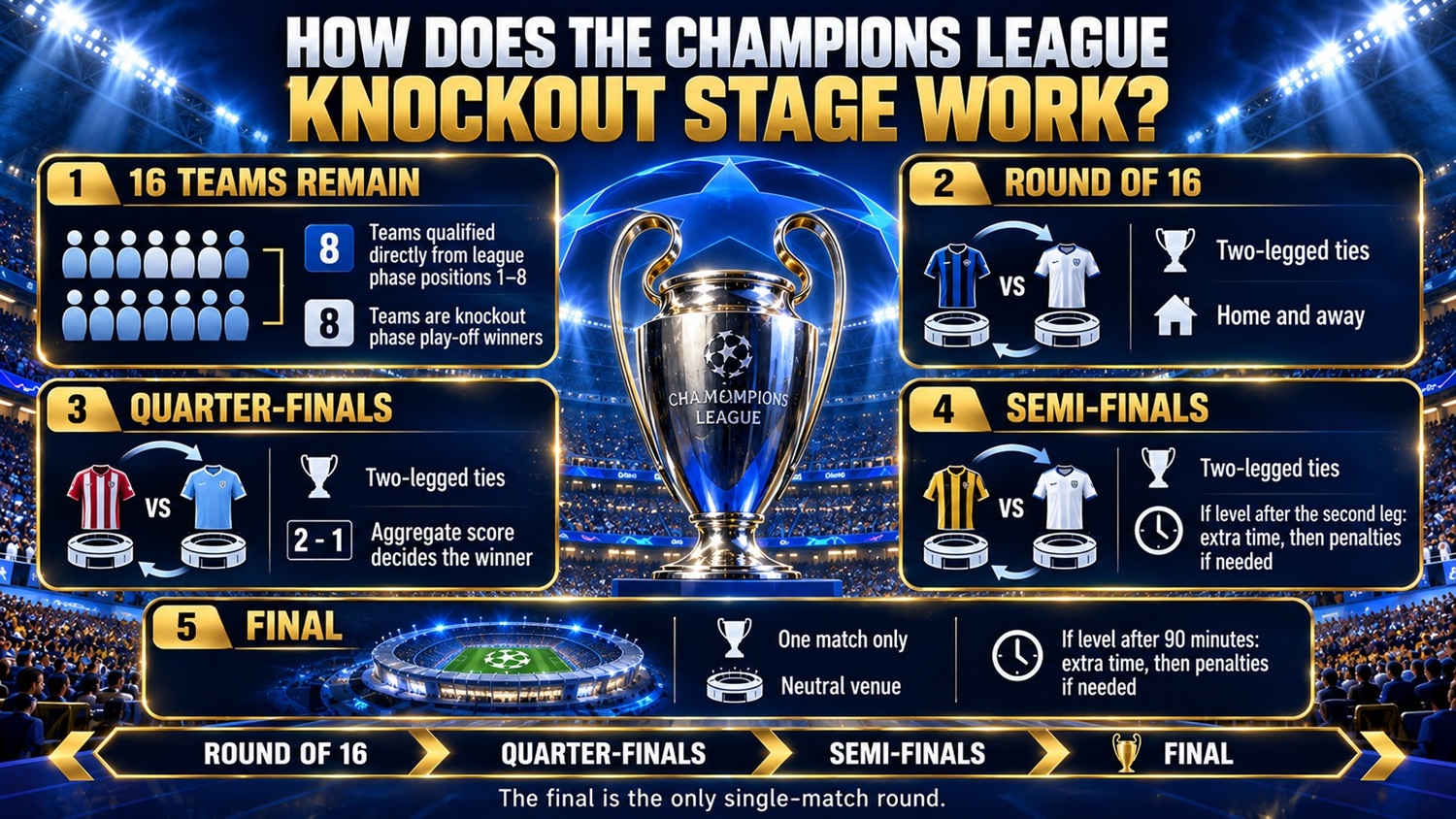
The UEFA Champions League knockout stage begins after the 36-team league phase and eventually reduces 24 remaining clubs to one European champion.
The first eight teams in the league phase qualify directly for the round of 16. Clubs finishing ninth to 24th must first compete in the knockout phase play-offs, while teams ranked 25th to 36th are eliminated.
From the play-offs through the semi-finals, ties are normally played over two legs. The final is different: it is one match at a predetermined neutral stadium.
In this guide, I will explain how every Champions League knockout round works, how aggregate scores are decided, what happens when teams finish level and why league-phase position continues to matter long after the league table is complete.
Read Also: Champions League Tiebreaker Rules Explained
How Many Teams Enter the Champions League Knockout Stage?
A total of 24 clubs progress from the league phase into the knockout phase. They reach it in two different ways.
Positions 1–8: qualify directly for the round of 16.
Positions 9–24: enter the knockout phase play-offs.
The remaining clubs, ranked 25th to 36th, are eliminated from European competition. The first knockout round therefore involves only 16 of the 24 surviving clubs. The top eight wait for the winners in the round of 16.
What Are the Champions League Knockout Rounds?
The knockout phase consists of:
Knockout phase play-offs
Round of 16
Quarter-finals
Semi-finals
Final
The first four stages use two-legged ties under the normal competition format. The final is played as a single match. The overall journey is therefore:
24 teams
↓
Knockout phase play-offs
↓
16 teams
↓
Round of 16
↓
8 teams
↓
Quarter-finals
↓
4 teams
↓
Semi-finals
↓
2 teams
↓
Final
↓
Champion
How Do the Knockout Phase Play-Offs Work?
The knockout phase play-offs involve the clubs finishing ninth to 24th in the league phase. The 16 teams are divided into:
9th–16th: seeded
17th–24th: unseeded
Their possible opponents are determined by league position:
9th or 10th vs 23rd or 24th
11th or 12th vs 21st or 22nd
13th or 14th vs 19th or 20th
15th or 16th vs 17th or 18th
The seeded clubs normally play the second leg at home. Eight clubs win their ties and advance. Eight are eliminated. I explain that round in detail in What Is the Champions League Knockout Phase Play-Off article.
What Happens in the Round of 16?
The eight play-off winners join the league phase's top eight. That creates the traditional 16-team field. The top-eight clubs are grouped according to their league-phase positions:
1st and 2nd
3rd and 4th
5th and 6th
7th and 8th
The round-of-16 draw places those clubs into predetermined areas of the knockout bracket against the relevant play-off winners. This means the round of 16 is not a completely open draw.
A first-placed club cannot simply be drawn against any one of the eight play-off winners. Its possible route is already limited by the bracket created from the league-phase rankings. The clubs that finished in the top eight are seeded and, in principle, play their round-of-16 second legs at home.
Read Also: How Do Champions League Pots and Seeding Work?
Is There Another Completely New Draw After the Round of 16?
No. This is one of the biggest differences between the current system and older Champions League formats. Once the knockout bracket has been established, the routes through the quarter-finals and semi-finals are already defined.
There is no completely open redraw before every round. The winner of one tie knows which part of the bracket it will move into next. League-phase position therefore helps shape a club's potential path toward the final. I explain the full positioning system separately in How Does the Champions League Knockout Draw Work?
How Do the Quarter-Finals Work?
Eight clubs reach the quarter-finals. They compete in four two-legged ties. Each team plays:
one first leg
one second leg
The scores are combined. The four aggregate winners advance to the semi-finals. Under the current system, league-phase ranking can still affect which club receives the second leg at home.
Teams originally ranked first to fourth in the league phase receive second-leg home status in the quarter-finals in principle. If one of those teams has already been eliminated, the club that eliminated it inherits that bracket position.
That means league-phase seeding can continue to influence the tournament even when the original seeded club is no longer involved.
Read Also: How Does the Champions League Draw Work?
How Do the Semi-Finals Work?
The four quarter-final winners advance to two semi-finals. These are also played over two legs. The two aggregate winners qualify for the Champions League final. League-phase ranking can again affect second-leg home status.
The bracket positions originally belonging to the clubs ranked first and second in the league phase receive the second leg at home in the semi-finals in principle.
If one of those clubs has already been knocked out, the team that eliminated it inherits its bracket position. This is why finishing near the very top of the league phase can still provide an advantage several rounds later.
What Does It Mean to Inherit a Seeded Position?
This is easier to understand with an example. Imagine Club A finishes first in the league phase. Its bracket position carries certain seeding advantages later in the knockout stage. Club B then eliminates Club A.
Club B does not suddenly take its own original league ranking into the next round. Instead, it takes over Club A's position in the bracket. That can include the second-leg home advantage attached to that position.
UEFA therefore does not recalculate seeding after every knockout round. The bracket position itself carries forward.
Read Also: How Does the Champions League League Phase Work?
How Are Two-Legged Champions League Ties Decided?
Every knockout tie before the final is normally played over two matches. One club hosts the first leg. The other hosts the second. UEFA adds the goals scored in both matches to create an aggregate score.
For example:
First leg: Club A 2-0 Club B
Second leg: Club B 2-1 Club A
Aggregate score:
Club A 3-2 Club B
Club A advances. Club B won the second leg, but Club A scored more goals across the entire tie. That is what matters.
What Happens If the Aggregate Score Is Level?
If the aggregate score is equal after 90 minutes of the second leg, the tie goes to extra time. Two periods of 15 minutes are played. If one club has scored more goals when extra time finishes, it advances.
If the teams remain level, the winner is determined by a penalty shoot-out. The progression is therefore:
Two legs
↓
Aggregate score level
↓
30 minutes of extra time
↓
If still level:
Penalty shoot-out
Does the Away Goals Rule Apply?
No. The away-goals rule does not apply.
Suppose:
First leg: Club A 1-0 Club B
Second leg: Club B 2-1 Club A
The aggregate score is:
2-2
It does not matter that one team may have scored more away goals. The tie goes to extra time. Away goals do still appear elsewhere in UEFA rules, such as among league-phase tiebreakers, but they do not decide level two-legged knockout ties.
Can Teams From the Same Country Play Each Other?
Yes. Once the competition reaches the knockout phase, clubs from the same national association can potentially face each other. The restriction that normally keeps teams from the same country apart during the league-phase draw does not continue in the same way.
For example, two English clubs could meet in the knockout stage if their bracket positions produce that matchup. The same applies to clubs from Spain, Germany, Italy, France or another association.
Can Teams Meet Again After Playing in the League Phase?
Yes. A club can face an opponent it already played during the league phase. The league-phase meeting does not prevent a later knockout matchup. The two stages work independently.
A single league-phase game also has no direct scoring effect on the later knockout tie. If the teams meet again, the knockout tie starts from 0-0 like any other.
Why Does League-Phase Position Matter So Much?
League position determines much more than whether a club qualifies. There are several advantages available at different points.
Top eight: Avoid the knockout phase play-offs completely.
Positions 9–16: Receive seeded status in the knockout phase play-offs and normally play the second leg at home.
Positions 1–8: Are seeded for the round of 16 and normally play the second leg at home.
Positions 1–4: Their bracket positions carry second-leg home status into the quarter-finals.
Positions 1–2: Their bracket positions carry that advantage into the semi-finals.
This creates a clear reason to keep competing for the highest possible league-phase position. Finishing first and finishing eighth both provide direct entry into the round of 16, but they do not necessarily provide identical knockout advantages.
Is Playing the Second Leg at Home an Automatic Advantage?
UEFA's system treats it as a seeding benefit, but it does not guarantee victory. A club playing the second leg at home knows the exact aggregate score it needs in front of its own supporters. That can be useful.
However, the first leg is just as important, and strong away performances can completely change a tie before the return match begins. So I would describe second-leg home status as a structural advantage rather than an assurance that the seeded club will advance.
What Happens to a Club That Loses a Knockout Tie?
It is eliminated from European competition. There is no transfer to the Europa League.
For example:
Lose knockout play-off → eliminated
Lose round of 16 → eliminated
Lose quarter-final → eliminated
Lose semi-final → eliminated
This differs from Champions League qualifying, where clubs eliminated at certain stages can continue in the Europa League or Conference League. Once the Champions League league phase has been reached, there is no such safety net.
How Does the Champions League Final Work?
The final is different from every previous knockout round. It is played as one match at a neutral, predetermined stadium. There is no first leg and second leg. If one club is ahead after 90 minutes, it becomes champion.
If the match is level, UEFA plays two 15-minute periods of extra time. If the score remains level after extra time, the Champions League winner is decided by penalties. For 2026/27, the final is scheduled for 5 June 2027 at the Estadio Metropolitano in Madrid.
Why Is the Final Only One Match?
The final is designed as the competition's single deciding event. Unlike the round of 16, quarter-finals and semi-finals, neither finalist receives its own home leg. Both teams travel to a stadium selected in advance by UEFA.
That removes the home-and-away aggregate system and creates one match to decide the European champion. UEFA still designates one team as the nominal home team for administrative purposes, but that does not mean the final is played at that club's actual home stadium.
What Happens If the Final Is Level?
There is no replay. If the score is level after 90 minutes they play extra time that is a two 15-minute periods. If the score is still level, they go to Penalty shoot-out and the shoot-out determines the Champions League winner.
When Are the 2026/27 Champions League Knockout Matches?
For the 2026/27 season, the knockout schedule is:
Knockout phase play-offs: 16–17 and 23–24 February 2027
Round of 16: 9–10 and 16–17 March 2027
Quarter-finals: 6–7 and 13–14 April 2027
Semi-finals: 27–28 April and 4–5 May 2027
Final: 5 June 2027
The final is scheduled for a Saturday, while knockout ties before it are normally arranged across Tuesdays and Wednesdays.
A Simple Knockout-Stage Example
Imagine FC Example finishes sixth in the league phase. Because it finishes in the top eight:
Step 1: It skips the knockout phase play-offs.
Step 2: It enters directly into the round of 16.
Step 3: It is seeded and normally plays the second leg at home.
FC Example wins its round-of-16 tie on aggregate. It reaches the quarter-finals. Because sixth place is outside the top four, it does not hold one of the league phase's top-four quarter-final seeded positions.
It wins again and reaches the semi-finals. At this point, whether it plays the second leg at home depends on which bracket position it has reached and whether that position originally carried the top-two league-phase seeding advantage.
It then wins its semi-final. The final is completely different. There is no aggregate score or second-leg advantage. FC Example must win one match at the neutral final venue to become European champion. This shows how league-phase seeding influences the route, but results eventually determine which clubs remain.
Is the Knockout Bracket Completely Fixed?
It is largely predetermined by league-phase finishing positions and the knockout draws. The play-off and round-of-16 draws establish where clubs enter the bracket. From there, the quarter-final and semi-final pathways are determined.
That means clubs can increasingly see their possible route to the final rather than waiting for a completely new open draw after every round. The exact draw mechanics deserve their own explanation, so I cover them in How Does the Champions League Knockout Draw Work?
Common Champions League Knockout-Stage Misunderstandings
There are several points I think are worth remembering.
The top eight do not start in the knockout phase play-offs. They qualify directly for the round of 16.
The knockout phase contains 24 clubs initially, not 16.
Every knockout round before the final is normally played over two legs.
Aggregate score determines who progresses.
The away-goals rule does not apply.
A level aggregate score leads to extra time and, if necessary, penalties.
Same-country teams can meet in the knockout stage.
Teams can face an opponent they already played during the league phase.
League-phase ranking can affect second-leg home status deep into the competition.
The final is one match at a predetermined neutral venue.
Knockout-stage losers do not drop into the Europa League.
Champions League Knockout Stage at a Glance
The simplest way I understand the knockout phase is:
League phase
↓
Top 8 → Round of 16
9th–24th → Knockout phase play-offs
↓
8 play-off winners + 8 top-eight teams
↓
Round of 16
↓
Quarter-finals
↓
Semi-finals
↓
Final
Before the final:
Two legs → Aggregate score
If level:
Extra time → Penalties if required
Final:
One match
If level:
Extra time → Penalties if required
Final Thoughts
The Champions League knockout stage is no longer completely separate from the league phase that comes before it.
Where a club finishes in the league table helps determine whether it must play an extra round, which opponents it can face, where it enters the bracket and, for the highest-ranked teams, which leg it normally plays at home later in the competition.
The actual knockout matches remain straightforward. Every round before the final is normally decided over two legs. The team with the higher aggregate score advances. A level aggregate score leads to extra time and, if necessary, penalties.
The final then removes the two-legged format entirely. Two clubs meet at one predetermined neutral stadium, and one match decides the Champions League winner.
For me, the most important thing to understand is that the current knockout stage rewards performance before it even begins. The league phase does not simply decide who survives. It helps shape the route those surviving clubs must take to reach the final.