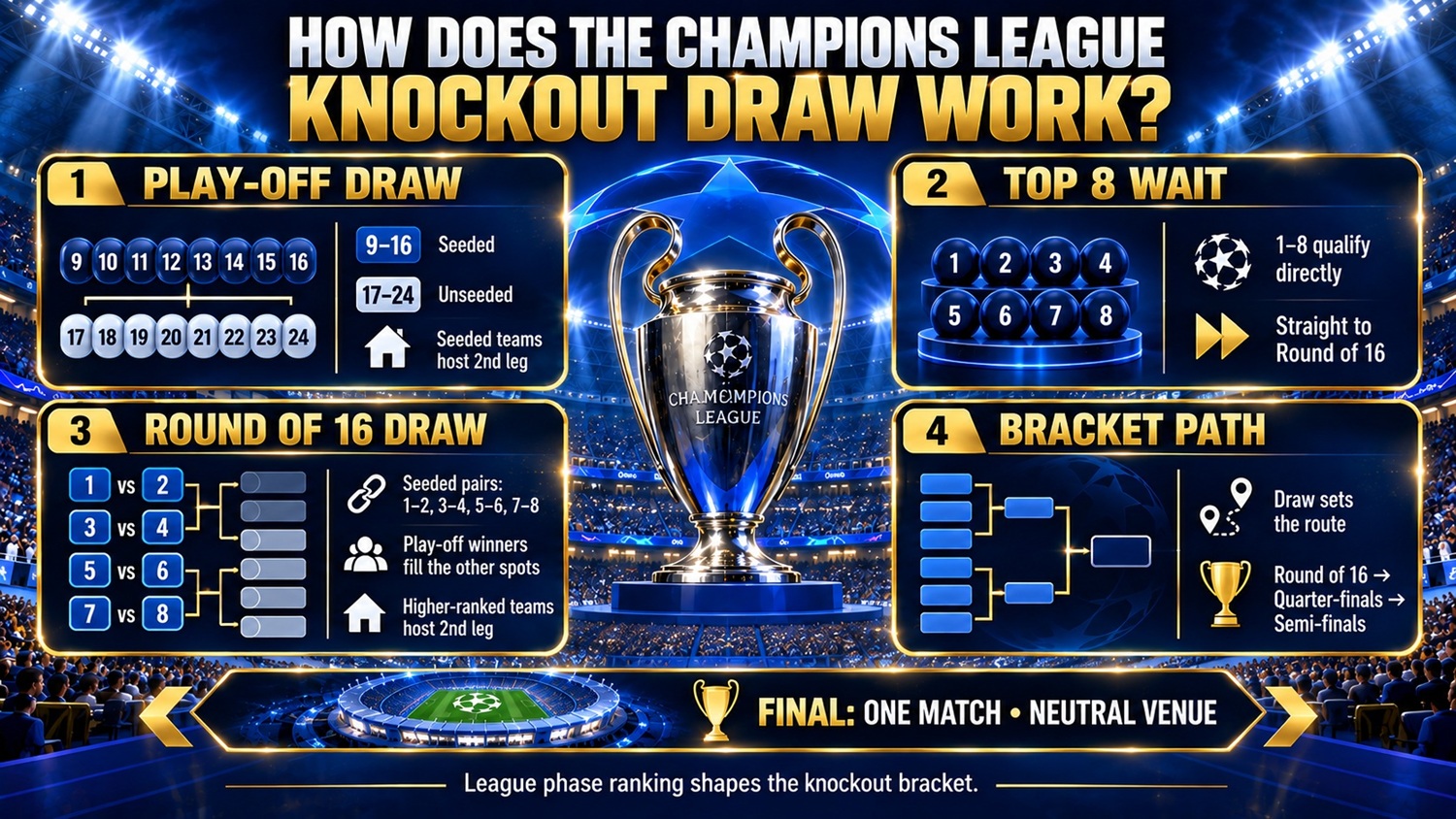
The UEFA Champions League knockout draw is closely connected to the final league-phase standings. It is not an open draw where every qualifying club can face any other team.
Instead, clubs enter predetermined areas of the knockout bracket according to where they finished in the 36-team league table. Teams ranked ninth to 24th first go through the knockout phase play-off draw.
The eight play-off winners then join the top eight in the round of 16, where another draw places the seeded clubs into their bracket positions. From that point, the routes through the quarter-finals and semi-finals are already determined.
In this guide, I will explain how the knockout draw works, which teams can face each other and why finishing higher in the league phase can affect a club's route all the way toward the final.
Read Also: How Does the Champions League Knockout Stage Work?
How Does League-Phase Position Affect the Knockout Draw?
The final league table is the starting point for the entire knockout bracket. After eight league-phase matches:
1st–8th: direct qualification for the round of 16
9th–24th: knockout phase play-offs
25th–36th: eliminated
But UEFA does not simply separate those three groups and forget the exact finishing positions. Each qualifying position helps determine where a club can enter the knockout bracket.
That is why finishing ninth instead of 16th, or first instead of eighth, can still matter even though those clubs qualify for the same general stage.
How Does the Knockout Phase Play-Off Draw Work?
The clubs finishing ninth to 24th are divided into seeded and unseeded pairs. The seeded positions are:
9th and 10th
11th and 12th
13th and 14th
15th and 16th
The unseeded positions are:
17th and 18th
19th and 20th
21st and 22nd
23rd and 24th
Those pairs are matched according to a predetermined structure:
9th or 10th vs 23rd or 24th
11th or 12th vs 21st or 22nd
13th or 14th vs 19th or 20th
15th or 16th vs 17th or 18th
The draw determines which specific club from one pair faces which club from the corresponding pair. I explain the round itself in What Is the Champions League Knockout Phase Play-Off?
A Simple Play-Off Draw Example
Imagine the league phase ends with:
9th — Club A
10th — Club B
23rd — Club C
24th — Club D
UEFA knows before the draw that these four clubs belong together. The draw can produce:
Club A vs Club C
Club B vs Club D
or:
Club A vs Club D
Club B vs Club C
Club A cannot suddenly draw a team that finished 17th because that position belongs to a different section of the bracket. So the league table has already reduced the possible opponents before a ball is drawn.
Read Also: Champions League Tiebreaker Rules Explained
Are Teams Ranked 9th to 16th Seeded?
Yes. Clubs finishing ninth to 16th are seeded in the knockout phase play-offs. In principle, the seeded team plays the second leg at home. That means league-phase performance can provide two benefits:
A higher-ranked opponent pairing.
Second-leg home status.
The seeded club is not guaranteed to progress, but the structure rewards the stronger league-phase finish.
Can Clubs From the Same Country Meet in the Play-Off Draw?
Yes. Once the Champions League reaches the knockout phase, clubs from the same national association can potentially meet.
For example, two English clubs can face each other if their league positions place them in corresponding bracket positions. The same applies to Spanish, Italian, German, French or other clubs.
This is different from the league-phase draw, where clubs from the same association are normally kept apart.
Read Also: How Do Champions League Pots and Seeding Work?
Can Teams Draw an Opponent They Already Played?
Yes. A club can face a team it already met during the league phase. The earlier match does not prevent a knockout rematch. This is another important difference from older Champions League draw systems.
Once the league-phase rankings have created the knockout bracket, the key factor is position rather than whether the teams have already played.
What Happens After the Knockout Phase Play-Offs?
Eight clubs survive the play-offs. They join the eight clubs that finished first to eighth in the league phase. That gives the round of 16 8 direct qualifiers plus 8 play-off winners for a total of 16 clubs.
UEFA then holds the round-of-16 draw. However, this is not an open draw either. The top-eight clubs are again grouped according to their league-phase positions.
How Does the Round-of-16 Draw Work?
The eight direct qualifiers form four seeded pairs:
1st and 2nd
3rd and 4th
5th and 6th
7th and 8th
Each pair is connected to specific positions already created by the knockout phase play-off draw. UEFA then draws each of the two seeded clubs into one of those available positions.
For example, first and second do not have eight possible play-off winners. They enter the section of the bracket assigned to their seeded pair. The draw determines which club takes which side of that section. This means the route is partly predetermined by league position and partly decided by the draw.
Does First Place Have the Same Possible Opponents as Eighth Place?
No. First and eighth both qualify directly for the round of 16, but they belong to different seeded pairs. The pairings are:
1st–2nd
3rd–4th
5th–6th
7th–8th
Each pair connects to a different section of the knockout bracket. So finishing first rather than eighth can change which play-off winners a club can eventually face. That is one reason clubs still have an incentive to finish as high as possible even after securing a top-eight position.
Are the Top Eight Seeded in the Round of 16?
Yes. Clubs finishing first to eighth are seeded for the round of 16. In principle, they play the second leg at home. The play-off winners are effectively placed on the opposite side of those round-of-16 ties. This is another reward for finishing directly inside the top eight rather than progressing through the play-offs.
Is There a New Draw for the Quarter-Finals?
Not in the traditional sense of placing all eight quarter-finalists back into one unrestricted draw. The quarter-final routes are already determined by the bracket. Once the round-of-16 positions are established, the winners move into predetermined quarter-final ties.
UEFA's regulations define those pairings through the competition bracket. That means a club reaching the quarter-finals can already see which two round-of-16 teams could provide its next opponent. There is no completely fresh open draw that resets the competition.
Is There a New Draw for the Semi-Finals?
The same principle applies. The semi-final routes are already established by the bracket. The winner of one quarter-final progresses into the corresponding semi-final position.
So once the round-of-16 draw has established the knockout bracket, the broader route toward the final is effectively known. The teams still have to win their matches, but the possible pathways are visible.
Why Does the Knockout Bracket Matter?
The bracket means league-phase position can affect more than a club's next opponent. It can influence an entire potential route. Imagine Club A finishes first. Before playing its round-of-16 tie, it can already identify:
the limited group of teams it could face in the round of 16
which ties feed into its quarter-final
which side of the semi-final bracket it occupies
The exact future opponents depend on who wins each tie, but the route itself is no longer completely random. That makes the league-phase standings part of the knockout competition rather than simply a qualification table.
How Does Second-Leg Home Advantage Work?
League-phase rankings can also determine which club plays the return leg at home. Under the 2026/27 rules:
Knockout phase play-offs: Teams ranked 9th–16th play the second leg at home in principle.
Round of 16: Teams ranked 1st–8th play the second leg at home in principle.
Quarter-finals: Bracket positions belonging to teams ranked 1st–4th receive the second leg at home.
Semi-finals: Bracket positions belonging to teams ranked 1st–2nd receive the second leg at home.
This gives the highest league-phase positions advantages that can extend much further than the first knockout round.
What Happens If a Seeded Club Is Eliminated?
The seeding position stays with the bracket. The team that eliminates the seeded club inherits that position. For example, imagine the club that finished first in the league phase is knocked out.
Its opponent then takes over the first-placed club's position in the bracket. If that position carries second-leg home status in a later round, the team that caused the upset inherits that benefit.
UEFA does not recalculate the competition based on the surviving clubs' original league rankings. The bracket position is what matters.
A Simple Seeding Example
Imagine:
Club A finishes 1st
Club B finishes 14th
Club B progresses through the knockout play-offs and eventually faces Club A. Club B eliminates Club A. Club B does not continue through the competition as if it were still the 14th-ranked club for seeding purposes.
It takes over Club A's bracket position. That position can carry the advantages originally attached to first place. This prevents UEFA from having to redraw or reseed the tournament after every upset.
Are Quarter-Final and Semi-Final Opponents Completely Random?
No. This is one of the most useful things to understand about the current Champions League. The early knockout draws build the bracket. Once that structure is established, teams advance through it.
The quarter-finals and semi-finals are therefore not unrestricted lotteries involving every remaining club. Your future opponent comes from the neighboring tie in your section of the bracket. This creates a system more similar to a traditional tournament bracket.
Can Same-Country Teams Meet in the Quarter-Finals or Semi-Finals?
Yes. There is no general protection keeping teams from the same national association apart at these stages. If the bracket produces an all-English, all-Spanish, all-Italian or another same-country matchup, the tie can take place.
The same applies to teams that have already met earlier in the Champions League. Once the knockout bracket is established, those previous relationships do not prevent another meeting.
Does UEFA Use Club Coefficients for the Knockout Draw?
Not to decide the knockout bracket in the same way as league-phase pot placement. The key ranking for the knockout draw is the club's league-phase finishing position. This is different from the league-phase draw, where UEFA club coefficients determine the four pots.
Once the league phase has been played, current Champions League performance takes over. A club that began in Pot 4 but finishes second receives the knockout position associated with second place. A Pot 1 club finishing 20th receives the position associated with 20th. The original draw pot no longer protects it.
Is the Knockout Draw the Same as the League-Phase Draw?
No. The two draws solve completely different problems.
League-phase draw
Determines eight league-phase opponents.
Uses four coefficient-based pots.
Each club receives two opponents from every pot.
Knockout draw
Uses final league-phase ranking.
Places clubs into predetermined bracket positions.
Determines specific knockout ties and routes through the bracket.
I explain the earlier process in How Does the Champions League Draw Work?
Why Is Finishing First Better Than Simply Finishing in the Top Eight?
Both positions avoid the knockout phase play-offs, but first place carries a stronger bracket position.
Under the current system, the first- and second-placed bracket positions retain second-leg home status as far as the semi-finals. Third and fourth retain that advantage through the quarter-finals. Fifth to eighth receive it in the round of 16.
That creates several levels of reward within the top eight rather than treating all eight positions identically. So the league phase is not simply a race to finish eighth. There can still be value in climbing higher.
Common Champions League Knockout Draw Misunderstandings
There are several points I think are worth clearing up.
The knockout draw is not completely open. League-phase positions determine the bracket.
Teams finishing ninth to 16th are seeded in the play-offs.
The top eight are seeded in the round of 16.
League position limits possible opponents before the draw begins.
Teams from the same country can meet in the knockout phase.
Clubs can face teams they already played during the league phase.
There is no completely new open draw before every later round. The quarter-final and semi-final routes come from the established bracket.
Higher league positions can provide second-leg home advantages beyond the round of 16.
If a seeded club is eliminated, its opponent inherits that bracket position.
League-phase draw pots no longer decide knockout seeding. Final league position does.
Champions League Knockout Draw at a Glance
The easiest way I understand the system is:
League phase ends
↓
1st–8th → Round of 16
9th–24th → Knockout phase play-offs
↓
Play-off positional pairs:
9/10 vs 23/24
11/12 vs 21/22
13/14 vs 19/20
15/16 vs 17/18
↓
8 play-off winners
↓
Join:
League positions 1–8
↓
Round-of-16 seeded pairs:
1/2
3/4
5/6
7/8
↓
Round-of-16 draw completes the bracket positions
↓
Quarter-final route predetermined
↓
Semi-final route predetermined
↓
Final
Final Thoughts
The Champions League knockout draw makes the league phase much more important than simply deciding who qualifies. Every finishing position helps place a club somewhere in the knockout structure.
Teams ranked ninth to 24th enter specific play-off pairings. The top eight enter predetermined round-of-16 sections. Once those draws are complete, the quarter-final and semi-final routes follow the established bracket.
The result is a system where clubs can increasingly see their potential path to the final. Higher league positions can also provide second-leg home advantages, and those advantages remain attached to the bracket even if the original seeded team is eliminated.
For me, the simplest way to understand the current system is that the league phase builds the knockout bracket. The draws add the final details, but much of the structure has already been decided by where each club finished after its eight league-phase matches.