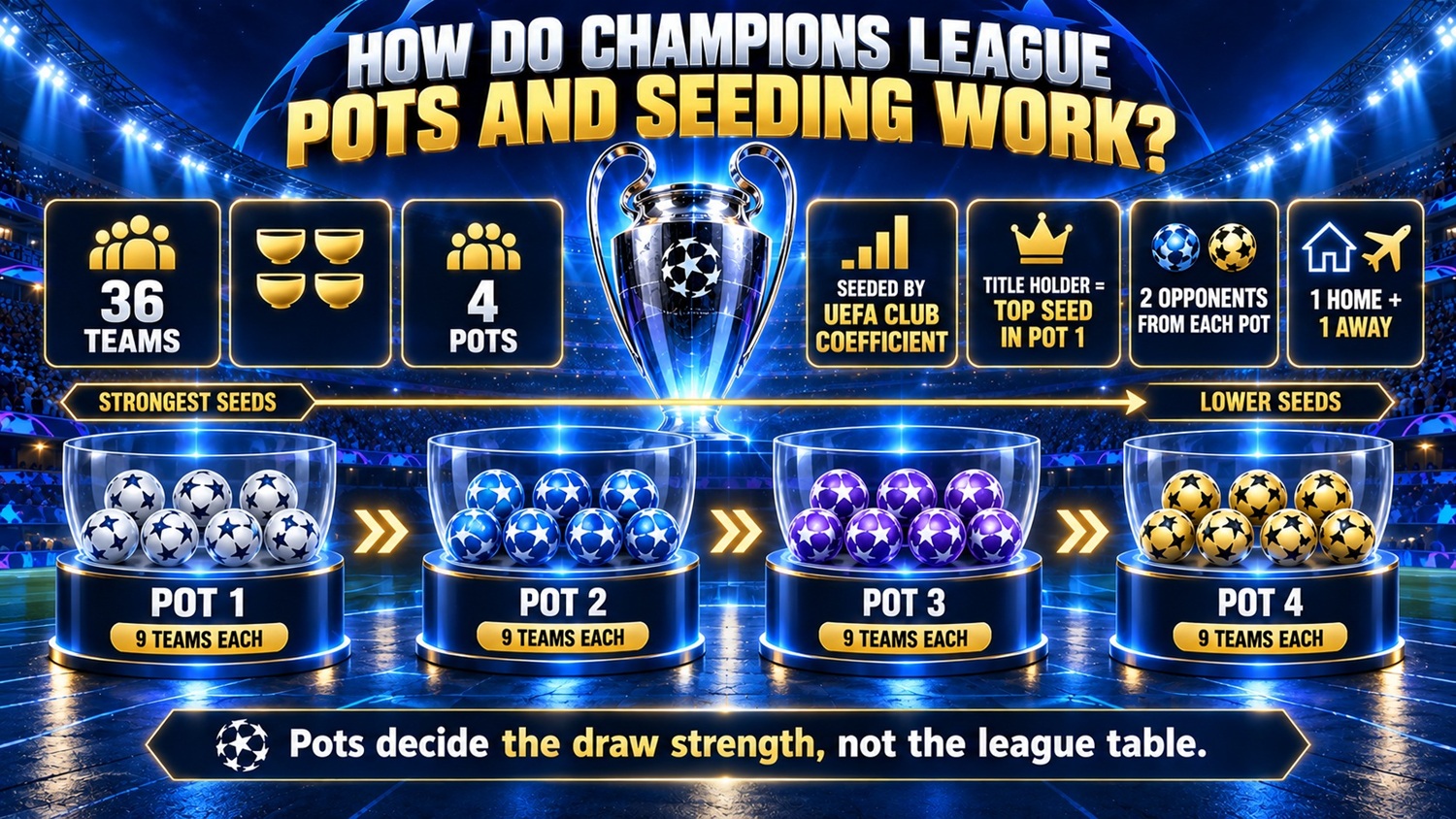
UEFA Champions League pots and seeding are closely connected, but they do not work the same way throughout the competition. For the league phase, UEFA divides the 36 clubs into four pots of nine, mainly according to UEFA club coefficients. However, being in Pot 1 no longer means avoiding the other Pot 1 clubs.
Every club plays two opponents from each of the four pots. Qualifying rounds work differently. There, clubs are normally separated into seeded and unseeded teams, and that status can directly affect which opponents they can draw.
In this guide, I will explain how the Champions League pots are decided, what UEFA club coefficients have to do with them and what being seeded actually means.
Read Also: How Does the Champions League League Phase Work?
How Many Champions League Pots Are There?
There are four pots for the Champions League league-phase draw. Each contains nine clubs:
Pot 1: 9 clubs
Pot 2: 9 clubs
Pot 3: 9 clubs
Pot 4: 9 clubs
That accounts for all 36 league-phase teams. The clubs are placed into these pots before the league-phase draw takes place. However, the pots do not create four separate sections of the competition. All 36 teams eventually compete in the same overall league table.
How Are the Champions League Pots Decided?
The pots are mainly determined by the UEFA club coefficient ranking established at the beginning of the season. In simple terms, clubs with stronger recent records in UEFA competitions tend to have higher coefficients.
Those rankings are then used to order the league-phase participants. The highest-ranked clubs go into Pot 1, followed by Pot 2, Pot 3 and Pot 4. There is one important exception.
The reigning Champions League winner is automatically the top seed in Pot 1, regardless of where its club coefficient would otherwise place it. After that, the coefficient ranking determines the other positions.
What Is a UEFA Club Coefficient?
A UEFA club coefficient is a ranking value based mainly on a club's performance in European competitions over several seasons. For the 2026/27 competition, UEFA's five-season club coefficient uses results from:
2021/22
2022/23
2023/24
2024/25
2025/26
UEFA adds together the club's season coefficients across that five-season period. Under the current calculation, a club's five-season coefficient is either:
the total of its own five season coefficients, or
20% of its association's five-season coefficient
whichever is higher. European results therefore build a club's coefficient over time.
That is why a club with a strong recent history in UEFA competitions can be ranked above another club even if the second club performed better domestically in the most recent season. I will explain the coefficient calculation in more detail in How Do UEFA Coefficients Work?
Read Also: How Do the Champions League Qualifying Rounds Work?
Does Domestic League Position Decide a Club's Pot?
No. Domestic league performance can qualify a club for the Champions League, but it does not normally determine which league-phase pot the club enters. That is an important distinction.
A club could win its domestic league but still enter a lower Champions League pot if its UEFA club coefficient is relatively low. Another club could finish below first place domestically but enter Pot 1 because it has accumulated a much stronger European coefficient.
So there are two separate questions:
How did the club qualify for the Champions League? and
Where is the club seeded once it gets there?
Domestic performance is central to the first question. The UEFA club coefficient is central to the second.
What Did the 2026/27 Champions League Pots Look Like?
The 2026/27 draw provides a useful example. Pot 1 contained:
Paris Saint-Germain
Bayern München
Real Madrid
Liverpool
Inter
Manchester City
Arsenal
Barcelona
Atlético de Madrid
Those clubs were followed by another nine teams in Pot 2, then nine in Pot 3 and nine in Pot 4. Some familiar clubs appeared further down the pots because current domestic strength alone does not determine the ranking.
For example, Napoli were in Pot 3 for the 2026/27 draw, while Stuttgart were in Pot 4. That illustrates why the pots should not simply be read as a ranking of which teams are strongest right now. They reflect UEFA's coefficient system.
Read Also: Champions Path vs League Path: What's the Difference?
Does Being in Pot 1 Mean You Avoid the Other Pot 1 Teams?
No. This is probably the most important thing to understand about Champions League pots under the current format. Every club receives:
two opponents from Pot 1
two opponents from Pot 2
two opponents from Pot 3
two opponents from Pot 4
That applies to everyone. A Pot 1 club therefore plays two other Pot 1 clubs. A Pot 4 club also plays two Pot 1 clubs. This is very different from the old Champions League group stage.
Under the previous system, one club from each pot was normally placed into a group. A Pot 1 team therefore could not face another Pot 1 team in that group. The current league phase removed that protection. I explain the complete opponent-selection process in How Does the Champions League Draw Work?
Does Being in Pot 1 Give a Team an Easier League-Phase Draw?
Not automatically. This is another area where the old understanding of Champions League seeding can cause confusion. Because every club plays two teams from every pot, being placed in Pot 1 does not mean a club gets to replace difficult Pot 1 opponents with easier teams. A Pot 1 club still has:
two Pot 1 opponents
two Pot 2 opponents
two Pot 3 opponents
two Pot 4 opponents
A Pot 4 club gets exactly the same distribution. The difficulty comes from which specific clubs are selected from those pots.
For example, two teams might both receive two Pot 1 opponents, but the identities of those opponents can make their schedules look very different. So I would not describe Pot 1 as an automatic easy-draw advantage under the current league-phase system.
Then Why Do the Pots Still Matter?
The pots still provide structure to the draw. Without them, a club could theoretically receive eight opponents from the highest-ranked part of the field while another received eight from much lower down the coefficient ranking.
The four-pot system ensures every club gets opponents from across the coefficient range. Each team's eight-match schedule includes exactly two clubs from each pot. The pots therefore help distribute the field. They do not guarantee that every schedule will have the same difficulty.
What Does “Seeded” Mean in Champions League Qualifying?
Seeding has a more traditional effect during the Champions League qualifying rounds. UEFA uses club coefficients to divide clubs into:
seeded teams
unseeded teams
A draw between the seeded and unseeded sides then determines the qualifying ties. This can directly affect a club's possible opponents. For example, if FC Example is seeded, it is normally drawn against a club from the unseeded side of that qualifying draw rather than another seeded club.
That makes qualifying-round seeding different from league-phase pot placement. In qualifying:
Seeded status helps determine the opponent pool.
In the league phase:
Pot placement helps create the mix of eight opponents, but every club still faces two teams from every pot.
How Is Qualifying Seeding Decided?
UEFA uses the club coefficient ranking established at the beginning of the season. The clubs involved in a qualifying draw are separated into the required number of seeded and unseeded teams.
UEFA can also create smaller draw groups before conducting the draw. The purpose is to organise the participating clubs while following the competition's draw procedures.
If the identity of a qualifying participant is not yet known because an earlier tie has not finished, UEFA uses the higher coefficient of the two clubs still involved in that unresolved tie for draw purposes. So coefficients can have a very practical effect before the league phase even begins.
Does Being Seeded Guarantee an Easier Qualifying Opponent?
No. Being seeded limits which clubs a team can draw under that particular draw structure, but it does not guarantee an easy match. An unseeded club can still be very strong.
A team's coefficient reflects European performance over several seasons, not a perfect measurement of its current squad quality. A club may have:
improved significantly
changed manager
signed stronger players
returned to Europe after an absence
declined since earning many of its coefficient points
So seeding affects the draw structure, but it does not decide the match.
Can a New or Improving Club Have a Low Coefficient?
Yes. Because coefficients are based on several seasons of European results, a club experiencing a recent rise can still have a relatively modest ranking. Imagine a club qualifies for the Champions League after suddenly becoming one of the strongest teams in its domestic competition.
If it has little recent European history, it may not have accumulated many UEFA coefficient points. That club could therefore enter a lower pot despite being very competitive on the pitch.
This is one reason I do not treat Pot 4 as meaning "the weakest nine teams." It means those clubs occupy the lowest coefficient positions among that season's league-phase participants, subject to the titleholder rule. That is not exactly the same thing as current football strength.
Can a Club's Pot Change From One Season to the Next?
Yes. Champions League pots are not permanent. A club's coefficient changes as seasons move in and out of the five-season reference period and new European results are added.
A club that performs consistently well in Europe can improve its ranking. A club that stops qualifying for European competitions or has several poor campaigns can eventually fall.
The other teams qualifying for that particular Champions League also matter. A coefficient that is high enough for Pot 2 in one season might produce a different pot placement in another season depending on the other 35 participants.
Do Champions League Qualifying Matches Add to the Club Coefficient?
UEFA awards coefficient points across its club competitions, including qualifying under the relevant rules. However, coefficient calculations have their own points and bonus system and should not be confused with the normal league standings.
For example, the three points a club earns for winning a Champions League league-phase match are competition-table points. UEFA's coefficient system uses its own calculation rules for ranking purposes. I cover those differences in How Do UEFA Coefficients Work?
Is the Association Coefficient the Same as the Club Coefficient?
No. This is another important distinction.
Club coefficient
This relates to an individual club's European performance. It can affect:
qualifying-round seeding
league-phase pot placement
certain access-list rebalancing situations
Association coefficient
This measures the collective European performance of clubs from a national association. It helps determine things such as:
how many European places an association receives
where those clubs enter UEFA competitions
the association's position in the Champions League access list
So if I am asking:
Why is this club in Pot 2?
I should mainly look at its club coefficient.
If I am asking:
Why does this country receive this number of Champions League places?
I should mainly look at its association coefficient. They serve different purposes.
Does League-Phase Pot Seeding Affect the Knockout Stage?
Not directly. Once the league phase begins, the important ranking becomes the club's league-phase finishing position. The four pots do not carry forward into the knockout rounds.
For example, a Pot 4 club that finishes third in the league phase is treated according to its third-place league finish when the knockout bracket is formed. A Pot 1 club that finishes 20th enters the knockout phase play-offs based on finishing 20th.
Its original Pot 1 status does not protect it. The league-phase standings therefore replace the original draw pots as the important seeding information. I explain how those finishing positions shape the later bracket in How Does the Champions League Knockout Draw Work?
A Simple Example
Imagine four fictional teams:
Club A — Pot 1
Club B — Pot 2
Club C — Pot 3
Club D — Pot 4
Each club still needs:
two Pot 1 opponents
two Pot 2 opponents
two Pot 3 opponents
two Pot 4 opponents
So Club A does not receive a completely different type of schedule simply because it is in Pot 1. Now imagine Club D performs brilliantly and finishes fourth in the league phase.
Club A struggles and finishes 18th. From that point, Club D's fourth-place league finish matters more for the knockout structure than its original Pot 4 placement.
Club A's historical coefficient cannot rescue it from the consequences of finishing 18th. That example shows the difference between pre-competition seeding and performance during the competition.
Common Champions League Pots and Seeding Misunderstandings
There are several points I think are useful to remember.
Pot 1 does not mean a club avoids other Pot 1 clubs. Every team faces two opponents from every pot.
Domestic champions are not automatically placed in Pot 1. Pot placement is mainly based on UEFA club coefficients, apart from the Champions League titleholder.
Pot 4 does not necessarily contain the nine weakest teams. It contains the lowest coefficient-ranked teams among that season's participants.
A higher pot does not automatically mean an easier league-phase schedule. Every club gets the same two-opponents-per-pot structure.
League-phase pots and qualifying-round seeding are not the same thing. Qualifying uses seeded and unseeded groups to determine potential ties.
The pots do not follow clubs into the knockout stage. League-phase finishing position becomes the important ranking.
Club coefficient and association coefficient are different. One ranks individual clubs; the other helps determine national association access.
Champions League Pots and Seeding at a Glance
The simplest way I understand it is:
Before the league phase:
36 teams
Ranked mainly by UEFA club coefficient
Four pots of nine
The Champions League holder is the top seed in Pot 1.
Then every club receives:
2 Pot 1 opponents
2 Pot 2 opponents
2 Pot 3 opponents
2 Pot 4 opponents
During qualifying:
Higher club coefficients → seeded status where applicable
Seeded and unseeded clubs are then paired according to the draw procedure.
Once the league phase starts:
Actual league results determine what happens next.
The original pots no longer decide who qualifies or where a club finishes.
Final Thoughts
Champions League pots are easier to understand once I separate them from the old group-stage idea of seeding. Under the current league-phase format, Pot 1 does not give a club protection from the other highest-ranked teams.
Every club plays two opponents from every pot. The pots mainly provide structure by making sure each team receives opponents from across the coefficient ranking.
Qualifying-round seeding works differently because seeded and unseeded clubs are separated when ties are drawn, making a club's coefficient more directly relevant to its possible opponents. The UEFA club coefficient sits behind both systems, but once the league phase begins, historical ranking only takes a club so far.
What ultimately matters is what happens on the pitch. League-phase results determine whether a club finishes in the top eight, enters the knockout phase play-offs or is eliminated — regardless of whether it started the competition in Pot 1 or Pot 4.