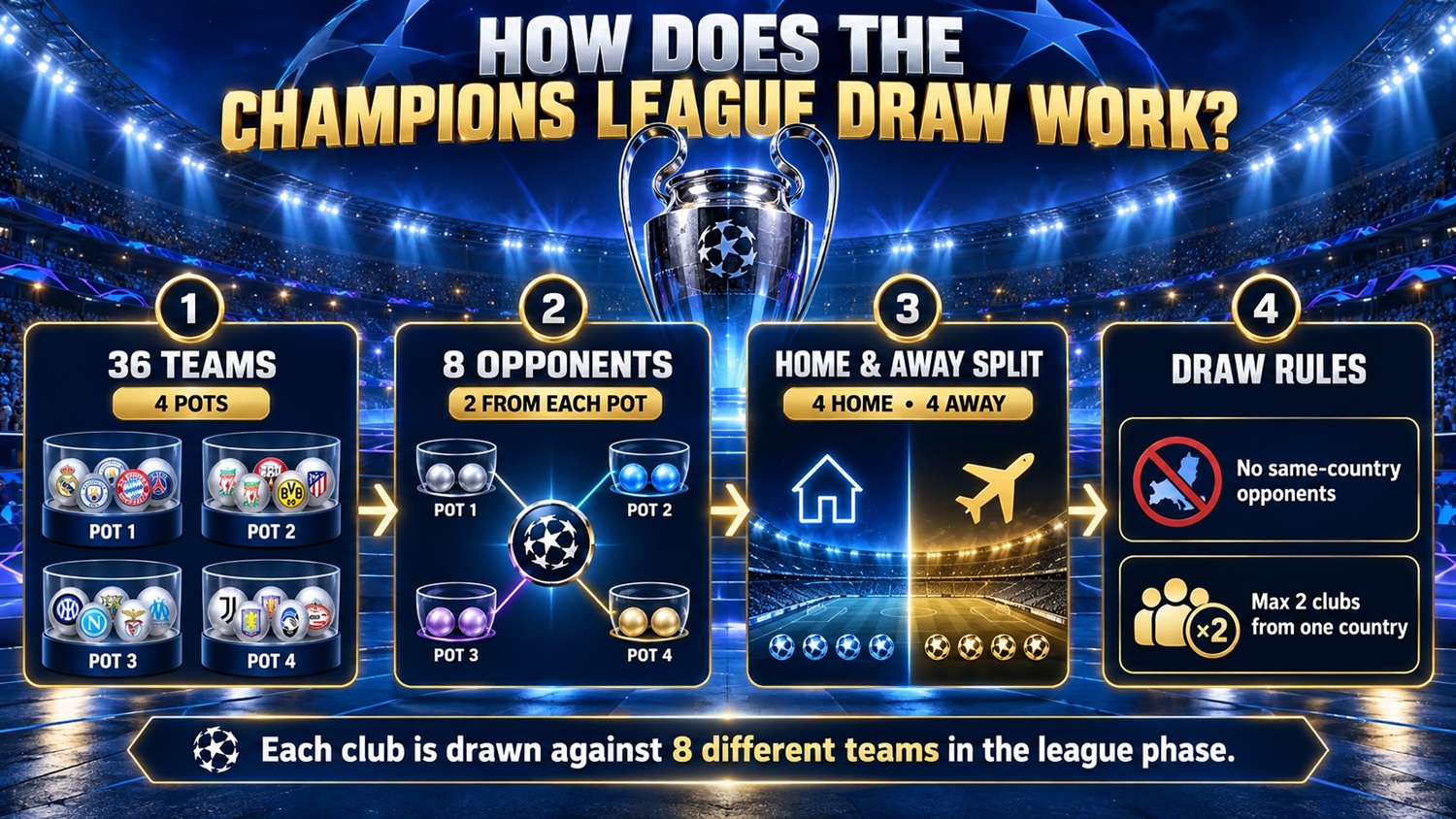
The UEFA Champions League draw no longer places clubs into traditional four-team groups. Under the current format, 36 clubs enter one league phase, and each team needs eight different opponents.
To create those matchups, UEFA divides the clubs into four pots of nine teams. Every club then receives two opponents from each pot, with one played at home and the other away.
The process is partly manual and partly digital because UEFA has to create 144 league-phase matches while respecting several draw restrictions at the same time.
In this guide, I will explain how the Champions League league-phase draw works, what the four pots mean, how the software-assisted process works and why being in Pot 1 does not mean avoiding the other strongest-seeded clubs.
How Many Teams Are in the Champions League Draw?
The league-phase draw contains 36 clubs. Before the draw, UEFA divides them into:
Pot 1: 9 clubs
Pot 2: 9 clubs
Pot 3: 9 clubs
Pot 4: 9 clubs
The pots are mainly determined by each club's UEFA club coefficient at the beginning of the season. The Champions League titleholder is the exception because it is placed as the top seed in Pot 1.
The purpose of the pots is to help distribute each club's eight opponents across different seeding levels. They do not create separate groups. I explain the coefficient and seeding system in more detail in How Do Champions League Pots and Seeding Work?
How Many Opponents Does Each Club Get?
Every club receives eight different league-phase opponents. Those eight are divided evenly across the four pots:
two from Pot 1
two from Pot 2
two from Pot 3
two from Pot 4
For each pot, the club plays:
one opponent at home
one opponent away
So the final schedule contains:
4 home matches + 4 away matches = 8 league-phase matches
The same opponent is not played twice during the league phase.
This is completely different from the old group stage, where a club faced three opponents both home and away.
Can a Pot 1 Team Draw Another Pot 1 Team?
Yes. This is one of the biggest differences between the current Champions League format and the old group stage. Under the previous system, clubs in the same seeding pot could not be placed in the same group.
That meant a Pot 1 club avoided all the other Pot 1 clubs during the group stage. That is no longer how the pots work. Every team now receives two opponents from every pot, including its own. So a Pot 1 club will play:
two Pot 1 teams
two Pot 2 teams
two Pot 3 teams
two Pot 4 teams
A Pot 4 club follows the same pattern. This means being in Pot 1 can still be valuable for how a club is ranked and seeded, but it does not protect that team from playing other Pot 1 opposition.
Why Are There Four Pots?
The four pots help create a spread of opponents for every club. Without pots, one team could theoretically receive an unusually difficult set of eight opponents while another receives a much lighter schedule.
The current system instead ensures that every club gets two opponents from each seeding level. That does not mean every schedule is equally difficult. Two clubs can still receive very different opponents.
For example, two Pot 2 teams will each play two Pot 1 opponents, but one may draw a particularly strong pair while the other receives a different combination. The pots create structure, not identical schedules.
How Does the Actual Draw Work?
The current Champions League league-phase draw is carried out using a combination of physical balls and automated software. Four bowls are prepared, one for each pot. Each bowl contains nine balls representing the nine clubs in that pot.
The draw begins with Pot 1. A club is physically drawn from the bowl. Once that club is revealed, UEFA's automated draw software selects its eight opponents:
two from Pot 1
two from Pot 2
two from Pot 3
two from Pot 4
The software also determines which four opponents are played at home and which four are played away. The result is then displayed before the draw moves to the next club.
Why Does UEFA Use Software for the Draw?
The main reason is the number of combinations and restrictions involved. Under the old group-stage format, drawing one club into one group was relatively straightforward. The current format is more complicated.
Each of the 36 clubs needs eight opponents while UEFA must also make sure the entire draw remains possible for every team still waiting to be allocated. The software therefore has to respect the draw conditions while preventing a situation in which later clubs can no longer receive a valid set of opponents.
For example, it has to consider:
the four-pot structure
home and away allocation
association restrictions
limits on opponents from the same foreign association
whether the remaining clubs can still receive valid schedules
This is why simply pulling eight names from a bowl would not be practical.
Is the Champions League Draw Fully Computerised?
No. The process combines manual and digital elements. The club being processed is selected using a physical ball from the relevant pot. The automated software then randomly selects that club's valid opponents and determines which matches are at home or away.
For the 2026/27 draw, UEFA stated that the entire manual and digital process was reviewed and checked by an appointed external auditor. So the current system keeps the traditional physical draw while using software to manage the much more complicated opponent allocation.
How Does the Draw Move Through the Four Pots?
UEFA processes the pots in order.
Pot 1
A Pot 1 club is physically drawn. The software assigns all eight of its opponents and the home-and-away positions. That process continues for the remaining Pot 1 teams.
Pot 2
By the time UEFA reaches Pot 2, some opponents have already been determined through the Pot 1 selections. The software therefore only needs to complete the remaining opponent allocations.
Pot 3
The same principle applies. A Pot 3 club will already have some of its opponents from the earlier pots, so the software completes the outstanding selections.
Pot 4
By the time Pot 4 is processed, many relationships are already fixed. The software completes the remaining valid pairings. This is why the draw becomes progressively more constrained as it moves from Pot 1 to Pot 4.
Can Two Clubs From the Same Country Play Each Other?
In principle, clubs from the same national association cannot be drawn against each other during the league phase. For example, an English club would not normally draw another English club among its eight league-phase opponents.
The same principle applies to clubs from Spain, Italy, Germany and every other association. However, UEFA's regulations allow the administration to adapt draw conditions where necessary to avoid a deadlock or deal with other relevant constraints.
So the rule is best understood as the normal league-phase draw principle rather than an unconditional rule that can never have an exception. Once the Champions League reaches the knockout phase, the situation changes and clubs from the same country can potentially meet.
How Many Teams From One Country Can a Club Face?
A club can normally face a maximum of two opponents from any one other association during the league phase. For example, a Spanish club could potentially receive two English opponents among its eight matches.
It would not normally receive three. This restriction helps prevent a club's league-phase schedule from becoming too concentrated around teams from one country. Again, UEFA can adapt draw conditions where necessary to keep the entire allocation workable.
Is Home or Away Decided Separately?
The home-and-away status is determined as part of the draw. Every club must receive:
one home opponent from Pot 1
one away opponent from Pot 1
one home opponent from Pot 2
one away opponent from Pot 2
one home opponent from Pot 3
one away opponent from Pot 3
one home opponent from Pot 4
one away opponent from Pot 4
That creates four home fixtures and four away fixtures. A club cannot simply receive eight opponents first and then choose where to play them. The home-and-away allocation is built into the draw.
Does the Draw Decide the Match Dates?
Not immediately. The draw determines:
the eight opponents
which four are played at home
which four are played away
UEFA then creates the detailed fixture schedule. That separate scheduling process decides:
the matchday for each fixture
whether the match is played on Tuesday or Wednesday
Thursday where applicable on the opening matchday
kick-off time
This means a club knows its opponents before it necessarily knows the exact order and dates of all eight matches. For the 2026/27 season, the league-phase draw took place on 27 August 2026, with UEFA confirming that the detailed fixture list would follow after the draw.
How Does UEFA Balance Home and Away Matches?
Each club receives four home and four away games through the draw. UEFA then applies scheduling principles when arranging those fixtures. In principle, a club should not play more than two consecutive league-phase matches at home or more than two consecutive matches away.
UEFA also aims to give every club:
one home and one away match across the first two matchdays
one home and one away match across the final two matchdays
Scheduling constraints can require exceptions, but these principles help prevent heavily unbalanced fixture sequences.
Does a Higher Pot Guarantee an Easier Draw?
No. A higher pot does not guarantee an easier schedule. Every club plays two opponents from every pot. The difference is that a club's own ranking determines which pot it occupies, but that pot does not remove opponents from the same level.
A Pot 1 team still faces two Pot 1 clubs. A Pot 4 team also faces two Pot 1 clubs. The exact difficulty depends on which specific teams are drawn from each pot. This is why I would not judge a club's league-phase schedule simply by saying it was in Pot 1 or Pot 4. The eight actual opponents matter more.
A Simple Draw Example
Imagine a fictional club called FC Example is placed in Pot 2. During the draw, it needs eight opponents.
The final allocation could look like this:
Pot 1: One opponent at home and One opponent away
Pot 2: One opponent at home and One opponent away
Pot 3: One opponent at home and One opponent away
Pot 4: One opponent at home and One opponent away
That gives FC Example:
eight different opponents
four home matches
four away matches
two opponents from every pot
Even though FC Example is in Pot 2, it still plays two other Pot 2 clubs. That is the key idea behind the current draw.
Why Don't All Teams Have the Same Schedule?
Because the Champions League league phase is not a complete round-robin competition. There are 36 clubs, but each team plays only eight matches. It would be impossible for every team to face the same opponents while maintaining that structure.
The draw therefore gives each club its own eight-match schedule. All results still feed into one 36-team standings table. This means teams can finish level on points despite having faced completely different opponents.
UEFA then uses its tiebreaking criteria to separate clubs when necessary. I explain how those standings work in How Does the Champions League League Phase Work? and cover equal-points situations separately in Champions League Tiebreaker Rules Explained.
Does the Draw Determine the Knockout Stage Too?
No. The league-phase draw only determines the eight league-phase opponents. The knockout phase uses another draw and a different system. League-phase finishing positions determine where clubs can be placed in the knockout bracket.
For example:
positions 1–8 qualify directly for the round of 16
positions 9–24 enter the knockout phase play-offs
positions 25–36 are eliminated
The knockout draw then uses those league positions to create possible pairings. I explain that separately in How Does the Champions League Knockout Draw Work?
Common Champions League Draw Misunderstandings
There are several points I think are especially useful to remember.
There are no traditional four-team groups. All 36 clubs compete in one league-phase table.
A club does not draw only one opponent from each pot. It receives two from every pot.
A team can face clubs from its own pot. Pot 1 teams play two Pot 1 opponents.
The eight opponents are not all drawn manually from bowls. The current process combines physical team selection with automated opponent allocation.
The software also determines home and away status. Each club gets one home and one away opponent from every pot.
Same-country clubs are normally kept apart during the league phase.
A club cannot normally face more than two teams from the same other national association.
The draw does not immediately provide the full fixture calendar. Exact dates and kick-off times are scheduled afterward.
Champions League Draw at a Glance
The easiest way I understand the draw is:
36 clubs
4 pots of 9
Each club gets:
2 Pot 1 opponents
2 Pot 2 opponents
2 Pot 3 opponents
2 Pot 4 opponents
From every pot:
1 home + 1 away
Final result:
8 opponents
4 home matches
4 away matches
Those eight games then determine where the club finishes in the 36-team league table.
Final Thoughts
The current Champions League draw may look more complicated than the old group-stage draw, but its basic idea is straightforward. UEFA places the 36 clubs into four pots of nine.
Every club must then receive two opponents from each pot, with one match at home and one away. The challenge is making all of those pairings work while respecting association restrictions and ensuring the remaining clubs can still receive valid schedules.
That is why the draw combines physical balls with automated software. The most important thing I keep in mind is that the pots no longer create groups. They create the balance behind each club's eight-match schedule.
Once those opponents are known, the next question is how the pots themselves are decided and what being seeded actually means. I cover that in How Do Champions League Pots and Seeding Work?