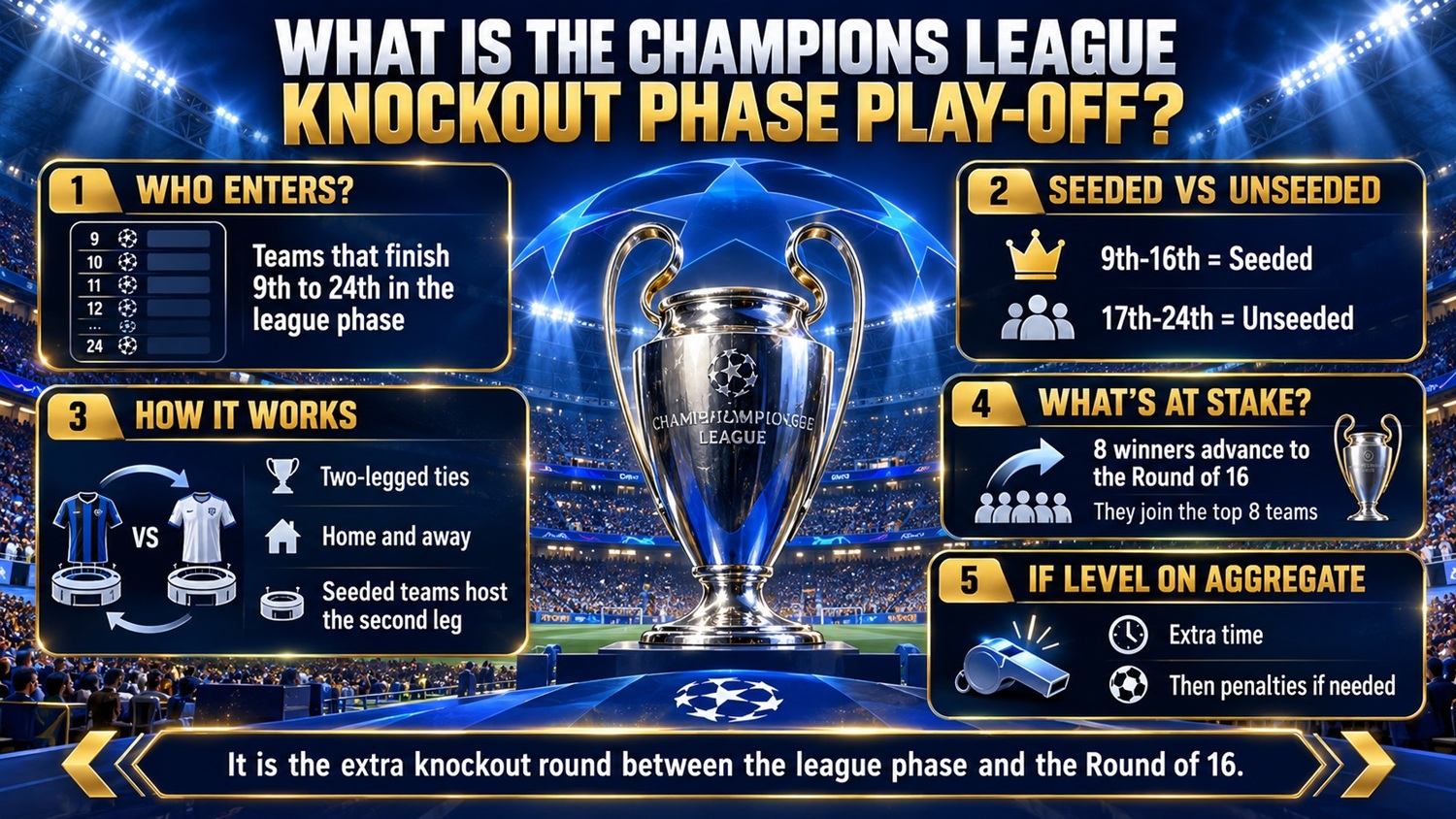
The UEFA Champions League knockout phase play-off is an extra two-legged round for clubs that finish between ninth and 24th in the league phase. The top eight avoid this round and qualify directly for the round of 16.
Teams ranked 25th to 36th are eliminated. That leaves 16 clubs competing in the knockout phase play-offs for the remaining eight places in the round of 16. However, the draw is not completely random. League-phase position determines which teams are seeded and limits the opponents they can face.
In this guide, I will explain how the knockout phase play-off works, why finishing ninth is different from finishing 24th and what happens after a club wins the tie.
Read Also: UEFA Champions League Explained: Format, Qualification and How It Works
Who Plays in the Champions League Knockout Phase Play-Off?
The clubs finishing ninth through 24th in the league phase enter the knockout phase play-offs. That gives UEFA 16 teams. They are divided into two broad groups:
9th–16th: seeded
17th–24th: unseeded
The eight winners progress to the round of 16. The eight losers are eliminated from European competition. So the league-phase outcomes can be summarized as:
1st–8th → Round of 16
9th–24th → Knockout phase play-offs
25th–36th → Eliminated
I explain how clubs reach those positions in How Does the Champions League League Phase Work?
Why Do the Top Eight Avoid the Play-Off?
Finishing in the top eight earns direct qualification for the round of 16. That is one of the biggest rewards available during the league phase. A team finishing eighth advances immediately.
A team finishing ninth has to play two additional Champions League matches and risks elimination before reaching the same stage.
This is why the difference between eighth and ninth is much more significant than a normal one-place movement in a league table. The top eight essentially receive a bye through the first knockout round.
How Are the Play-Off Teams Seeded?
The 16 clubs are divided according to their final league-phase positions. The seeded teams are:
9th
10th
11th
12th
13th
14th
15th
16th
The unseeded teams are:
17th
18th
19th
20th
21st
22nd
23rd
24th
However, UEFA does not simply put all eight seeded clubs in one bowl and all eight unseeded clubs in another. The finishing positions create smaller pairs that determine the possible matchups.
Read Also: How Do Champions League Pots and Seeding Work?
How Are the Knockout Phase Play-Off Pairings Decided?
UEFA groups the teams into paired league positions. The possible matchups are:
9th or 10th vs 23rd or 24th
11th or 12th vs 21st or 22nd
13th or 14th vs 19th or 20th
15th or 16th vs 17th or 18th
This means league position continues to matter even after a club has secured a play-off place. For example, the club finishing ninth cannot simply draw any team from positions 17 to 24.
Its possible opponents come specifically from the clubs finishing 23rd and 24th. Likewise, the club finishing 16th will face either the team finishing 17th or 18th.
Why Does Finishing Higher Matter?
The play-off structure rewards higher league-phase positions. Imagine two clubs both know they will finish outside the top eight. One eventually finishes ninth. The other finishes 16th.
Both must enter the play-offs, but their possible opponents come from different parts of the league table. The ninth-placed club can face a team ranked 23rd or 24th. The 16th-placed club can face a team ranked 17th or 18th.
This gives clubs a reason to keep pushing for the highest possible finish even when a top-eight position is no longer available. The same principle continues deeper into the knockout bracket. I explain the full structure in How Does the Champions League Knockout Draw Work?
Which Team Plays the Second Leg at Home?
In principle, the seeded team plays the second leg at home. That means clubs finishing ninth to 16th normally receive the return match at their own stadium.
For example, if the club finishing 10th is drawn against the club finishing 24th:
First leg: usually at the 24th-placed club's stadium
Second leg: usually at the 10th-placed club's stadium
Playing the second leg at home can be useful because the seeded club knows the exact aggregate situation it needs to manage in front of its own supporters. However, it does not guarantee progression. The result is still decided over both matches.
Read Also: How Does the Champions League Draw Work?
Are the Play-Offs Played Over Two Legs?
Yes. Each tie consists of:
first leg
second leg
One club plays at home in each match. The goals from both matches are added together. The club with the higher aggregate score advances to the round of 16.
For example:
First leg: Club A 2-1 Club B
Second leg: Club B 1-1 Club A
Aggregate:
Club A 3-2 Club B
Club A advances. The individual second-leg result does not matter on its own. The combined score across both matches decides the tie.
What Happens If the Aggregate Score Is Level?
If the aggregate score is level after 90 minutes of the second leg, the match goes to extra time. Two additional 15-minute periods are played. If the teams are still level after extra time, the tie is decided by a penalty shoot-out.
The away-goals rule does not apply. So if the aggregate score is 3-3, UEFA does not look at which club scored more goals away from home. The tie continues to extra time.
Read Also: How Do the Champions League Qualifying Rounds Work?
Can Teams From the Same Country Meet in the Play-Off?
Yes. The same-country restriction used during the league-phase draw no longer protects clubs in the knockout phase play-offs. Teams from the same national association can face each other.
For example, two English, Spanish, Italian, German or French clubs could be drawn together if their league-phase positions place them within the correct pairing. This is an important difference from the league phase.
During the league-phase draw, clubs from the same association are normally kept apart. That restriction does not apply in the same way once the knockout phase begins.
Can Teams Face an Opponent They Already Played in the League Phase?
Yes. A knockout phase play-off can repeat a league-phase matchup. There is no rule preventing two clubs from meeting again simply because they already played during the eight-match league phase.
For example, if Club A played Club B during the league phase and their final positions later place them within the correct play-off pairing, they can meet again. This is another change from some older Champions League draw restrictions.
Read Also: Champions Path vs League Path: What's the Difference?
Is the Play-Off Draw Completely Random?
No. There is still a draw, but the possible opponents are heavily shaped by final league position. Suppose a club finishes 10th. It does not have eight possible opponents. Its possible opponents are the clubs finishing:
23rd
24th
The draw determines which of those two it faces and where that tie sits in the knockout bracket. This makes the final league standings part of the knockout draw itself. The draw contains uncertainty, but league-phase performance has already narrowed the possibilities.
A Simple Play-Off Example
Imagine the final league standings include:
9th — Club A
10th — Club B
23rd — Club C
24th — Club D
UEFA treats:
Club A + Club B as one seeded pair.
Club C + Club D as the corresponding unseeded pair.
The draw then creates two ties from those four clubs. One possible outcome is:
Club A vs Club D
Club B vs Club C
Another possible outcome is:
Club A vs Club C
Club B vs Club D
Club A cannot suddenly draw the team finishing 18th because that club belongs to a different positional pairing. This is why finishing position matters before the draw even begins.
What Happens to the Eight Play-Off Winners?
They advance to the round of 16. There they join the eight clubs that finished at the top of the league phase. The round of 16 therefore contains 8 direct qualifiers from positions 1–8 plus 8 knockout phase play-off winners for a total of 16 clubs.
The play-off draw also helps determine which area of the knockout bracket each winner enters. That means the route toward later rounds begins taking shape before the play-off matches have even been completed.
Who Can a Play-Off Winner Face in the Round of 16?
The answer depends on where the clubs involved finished during the league phase. The top eight are grouped into seeded pairs:
1st and 2nd
3rd and 4th
5th and 6th
7th and 8th
The relevant play-off winners are then placed into corresponding positions in the round-of-16 bracket. So a play-off winner does not enter a completely fresh random draw against any of the top eight. Its route is connected to the league-phase positions that produced its play-off pairing.
This is one of the most important differences between the current knockout system and a traditional open draw. I cover the full bracket logic in How Does the Champions League Knockout Draw Work?
Are Play-Off Losers Moved to the Europa League?
No. If a club loses the Champions League knockout phase play-off, its European season is over. There is no Europa League drop-down.
This is different from Champions League qualifying, where an eliminated club can sometimes continue in the Europa League or Conference League depending on the stage.
Once the league phase has begun, clubs no longer transfer into another UEFA competition after elimination.
So:
Win knockout phase play-off → Round of 16
Lose knockout phase play-off → Eliminated from Europe
When Are the 2026/27 Knockout Phase Play-Offs?
For the 2026/27 Champions League, UEFA has scheduled the knockout phase play-offs for:
First legs: 16–17 February 2027
Second legs: 23–24 February 2027
The round of 16 then follows in March. That gives the top-eight clubs a clear scheduling advantage because they do not have to play these February ties. They can wait until the round of 16 while the other 16 qualifying clubs compete for the remaining places.
Is Ninth Place Better Than 10th?
Both ninth and 10th belong to the same seeded pair. That means they share the same possible opponent pair: 23rd and 24th. So for the immediate play-off draw, the distinction between ninth and 10th is not as large as the difference between 10th and 11th.
However, every league position contributes to the overall knockout bracket structure, and finishing higher can still matter when looking at the competition as a whole. The clearest structural steps are the paired positions:
9–10
11–12
13–14
15–16
and their corresponding unseeded pairs.
Is 16th Place Better Than 17th?
Yes, in a very clear way. Sixteenth is the final seeded play-off position. Seventeenth is the first unseeded position. That means:
16th: seeded and, in principle, plays the second leg at home.
17th: unseeded and, in principle, plays the first leg at home.
They can also potentially be drawn against each other because positions 15–16 are paired against positions 17–18. So just like eighth versus ninth and 24th versus 25th, the difference between 16th and 17th carries a real consequence.
Why Was the Knockout Phase Play-Off Introduced?
The play-off exists because the current Champions League league phase sends 24 of its 36 clubs into the knockout phase. UEFA needs to reduce those 24 teams to 16. The top eight receive direct passage to the round of 16. The remaining 16 qualifying clubs therefore contest eight play-off ties.
After those ties 8 top-eight clubs + 8 play-off winners = 16 round-of-16 clubs. The play-off is essentially the bridge between the 36-team league phase and the traditional 16-team knockout stage.
Is the Knockout Phase Play-Off the Same as Champions League Qualifying Play-Offs?
No. The names are similar, but they happen at completely different points in the competition.
Champions League qualifying play-offs
These take place before the league phase. Winning earns entry into the 36-team league phase. Losing sends the club into the Europa League league phase under the current system.
Champions League knockout phase play-offs
These take place after the league phase. They involve teams finishing ninth to 24th. Winning earns a place in the round of 16. Losing means elimination from Europe. So whenever I refer to a Champions League "play-off," it is important to identify which stage I mean.
Common Knockout Phase Play-Off Misunderstandings
There are several points I think are worth remembering.
The top eight do not play this round. They qualify directly for the round of 16.
Only positions nine to 24 participate.
Ninth to 16th are seeded. Seventeenth to 24th are unseeded.
The draw is not open. League positions determine the possible opponents.
A team finishing ninth or 10th can only face 23rd or 24th.
Seeded clubs normally play the second leg at home.
Teams from the same country can meet.
Clubs can face teams they already played during the league phase.
The away-goals rule does not apply.
Play-off losers do not drop into the Europa League. They are eliminated from European competition.
Champions League Knockout Phase Play-Off at a Glance
The easiest way I understand the round is:
League phase ends
↓
1st–8th → Direct to round of 16
↓
9th–24th → Knockout phase play-offs
↓
Seeded:
9th–16th
Unseeded:
17th–24th
↓
Possible pairings:
9/10 vs 23/24
11/12 vs 21/22
13/14 vs 19/20
15/16 vs 17/18
↓
Two-legged ties
↓
8 winners → Round of 16
8 losers → Eliminated
Final Thoughts
The Champions League knockout phase play-off makes the final league standings much more important than simply deciding which 24 clubs survive. Finishing ninth to 16th gives a club seeded status and, in principle, the second leg at home.
Finishing lower changes the possible opponent pool, while dropping below 24th means elimination altogether. The draw is therefore only partly random. By the time UEFA conducts it, the league phase has already determined which small group of opponents each club can face.
That gives the eight league matches greater importance. A club is not only trying to reach the top 24. It is trying to finish as high as possible, avoid the play-offs entirely if it can, or at least earn a better position within them.
The eight winners then join the league phase's top eight in the round of 16, where the Champions League moves deeper into its predetermined knockout bracket.