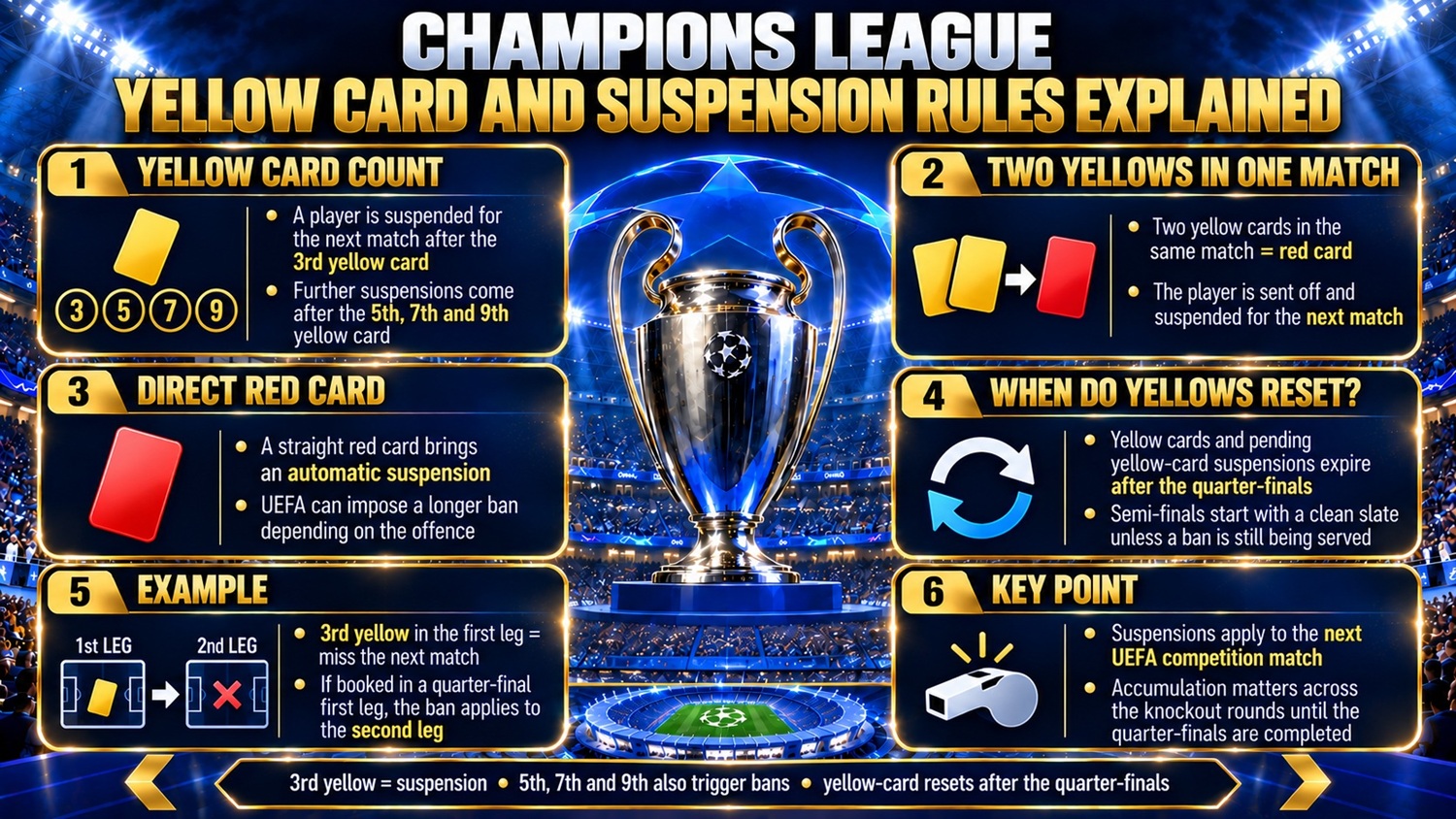
Yellow cards in the UEFA Champions League can eventually lead to a suspension, but the rules are different before and after the league phase. For 2026/27, a player is suspended after accumulating four yellow cards from the league phase onward.
Further suspensions follow after the sixth, eighth and later even-numbered yellow cards. Qualifying uses a different threshold, and UEFA also clears yellow cards at certain points in the competition.
In this guide, I will explain how the system works, what happens in the less obvious situations and when a booking can actually cause a player to miss an important match.
Read Also: Champions League Squad Registration Rules Explained
How Many Yellow Cards Lead to a Champions League Suspension?
From the first match of the league phase, a player or team official is suspended for the next competition match after receiving:
the 4th yellow card
the 6th yellow card
the 8th yellow card
every later even-numbered yellow card
These are yellow cards collected in different matches that did not result in a red card. For example, a player receives one yellow on Matchdays 1, 3, 5 and 7. His fourth yellow triggers a one-match suspension. After serving that suspension, his count does not return to zero. If he later receives his sixth yellow, he is suspended again.
Does a Suspension Reset the Yellow-Card Count?
No. Serving a suspension does not erase the player's accumulated total. For example 4th yellow equals suspension. After returning, the player is still considered to have reached four yellow cards.
His next suspension comes when he reaches 6 yellow cards then 8 yellow cards and so on. This is why the system should not be thought of as "four yellows, then start again from zero."
Read Also: How Does the Champions League Knockout Draw Work?
Do Yellow Cards Carry Into the Knockout Stage?
Yes. Yellow cards from the league phase continue into the knockout phase play-offs, round of 16 and quarter-finals. Imagine a player finishes the league phase with three yellow cards.
He then receives another yellow in the first leg of a knockout tie. That is his fourth booking, so he is suspended for the next Champions League match. Reaching a new round does not normally reset the count.
When Are Champions League Yellow Cards Cleared?
There are two important reset points.
After qualifying: Yellow cards and pending suspensions caused by accumulated yellow cards are cleared at the end of the qualifying play-offs. They do not carry into the league phase.
After the quarter-finals: All existing yellow cards are cleared after the quarter-finals. They do not carry into the semi-finals.
However, there is an important exception: A suspension that has already been triggered is not erased simply because the yellow cards are then cleared. That distinction matters.
Read Also: How Does the Champions League Knockout Stage Work?
What If a Player Gets His Fourth Yellow in the Quarter-Final Second Leg?
He misses the first leg of the semi-final. For example, if a player enters the quarter-final second leg with three yellow cards and receives another booking, that fourth yellow immediately triggers a one-match suspension.
UEFA clears accumulated yellow cards after the quarter-finals, but that reset does not cancel a suspension that has already been triggered. The player's yellow-card count is cleared, but he must still serve the suspension in the first leg of the semi-final.
Can a Player Miss the Champions League Final Because of Yellow Cards?
Not through ordinary yellow-card accumulation during the semi-finals. Yellow cards are cleared after the quarter-finals. From the league phase onward, four yellow cards are required to trigger the first accumulation suspension.
There are only two semi-final matches. A player could therefore receive a yellow in both semi-final legs without reaching four new yellow cards. This means a player cannot normally miss the final simply because of accumulated semi-final bookings.
He can still miss the final because of:
a red card
a longer UEFA disciplinary suspension
another suspension that remains to be served
Read Also: What Is the Champions League Knockout Phase Play-Off?
What Happens If a Player Gets a Red Card?
A player who is sent off is normally suspended for the next match in a UEFA club competition. This applies to:
a direct red card
a dismissal after two yellow cards in the same match
For more serious offences, UEFA's disciplinary bodies can increase the punishment beyond one match. A serious incident could therefore result in a player missing several matches.
This is different from yellow-card accumulation, where the suspension follows the fixed booking thresholds.
Can a Red-Card Suspension Carry Into Another UEFA Competition?
Yes. UEFA's rule refers to the next match in a UEFA club competition, which can include:
Champions League
Europa League
Conference League
UEFA Super Cup
This matters if a suspension cannot be served in the competition where the offence happened.
For example, if a player is sent off and his club is then eliminated before he can serve the full suspension, an outstanding disciplinary ban can carry forward under UEFA's suspension rules.
A red-card suspension should therefore not be assumed to disappear simply because a club's Champions League campaign has ended.
Do Two Yellow Cards in One Match Count Toward the Accumulation Total?
A two-yellow dismissal is treated as a sending-off. The yellow-card accumulation rule concerns cautions received in different matches that did not result in a red card.
So if a player receives two yellow cards in one game and is sent off, the consequence is the red-card suspension.
Those cautions do not create a separate accumulated-yellow suspension on top of the dismissal simply because two yellow cards were shown.
Read Also: How Does the Champions League League Phase Work?
What If a Player Is Already Close to a Yellow Suspension and Gets Sent Off?
The exact situation depends on which cards caused the dismissal. The important distinction is that yellow-card accumulation and red-card sanctions are separate disciplinary routes.
If a player has already triggered an accumulated-yellow suspension as well as another suspension, UEFA's disciplinary regulations state that the accumulated-yellow suspension is served first. This is uncommon, but it matters when more than one suspension applies to the same player.
How Do Yellow Cards Work During Champions League Qualifying?
The qualifying system is different. Before the league phase, a player or team official is suspended after:
the 3rd yellow card
the 5th yellow card
the 7th yellow card
later odd-numbered yellow cards
There is also a special qualifying rule designed to prevent bookings from building up indefinitely.
After every two completed UEFA club competition qualifying rounds in which the player was registered and eligible to play, any yellow-card total that has not already triggered a suspension is reduced by one.
How Does the Qualifying Card Reduction Work?
During qualifying, UEFA reduces a player's unused yellow-card total after every two completed qualifying rounds in which he was registered and eligible to play.
For example, if a player collects two yellow cards across those rounds without reaching the three-card suspension threshold, his total is reduced to one. If he has only one yellow card, the count is reduced to zero.
This rule can also apply when a club moves between the Champions League, Europa League and Conference League during qualifying, because UEFA tracks these cautions across its club competitions.
After the qualifying play-offs are completed, any remaining yellow-card accumulation and pending suspensions caused solely by accumulated yellow cards are cleared before the league phase begins.
Do Yellow Cards Carry Into the Next Champions League Season?
No. Yellow cards and outstanding suspensions caused by accumulated yellow cards are cleared at the end of the season.
A player therefore does not begin the following European season carrying ordinary yellow-card accumulation from the previous one.
Red-card or other disciplinary suspensions are different. If a disciplinary suspension remains unserved, UEFA's enforcement rules can carry it forward.
Do These Rules Apply to Coaches and Team Officials?
Yes. The yellow-card accumulation rules also apply to team officials. A coach or another member of the technical staff can therefore receive a suspension after reaching the applicable yellow-card threshold.
A team official who is sent off can also be suspended under UEFA's red-card rules. The system is not limited to players on the pitch.
Can a Yellow Card Be Appealed?
Normally, a yellow card cannot simply be appealed because the player or club believes the referee made the wrong decision.
Under UEFA's disciplinary rules, a protest against a yellow card or a sending-off caused by two yellow cards is generally admissible only when the referee is alleged to have mistaken the identity of the player.
That means ordinary disagreement over whether a foul deserved a booking is not normally enough to have the card removed.
What Happens If a Match Is Replayed?
This is a rare situation, but UEFA has a specific rule. If a match is ordered to be replayed in full, yellow cards from the original match are cancelled.
However, if a match is subsequently declared forfeited, yellow cards from that match are not automatically cancelled. These cases are uncommon, but they show why disciplinary records can sometimes depend on what UEFA later decides about the match itself.
A Simple League-Phase Example
Imagine a player receives yellow cards on Matchdays 1, 3 and 5. He now has three bookings but is still eligible to play. If he receives another yellow on Matchday 7, that becomes his fourth and triggers a one-match suspension.
After serving the suspension, his yellow-card count does not reset to zero. If he later reaches six yellow cards, he is suspended again. If he gets through the quarter-finals without triggering another suspension, any remaining yellow cards are then cleared before the semi-finals.
Common Champions League Card Misunderstandings
There are several rules I think are especially useful to remember.
Three yellow cards do not trigger the normal league-phase suspension in 2026/27. The first threshold is four.
Serving a suspension does not reset the player's yellow count to zero.
League-phase yellow cards carry into the early knockout rounds.
Qualifying uses a different threshold: third, fifth, seventh and later odd-numbered yellows.
Qualifying bookings can be reduced after every two completed qualifying rounds if they have not already caused a suspension.
Qualifying yellow cards do not carry into the league phase.
Yellow cards are cleared after the quarter-finals.
A suspension already triggered in the quarter-finals still has to be served.
Two yellow cards in the same match result in a sending-off and are handled under the red-card rules.
A red card normally means at least the next UEFA club match is missed.
Serious offences can lead to longer bans.
A player cannot normally miss the final through ordinary yellow-card accumulation in the semi-finals.
Champions League Card Rules at a Glance
Before the league phase, a player or team official is suspended after the third yellow card, then the fifth, seventh and later odd-numbered bookings. During qualifying, unused yellow-card totals can also be reduced after every two completed qualifying rounds.
Once the qualifying play-offs are over, the remaining yellow-card accumulation is cleared before the league phase begins. From the league phase onward, the first suspension comes after the fourth yellow card, followed by the sixth, eighth and later even-numbered bookings.
Yellow cards continue into the knockout rounds until the quarter-finals are completed. At that point, the existing yellow-card count is cleared, although any suspension already triggered must still be served.
Red cards are handled separately. A sending-off normally means missing at least the next UEFA club competition match, while more serious offences can lead to longer suspensions.
Final Thoughts
The Champions League card system is easier to understand when I separate three things: qualifying, league-phase accumulation and red cards. Before the league phase, the first yellow-card suspension comes after the third booking, with UEFA also reducing unused accumulation after every two qualifying rounds.
Once the league phase begins, the threshold changes. Four yellow cards trigger the first suspension, followed by the sixth, eighth and later even-numbered bookings. Those cards continue into the knockout rounds until the quarter-finals are completed.
The important detail is that clearing yellow cards does not cancel a suspension that has already been triggered. A player receiving his fourth yellow in a quarter-final second leg can still miss the first semi-final.
Red cards work separately and normally mean missing at least the next UEFA club match, with longer punishments possible for serious offences.
For me, the simplest way to remember the system is:
Qualifying starts at three yellows. The league phase starts at four. Yellow cards clear after the quarter-finals, but an earned suspension does not. Red cards are handled separately and can carry beyond a single competition.