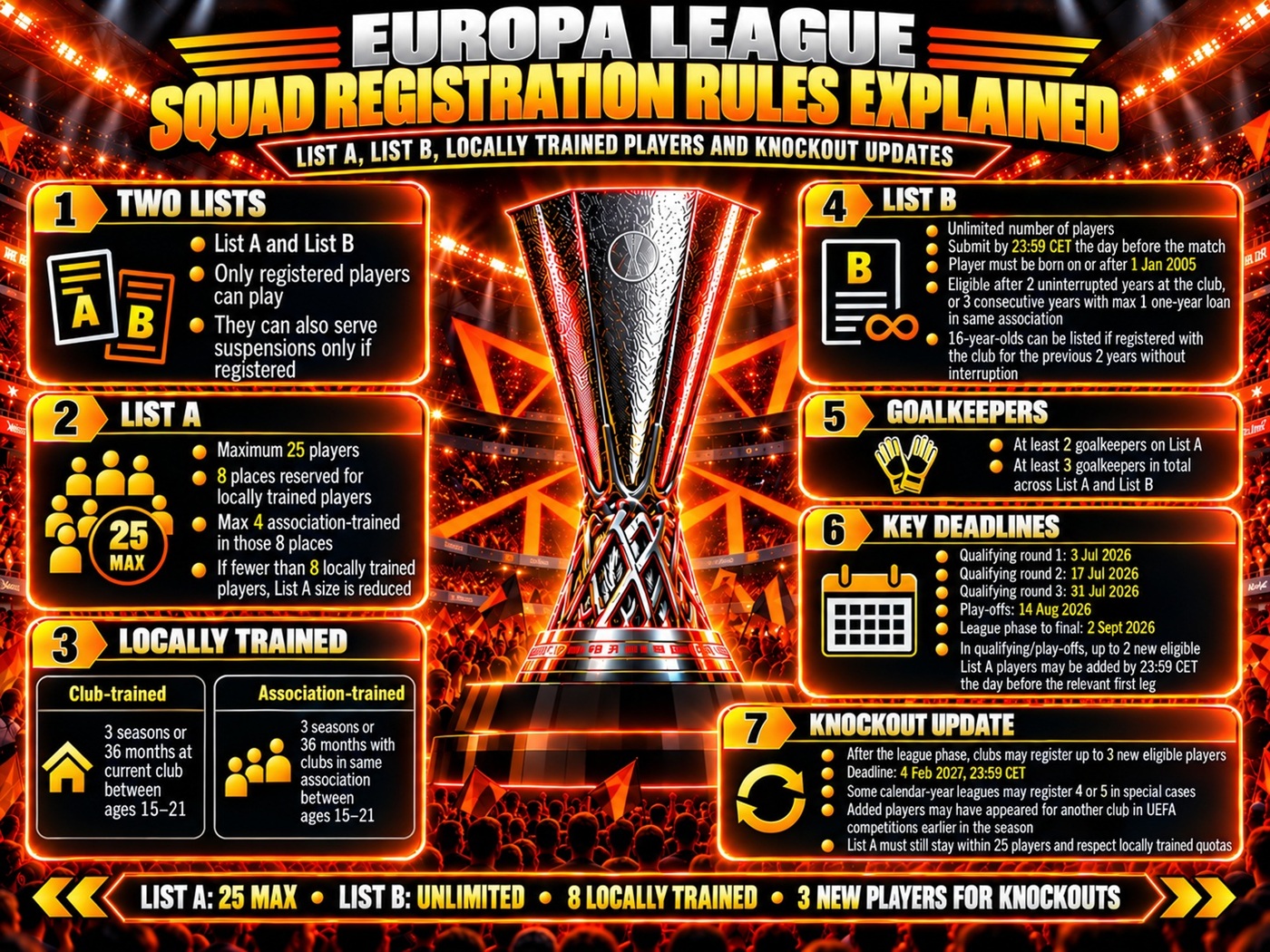
Europa League clubs cannot simply use every player registered with their domestic squad. Players must also be properly registered with UEFA. UEFA separates eligible players into List A and List B, with different rules applying to each.
List A is normally limited to 25 players and includes requirements for locally trained players and goalkeepers. List B is designed mainly for eligible younger players developed by the club and can be updated throughout the season.
There are also separate deadlines for qualifying, the league phase, and the knockout phase. In this guide, I will explain how the 2026/27 Europa League squad registration rules work.
Read Also: How Does the Europa League Knockout Draw Work?
What Are List A and List B?
Europa League squads are organised through two player lists:
List A
List B
Most senior first-team players are registered on List A. List B provides additional registration flexibility for younger players who meet UEFA's age and club-development requirements. A player must be properly registered on one of these lists to be eligible to play.
How Many Players Can Be Registered on List A?
A club can register up a 25 players on List A. However, 25 is not automatically available to every club. At least eight List A places are reserved for locally trained players.
If a club cannot fill all eight of those reserved places with eligible locally trained players, its maximum List A size is reduced. So a club cannot simply fill the unused locally trained places with other senior players.
What Is a Locally Trained Player?
UEFA divides locally trained players into two categories:
club-trained players
association-trained players
A locally trained player's nationality does not determine whether they qualify. The important factor is where they were registered during their development years.
Read Also: How Does the Europa League Knockout Stage Work?
What Is a Club-Trained Player?
A club-trained player is generally someone who was registered with their current club for at least three complete seasons or 36 months during the relevant development period between the ages of 15 and 21. The period does not have to be continuous.
For example, a player can qualify as club-trained even if they are not from the country in which the club is based. Nationality is not the deciding factor. It is the player's registration history with that club.
What Is an Association-Trained Player?
An association-trained player is someone who completed the required development period with one or more clubs belonging to the same national association as their current club.
For example, a player at an English Europa League club could qualify as association-trained after spending the relevant development period at another English club. They would not necessarily be club-trained for their current team, but they could still count toward the locally trained quota.
Read Also: What Is the Europa League Knockout Phase Play-Off?
How Many Association-Trained Players Can Count Toward the Eight Places?
A maximum of four association-trained players can occupy the eight locally trained List A places. This means a club wanting to use the full 25-player List A effectively needs at least four club-trained players among its locally trained allocation.
The other four locally trained places can be filled by either club-trained players or eligible association-trained players. A club can have more than four club-trained players if it wants.
What Happens If a Club Does Not Have Eight Locally Trained Players?
Its List A becomes smaller. For example, imagine a club has only six eligible locally trained players instead of eight. It is two players short. Its maximum List A would therefore fall from 25 to 23 players.
If it had seven locally trained players, the maximum would be 24. UEFA does not allow the club to replace those missing locally trained places with unrestricted players.
Read Also: Europa League Tiebreaker Rules Explained
Is This the Same as a Homegrown Player Rule?
The term "homegrown" is often used informally, but UEFA's regulations specifically refer to locally trained players.
That distinction is useful because the rule is based on player development and registration rather than nationality. A foreign national can qualify as club-trained. A domestic national who spent their development years elsewhere may not.
What Is List B?
List B allows qualifying younger players to be registered separately from the 25-player List A. Unlike List A, UEFA does not set a numerical limit on how many eligible List B players a club can register during the season.
However, a player must satisfy both age and development requirements. This prevents clubs from simply placing every young signing on List B.
Who Can Be Registered on List B in 2026/27?
For the 2026/27 Europa League, a List B player must generally have been born on or after 1 January 2005. The player must also, since their 15th birthday, have been eligible to play for the club for either:
an uninterrupted period of two years, or
three consecutive years with a maximum of one loan spell of no more than one year to another club from the same association
UEFA has an additional provision for 16-year-old players, who can qualify if they have been registered with the participating club for the previous two years without interruption.
Read Also: How Do Europa League Pots and Seeding Work?
Does List B Count Toward the 25-Player Limit?
No. The 25-player maximum applies to List A. Eligible List B players are registered separately. This is why clubs with strong academy systems can effectively have more than 25 players available during a European campaign, provided the additional players genuinely meet List B requirements.
When Must List B Players Be Registered?
List B can be updated throughout the season. A club must submit the relevant List B registration by 23:59 CET on the day before the match in which the player is expected to be available. This gives clubs more flexibility to involve eligible academy players as the season develops.
What Are the Goalkeeper Requirements?
Every club must register at least two goalkeepers on List A. It must also have at least three goalkeepers in total across List A and List B combined. For example, a club could register:
two goalkeepers on List A
one eligible goalkeeper on List B
That would satisfy the minimum requirement.
When Is the Europa League League-Phase Squad Deadline?
For 2026/27, clubs had to submit their List A for the league phase by 2 September 2026 at 23:59 CET. That list applies from the first league-phase match onward, subject to UEFA's permitted replacement and subsequent-registration rules. The league phase itself began later in September.
Read Also: How Does the Europa League Draw Work?
Are There Separate Squad Deadlines During Qualifying?
Yes. For 2026/27, the List A deadlines were:
First qualifying round: 3 July 2026
Second qualifying round: 17 July 2026
Third qualifying round: 31 July 2026
Play-offs: 14 August 2026
League phase: 2 September 2026
Each deadline was at 23:59 CET. This means a club's squad can change as it progresses through qualifying.
Can Clubs Add Players After a Qualifying Deadline?
Yes, within specific limits. During qualifying and the play-offs, a club can register up to two new eligible List A players after the normal deadline for that round.
They must be registered by 23:59 CET on the day before the relevant first-leg match. The locally trained quota must still be respected. If adding the player would take List A above 25, another player must be removed.
Is the League-Phase Squad Completely Locked Until February?
Not absolutely. UEFA allows certain exceptional replacements during the league phase. These include specific cases involving:
long-term goalkeeper injury or illness
certain goalkeeper transfers
long-term injury or illness to one outfield player
The conditions are tightly controlled, so these are exceptions rather than ordinary squad changes.
Can an Injured Goalkeeper Be Replaced?
Yes. A goalkeeper on List A can be temporarily replaced if UEFA considers the injury or illness long-term. For this rule, a goalkeeper injury or illness is considered long-term when it lasts at least 30 days.
The club must provide the required medical evidence. Once the original goalkeeper becomes eligible to return, the replacement is removed when the original goalkeeper resumes their place.
Can a Long-Term Injured Outfield Player Be Replaced?
Under the 2026/27 rules, a club can temporarily replace a maximum of one List A outfield player during the league phase up to and including Matchday 6 if that player suffers a qualifying long-term injury or illness.
For an outfield player, long-term means at least 60 days. The replacement must already have been registered with the club by the original league-phase List A deadline.
If the injured player occupied a club-trained or association-trained place, the replacement must also allow the relevant locally trained quota to remain compliant.
Can Clubs Change Their Squad Before the Knockout Phase?
Yes. After the league phase and before the knockout stage begins, each qualifying club can register up to three new eligible players. For 2026/27, the deadline is 4 February 2027 at 23:59 CET.
This is the main opportunity for clubs to add January signings or other eligible players before the knockout phase.
Can Clubs Have More Than 25 List A Players After January Changes?
No. The maximum remains 25. If registering new players pushes List A beyond 25, the club must remove enough previously registered players to return to the limit.
The locally trained requirements must also continue to be respected. So registering three new players may require removing up to three existing List A players.
Can January Signings Be Registered?
Yes, provided they are eligible, and the club has room within its permitted changes. A January signing can be one of the maximum three new players registered before the knockout phase.
The player does not have to have been at the club during the league phase. This is one of the main reasons UEFA allows the post-league-phase registration window.
Can a Player Who Already Played in Europe for Another Club Be Registered?
Yes, under the current rules. A player registered among a club's permitted knockout-phase additions may previously have played for another club during the qualifying rounds, play-offs, or league phase of the:
Champions League
Europa League
Conference League
So the old idea that a January signing is automatically "cup-tied" because they appeared for another European club no longer applies in the same way. The new club must still register the player properly within the three-player limit and satisfy the other squad rules.
Can a Player Represent Two Clubs in UEFA Competitions During the Same Season?
Normally, a player cannot simply move between UEFA clubs without restriction. However, UEFA provides specific exceptions. A player who appeared for one club during qualifying or the play-offs can be registered for another club from the league phase onward if the regulations allow it.
Then, before the knockout phase, Article 32 allows newly registered players to have previously appeared for another club in a UEFA competition earlier that season. So a player's earlier European appearance does not necessarily prevent a mid-season move and subsequent registration.
Does the Three-Player Knockout Limit Apply to List B?
The three-new-player rule concerns the new eligible players being added for the remaining knockout matches, particularly changes to List A.
Eligible List B players continue to operate under the normal List B conditions and registration deadlines. A qualifying academy player can therefore remain available through List B without taking one of the 25 List A places.
Are There Any Exceptions to the Three-Player Knockout Limit?
Yes, but they apply to a specific group of clubs. UEFA provides additional flexibility for clubs playing in domestic championships that start and finish within the same calendar year.
If more than five List A players are no longer registered with that club after the league phase, the club may be allowed to register a fourth new player. If more than seven have left, it may register a fifth. These exceptions do not change the normal three-player rule for most Europa League clubs.
Do Suspended Players Still Need to Be Registered?
Yes. UEFA specifies that only players properly registered through List A or List B can validly serve pending suspensions.
Registration therefore matters even when a player is unavailable to play because of a disciplinary ban. A club cannot simply leave the player outside its UEFA lists and assume the suspension is being served.
A Simple Europa League Squad Example
Imagine a club wants the full 25-player List A. Eight places must be reserved for locally trained players. Among those eight, no more than four can be association-trained. The club could therefore have:
four club-trained players
four association-trained players
17 other List A players
That produces a 25-player squad. The club can also use eligible List B players separately.
If the team reaches the knockout phase and signs three players in January, it can register all three by the February deadline, but it would need to remove three existing List A players if the list were already full.
Common Europa League Squad Registration Misunderstandings
List A is not automatically 25 players. A shortage of locally trained players reduces the maximum.
The locally trained rule is not based on nationality. It is based on where the player developed.
Only four of the eight reserved locally trained places can be filled by association-trained players.
List B players do not count toward the 25-player List A limit.
List B is not simply for any young player. Players must satisfy UEFA's age and development requirements.
Clubs need at least two goalkeepers on List A and three across Lists A and B combined.
The league-phase List A deadline is not the final chance to make any changes. UEFA permits specific injury replacements and later knockout additions.
Clubs reaching the knockout phase can normally add up to three new eligible players.
January signings can be registered.
A player who represented another club in Europe earlier in the season can still be eligible for a new club during the knockout phase under UEFA's current rules.
Europa League Squad Registration at a Glance
List A contains a maximum of 25 players, with eight places reserved for locally trained players. No more than four association-trained players can fill those eight reserved places.
If a club cannot meet the full locally trained allocation, its maximum List A size is reduced. List B can contain an unlimited number of eligible young players who meet UEFA's age and development requirements.
For 2026/27, List B players must generally have been born on or after 1 January 2005. Each club must have at least two goalkeepers on List A and three goalkeepers across Lists A and B combined. The league-phase List A deadline was 2 September 2026.
Clubs reaching the knockout phase can normally register up to three new eligible players by 4 February 2027 while continuing to respect the 25-player maximum and locally trained requirements.
Final Thoughts
Europa League squad registration is easier to understand when I separate List A from List B. List A is the main senior squad and can contain up to 25 players, but eight places are reserved for locally trained players.
List B provides additional space for eligible younger players who have spent enough time developing at the club. The squad is also not completely fixed for the entire season.
Qualifying has its own deadlines, UEFA permits limited exceptional replacements during the league phase, and clubs reaching the knockout rounds can normally add three new eligible players after the league phase.
For me, the most important thing to remember is that the 25-player figure is a maximum, not an automatic entitlement. A club's actual List A capacity depends on satisfying UEFA's locally trained player rules.