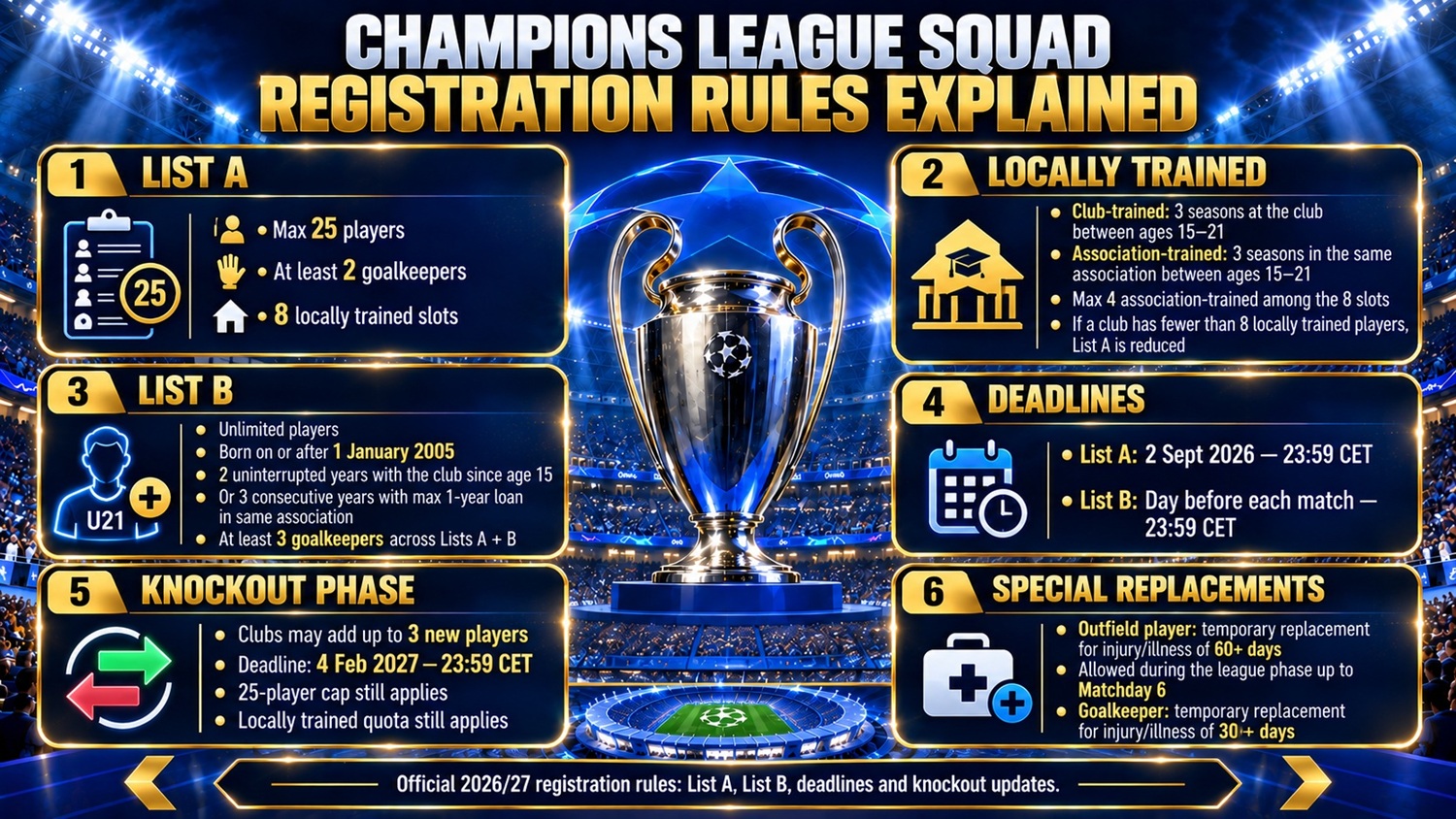
Champions League squad registration is more structured than simply naming every player a club has under contract. UEFA requires clubs to register eligible players on either List A or List B. List A is the main squad and can contain up to 25 players, subject to locally trained player requirements.
List B is designed mainly for eligible younger players who have spent enough time with the club and can be updated throughout the season. There are also specific deadlines, goalkeeper requirements and rules for changing the squad before the knockout phase.
In this guide, I will explain how Champions League squad registration works and why a club with more than 25 senior players cannot simply register all of them.
Read Also: How Does the Champions League Knockout Draw Work?
What Are List A and List B?
Every Champions League club submits two types of player lists to UEFA:
List A
List B
A player must normally appear on one of those lists to play in the competition. The two lists serve different purposes. List A contains the club's main registered squad. List B allows eligible younger players developed within the club to be registered separately.
The distinction is important because List B players do not use up the 25 places available on List A.
How Many Players Can Be Registered on List A?
A club can register a maximum of 25 players on List A. At least two of those players must be goalkeepers. However, a club does not automatically receive all 25 places. Eight positions are reserved for locally trained players.
If the club cannot provide enough eligible locally trained players, its maximum List A size is reduced. So the basic rule is, maximum List A size is 25 but only if the club meets the locally trained player requirements.
What Are Locally Trained Players?
UEFA divides locally trained players into two categories:
Club-trained players
Association-trained players
These terms are sometimes loosely described as "homegrown" rules, although UEFA uses the more precise term locally trained players. A club needs eight locally trained places within a full 25-man List A.
However, no more than four of those eight places can be filled by association-trained players. That effectively reserves at least four places for club-trained players if a club wants to use the full 25-man allocation.
Read Also: How Does the Champions League Knockout Stage Work?
What Is a Club-Trained Player?
A club-trained player is someone who, between the ages of 15 and 21, was registered with the club for:
three entire seasons, or
36 months
The important point is that nationality does not decide whether a player is club-trained. A player does not need to be born in the country where the club plays. What matters is the player's registration history during the relevant development years.
For example, a player from another country who joined a club young enough and spent the required period there could qualify as club-trained.
What Is an Association-Trained Player?
An association-trained player also needs three entire seasons or 36 months of registration between the ages of 15 and 21. The difference is that the player does not necessarily need to have spent that time at the current club. He can have developed at another club affiliated with the same national association.
For example, a player who developed at one English club and later moved to another English club could potentially qualify as association-trained for UEFA registration purposes. He would not necessarily count as club-trained at his new club.
Read Also: What Is the Champions League Knockout Phase Play-Off?
What Happens If a Club Does Not Have Eight Locally Trained Players?
Its List A limit is reduced. This rule is often misunderstood. UEFA does not force a club to fill the locally trained places with players who do not qualify. Instead, the unused reserved places remain empty. Imagine a club has only six eligible locally trained players.
Instead of registering 25 players, its maximum List A would effectively fall to 23. If it had only five eligible locally trained players, the maximum would fall further. This is why the locally trained requirement affects actual squad size rather than simply being a recommendation.
Does a Club Need Four Club-Trained Players?
A full 25-player List A effectively requires at least four club-trained players because no more than four of the eight locally trained places can be association-trained.
The eight reserved locally trained places can therefore be structured as 4 club-trained + 4 association-trained or a combination containing more club-trained players. For example, 5 club-trained + 3 association-trained would satisfy the requirement.
What UEFA does not allow is all eight locally trained places being filled only by association-trained players.
Read Also: Champions League Tiebreaker Rules Explained
Does Nationality Matter for the Locally Trained Rule?
No, not directly. The UEFA rule is based on player development and registration history rather than passport or nationality. A foreign player can qualify as club-trained if he spent the required development period at the club.
A domestic player might fail to qualify as club-trained if he joined too late. This is why I think "homegrown" can sometimes be misleading when discussing UEFA rules.
The key question is:
Where was the player registered during the relevant years?
not simply:
What nationality is the player?
What Is List B?
List B is mainly intended for younger players who have developed within the club. Unlike List A, there is no fixed numerical limit on how many eligible players a club can register on List B during the season.
That gives clubs more flexibility when using academy players. However, a young player's age alone does not automatically make him eligible. He must also meet UEFA's club-registration requirements.
Who Can Be Registered on List B in 2026/27?
For the 2026/27 Champions League, a player can generally be included on List B if he:
was born on or after 1 January 2005, and
has been eligible to play for the club for the required period since his 15th birthday
The normal requirement is either:
an uninterrupted period of two years with the club, or
three consecutive years with a maximum one-year loan spell at another club belonging to the same national association
There is also a specific provision for 16-year-old players. A 16-year-old can be registered on List B if he has been registered with the club for the previous two years without interruption.
Read Also: How Do Champions League Pots and Seeding Work?
Can Any Under-21 Player Go on List B?
No. This is one of the most common misunderstandings. A player does not qualify for List B simply because he is young. He must satisfy both the age requirement and the required period of registration with the club.
Imagine a 19-year-old player is signed from another club during the summer. He may be young enough by age, but if he has not spent the required period registered with his new club, he cannot simply be placed on List B. The club may need to use a List A place instead.
Does List B Have a Registration Deadline?
Yes, but it is much more flexible than List A. List B can be amended throughout the season. A club must submit the relevant List B registration no later than 23:59 CET on the day before the match in question.
This means eligible academy players can be added during the Champions League season rather than requiring the club to predict every young player it might need in September. That flexibility is one of the main purposes of List B.
How Many Goalkeepers Must a Club Register?
Every club must have at least three goalkeepers across List A and List B combined. At least two goalkeepers must be on List A. For example, a club could register:
two goalkeepers on List A
one eligible goalkeeper on List B
That would satisfy the minimum requirement. The club could also register all three on List A if it preferred.
When Is the Champions League List A Deadline?
For the 2026/27 Champions League league phase, clubs had to submit their List A by 2 September 2026 at 23:59 CET. This deadline applies regardless of when a country's domestic transfer window closes. That distinction matters.
A player can legally join a club after UEFA's List A deadline if the domestic transfer window remains open, but that does not automatically make him eligible to play in the Champions League league phase. The UEFA registration deadline is what matters for Champions League eligibility.
Can a Player Signed After the UEFA Deadline Play in the League Phase?
Normally, no. If the player is not registered on the relevant UEFA list by the deadline and does not qualify for List B or another permitted exception, he cannot simply be added for the next league-phase match.
This is why clubs have to plan their European squads separately from their domestic squad registration. A player can therefore be eligible for domestic league matches while being unavailable for Champions League fixtures.
Are Qualifying Squads the Same as League-Phase Squads?
Not necessarily. The clubs that come through Champions League qualifying can submit different player lists for the league phase. So a player appearing during qualifying does not automatically guarantee that he will be included in the club's league-phase List A.
Similarly, a club can add eligible players before the league-phase registration deadline. Qualifying and the league phase therefore have separate registration considerations.
Can a Player Represent Two Clubs in Europe in the Same Season?
Under the current rules, yes in certain circumstances. A player who represented one club in Champions League, Europa League or Conference League qualifying can still represent another club from the league phase onward if he becomes eligible and is properly registered.
The current rules also allow clubs reaching the knockout phase to register new players who may already have played for another club in UEFA competition earlier that same season. This is different from older "cup-tied" rules that many fans may remember.
Can Clubs Change Their Squad After the League Phase?
Yes. After the league phase is completed and before the knockout phase begins, qualifying clubs can register up to three new eligible players. For 2026/27, the deadline is 4 February 2027 at 23:59 CET. These new registrations can include winter signings.
They can also include players who represented another club in UEFA competition earlier in the same season. This gives clubs an opportunity to update their squads after the winter transfer window.
Does Adding Three Players Mean a Club Can Have 28 Players on List A?
No. The List A rules still apply. Registering up to three new players does not simply expand the normal maximum squad to 28. The club must remain within the applicable List A limits and locally trained requirements.
In practical terms, new players often replace players who have left, been removed or are otherwise no longer included. The three-player rule concerns the number of new registrations allowed for the knockout phase, not an automatic increase in squad size.
Can January Signings Play in the Champions League?
Yes, if the club qualifies for the knockout phase and registers them correctly. A January signing can be one of the maximum three new eligible players added after the league phase.
Under the current rules, it does not matter if the player already appeared for another club in a UEFA competition earlier that season.
So a player can potentially play European football for one club before January and then appear for another club in the Champions League knockout phase. The club still has to meet the List A requirements.
Are There Exceptions for Certain Domestic League Calendars?
Yes. UEFA provides additional flexibility for clubs whose domestic championships begin and end within the same calendar year. Under specific circumstances, those clubs can register more than the usual three new players before the knockout phase if several List A players have left the club.
For 2026/27:
if more than five List A players have left, the club can register one additional player, making four
if more than seven have left, it can register two additional players, making five
These exceptions recognize that calendar-year leagues can have significantly different squad turnover between the Champions League league and knockout phases.
Can Clubs Replace an Injured Goalkeeper?
Yes, under specific conditions. UEFA allows a club to temporarily replace a List A goalkeeper who suffers a long-term injury or illness. For this rule, the goalkeeper's absence must normally last at least 30 days.
The club must provide the necessary medical evidence. The replacement goalkeeper does not need to satisfy the locally trained status of the goalkeeper being replaced. Once the original goalkeeper is fit again, he can return and the temporary replacement must be removed.
Can an Injured Outfield Player Be Replaced?
Yes, but the rule is more limited. During the league phase up to and including Matchday 6, a club may temporarily replace a maximum of one List A outfield player suffering from a qualifying long-term injury or illness.
For an outfield player, UEFA defines the relevant long-term absence as at least 60 days. The replacement player must already have been registered with the club under the relevant eligibility rules before the List A deadline.
If the injured player occupied a club-trained or association-trained position, the replacement must preserve the applicable locally trained quota. This exception is therefore narrower than simply allowing clubs to sign an emergency replacement whenever a player gets injured.
Can a Goalkeeper Who Leaves the Club Be Replaced?
There is also a specific provision for goalkeepers who leave permanently. After Matchday 6 and before the end of the league phase, a club can replace a goalkeeper on List A following an outgoing permanent transfer.
If the club reaches the knockout phase, that added goalkeeper counts as one of the new registrations permitted for the knockout phase. At that point, the locally trained quota must again be respected.
Why Are Goalkeeper Rules More Flexible?
Goalkeeper is a unique position. An injury crisis involving goalkeepers can leave a club without enough specialists to play normally.
UEFA therefore provides specific replacement rules for long-term goalkeeper injuries and certain permanent departures.
These rules do not mean clubs can freely change goalkeepers whenever they want. The relevant conditions and registration procedures still have to be satisfied.
A Simple List A Example
Imagine FC Example wants to register the full 25-player Champions League squad. Its List A could contain 17 unrestricted players plus 8 locally trained players.
Among those eight locally trained players:
at least four would need to qualify as club-trained if the other four are association-trained
more than four can be club-trained
Now imagine FC Example has only six eligible locally trained players. It cannot simply register 19 unrestricted players and six locally trained players to reach 25. The two missing locally trained places remain unavailable.
Its maximum List A becomes 23 players. That is why academy development can directly affect how many senior players a club can register.
A Simple List B Example
Imagine FC Example has an 18-year-old academy midfielder. He meets the age requirement and has been continuously registered with the club since he was 14. He can potentially be registered on List B.
He therefore does not require one of the 25 List A places. Now imagine FC Example signs another 18-year-old midfielder from a foreign club during the summer.
Even though he is the same age, he has not spent the required period registered with FC Example. He cannot automatically be treated as a List B player. Age alone is not enough.
Why Does List B Matter So Much for Academy Players?
List B allows clubs to use eligible young players without sacrificing senior List A places. That can be especially useful during a long season when:
first-team players are injured
fixture congestion increases
academy players develop faster than expected
a club wants to rotate its squad
Because List B can be updated during the season, an eligible academy player can become part of the Champions League squad even if he was not expected to feature when List A was submitted. This gives genuine value to players developed within the club.
Common Champions League Squad Registration Misunderstandings
There are several points I think are worth remembering.
A club does not automatically have 25 unrestricted List A places. Eight are reserved for locally trained players.
Locally trained does not mean the player must have that country's nationality. Registration history matters.
A young player is not automatically eligible for List B. He must also meet the required club-registration period.
List B is not limited to a fixed number of players. Eligible players can be added throughout the season.
At least two goalkeepers must be on List A. At least three must be registered across Lists A and B combined.
A player signed after the List A deadline is not automatically eligible for the league phase.
Clubs can register up to three new eligible players before the knockout phase.
Players are no longer automatically cup-tied simply because they represented another club earlier in the same European season.
Serious injuries do not allow unlimited replacements. UEFA has specific goalkeeper and outfield-player exceptions.
Champions League Squad Registration at a Glance
The easiest way I understand the system is:
List A
Maximum 25 players with at least 2 goalkeepers and within the 25, there are 8 places reserved for locally trained players with no more than 4 association-trained players among those eight
List B
Unlimited eligible players and its main requirements include:
age criteria
required development period with the club
List B must be submitted by 23:59 CET the day before the relevant match
After the league phase
After the league phase, clubs normally may register up to 3 new eligible players for the knockout phase. For 2026/27, the deadline is 4 February 2027.
Final Thoughts
Champions League squad registration is designed to balance first-team flexibility with player development. List A gives clubs their main squad, but the full 25 places are only available when the locally trained player requirements are met.
List B then gives clubs a separate route for eligible younger players who have spent enough time developing within the club. The most important distinction for me is that squad size, player age and nationality do not tell the whole story.
A player's development history can determine whether he counts as club-trained, association-trained, List B eligible or an unrestricted List A player. The rules also change at specific points in the season.
Clubs submit their main league-phase squad in September, can use eligible List B players throughout the campaign, and normally receive another opportunity to register up to three new players before the knockout phase.
That is why Champions League squad planning begins long before a manager names a starting XI. Registration decisions can determine which players are actually available when the biggest European matches arrive.