Not every club that qualifies for the UEFA Champions League goes directly into the 36-team league phase. Some clubs must first progress through Champions League qualifying, which takes place before the main phase of the competition.
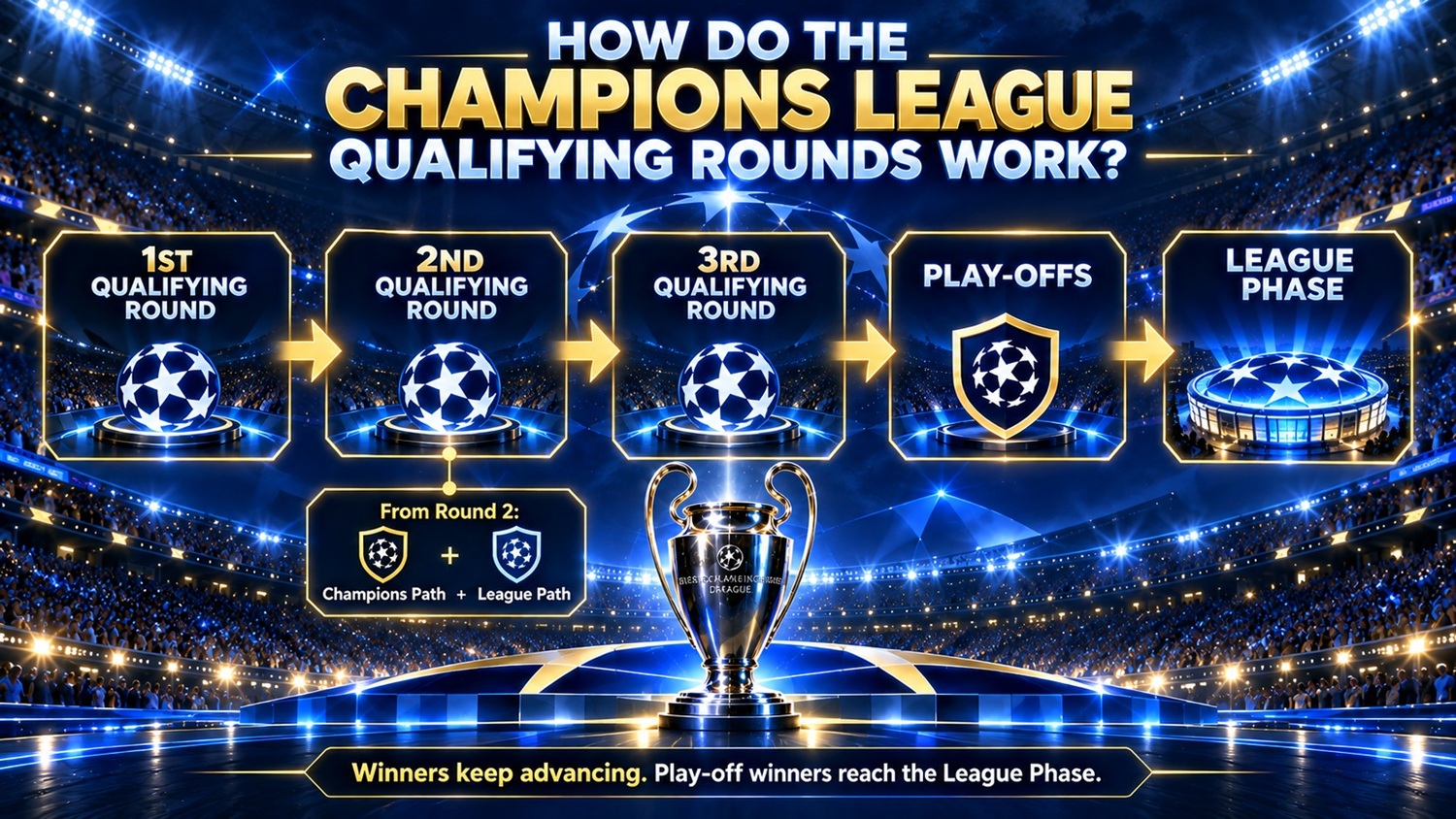
The qualifying process contains three qualifying rounds followed by a play-off round. Clubs enter at different stages depending on UEFA's access system, and from the second qualifying round, the competition is divided into the Champions Path and League Path.
For the 2026/27 season, qualifying produced the final seven clubs needed to complete the 36-team Champions League league phase. In this guide, I will explain how each round works, how winners advance, how ties are decided, and what happens to clubs that are eliminated.
Read Also: How Do Champions League Pots and Seeding Work?
How Many Champions League Qualifying Rounds Are There?
There are three qualifying rounds followed by the play-offs:
First qualifying round
Second qualifying round
Third qualifying round
Play-off round
However, a club does not necessarily play in all four stages. Some clubs enter in the first qualifying round, while others join in the second, third or play-off round. The starting point depends mainly on the Champions League access position allocated to the club's national association.
That is why one domestic champion may need to survive several qualifying ties while another club enters much later or qualifies directly for the league phase. I explain those different qualification routes in this How Do Teams Qualify for the UEFA Champions League article.
How Are Champions League Qualifying Ties Played?
Champions League qualifying normally uses a two-legged knockout system. Each pair of clubs plays:
one match at one club's stadium
one return match at the other club's stadium
The scores from the two matches are added together. For example, imagine Club A wins the first leg 2-0 but loses the second leg 1-0.
The aggregate score is:
Club A 2-1 Club B: Club A advances because it scored more goals across the two matches. The individual result of the second leg does not change the fact that Club A won the tie on aggregate.
What Happens If the Aggregate Score Is Level?
If both clubs have scored the same number of goals after the second leg, the tie goes to extra time. Two 15-minute periods are played. If the aggregate score is still level after extra time, the winner is decided by a penalty shoot-out.
The away-goals rule no longer applies. This means a goal scored away from home does not count more than a goal scored at home. If the aggregate score is 3-3 after two legs, the teams are level regardless of where those goals were scored.
How Does the First Qualifying Round Work?
The first qualifying round belongs entirely to the Champions Path. There is no League Path at this stage. It mainly contains domestic champions from associations whose Champions League places begin early in the qualification process.
For 2026/27, 28 clubs entered the first qualifying round, creating 14 two-legged ties. The winners advanced to the Champions Path of the second qualifying round. The defeated clubs generally moved into the UEFA Conference League qualifying system rather than being immediately eliminated from European competition.
This is an important feature of UEFA qualifying. Losing in Champions League qualifying does not always mean a club's European season is over.
How Does the Second Qualifying Round Work?
The second qualifying round is where Champions League qualifying splits into two separate routes:
Champions Path
League Path
The Champions Path contains domestic champions. The League Path contains eligible non-champions that qualified through domestic league positions. For the 2026/27 second qualifying round, there were:
24 clubs in the Champions Path
4 clubs in the League Path
The Champions Path included the 14 winners from the first qualifying round plus 10 clubs entering at this stage. The four League Path clubs entered qualifying at this round. Winners advanced to the third qualifying round within their respective paths.
For 2026/27, clubs eliminated from either path in the second qualifying round moved into the corresponding third qualifying round of the Europa League. If you want a more detailed explanation of why UEFA separates these clubs, see Champions Path vs League Path: What's the Difference?
How Does the Third Qualifying Round Work?
The third qualifying round continues with the Champions Path and League Path kept separate. For 2026/27, the round contained:
12 Champions Path clubs
8 League Path clubs
The 12 Champions Path teams were the winners from the second qualifying round. In the League Path, six clubs entered at this stage and joined the two winners from the previous round.
The winners advanced to the Champions League play-off round. The destination for losing clubs differed depending on their path.
Champions Path losers
Clubs eliminated from the Champions Path moved into the Europa League play-off round.
League Path losers
Clubs eliminated from the League Path moved directly into the Europa League league phase.
This difference is useful to understand because losing at the same Champions League qualifying stage can lead to a different Europa League entry point depending on which path a club followed.
How Does the Champions League Play-Off Round Work?
The play-off round is the final step before the Champions League league phase. For 2026/27, it contained:
10 Champions Path clubs
4 League Path clubs
The Champions Path consisted of six third-round winners plus four clubs entering at the play-off stage. The League Path consisted of the four winners from the third qualifying round.
These clubs played two-legged ties under the same aggregate-score system used in the earlier qualifying rounds. The difference is what was at stake. The winners did not advance to another qualifying round.
They qualified directly for the Champions League league phase. For 2026/27:
five Champions Path winners qualified
two League Path winners qualified
That created the final seven league-phase qualifiers. They joined the 29 clubs that had already secured league-phase places, completing the field of 36.
What Happens If a Club Loses in the Champions League Play-Offs?
All clubs defeated in the 2026/27 Champions League play-offs moved directly into the Europa League league phase. So reaching the Champions League play-offs guarantees a club league-phase European football even if it loses the final Champions League qualifying tie.
The possible outcomes are therefore:
Win the play-off → Champions League league phase
Lose the play-off → Europa League league phase
That makes the play-off round particularly significant. The club is not playing to remain in Europe. It is playing to determine which European league phase it will enter.
Why Do Some Clubs Enter Qualifying Later?
Not every qualifying club starts from the first round because UEFA uses an access list. The access list is influenced by UEFA's association coefficient rankings and determines where each domestic qualifying position enters European competition.
As a result:
some champions enter in the first round
others join later
some non-champions enter through the League Path
clubs from certain associations qualify directly for the league phase
A later entry is clearly useful because it means fewer knockout ties stand between the club and the league phase. A team entering in the first qualifying round could potentially have to survive four two-legged ties. A club entering at the play-off round needs to win only one.
How Does Seeding Work in Champions League Qualifying?
UEFA normally divides clubs into seeded and unseeded teams for qualifying draws. The seeding is based on UEFA club coefficient rankings established for the season.
A draw then pairs seeded and unseeded clubs and determines which team plays the first leg at home. This means qualifying is not simply one completely random draw involving every club.
Coefficient rankings influence which teams are seeded. However, being seeded does not guarantee progression. Every tie still has to be decided on the pitch. I will explain how coefficients are calculated and why they matter in How Do UEFA Coefficients Work?
Can Two Clubs From the Same Country Meet in Qualifying?
The Champions League qualifying draw operates under UEFA's draw principles and restrictions. The exact draw procedures are published for each round, and UEFA can create groups before conducting the draw.
This is another reason it is useful to distinguish the qualifying draw from the league-phase draw. They use different systems.
The qualifying stage primarily involves seeded and unseeded clubs being paired for knockout ties, while the league-phase draw must assign each of the 36 clubs eight different opponents. I cover the league-phase process separately in How Does the Champions League Draw Work?
What Happens to Eliminated Clubs?
One of the most confusing parts of Champions League qualifying is that eliminated teams can continue in another European competition. Where they go depends on the stage and path in which they lose.
Under the current structure:
First qualifying round
Champions Path losers generally move into the Conference League qualifying system.
Second qualifying round
Champions Path and League Path losers enter the Europa League third qualifying round in their respective routes.
Third qualifying round
Champions Path losers enter the Europa League play-offs. League Path losers enter the Europa League league phase.
Play-off round
Both Champions Path and League Path losers enter the Europa League league phase. This system gives clubs eliminated later in Champions League qualifying a different European route from clubs eliminated earlier.
It also explains why a team can begin the season in the Champions League and eventually compete in the Europa League or Conference League.
Can a Club Drop From the Champions League to the Europa League During the League Phase?
No. This is where qualifying and the league phase work differently. During qualifying, eliminated clubs can move into the Europa League or Conference League according to UEFA's access system.
But once a club reaches the Champions League league phase, there is no Europa League drop-down. Teams finishing:
1st to 8th qualify directly for the round of 16
9th to 24th enter the knockout phase play-offs
25th to 36th are eliminated from Europe
A club finishing 25th does not move into the Europa League. That distinction is important because it differs from older UEFA competition formats.
A Simple Example of the Full Qualifying Journey
Imagine a fictional club called FC Example wins its domestic championship and receives a first-qualifying-round place. It enters the Champions Path.
First qualifying round: FC Example wins its two-legged tie. It advances.
Second qualifying round: It wins again. It moves into the third qualifying round.
Third qualifying round: Another aggregate victory takes it into the play-offs.
Play-off round: FC Example wins its final two-legged tie.
It has now survived four rounds and eight matches to reach the Champions League league phase. Now imagine it loses the play-off instead. Its Champions League campaign ends, but it enters the Europa League league phase.
This example shows why simply saying that a club "qualified for the Champions League" can mean different things. Entering Champions League qualifying is not the same as securing one of the 36 league-phase places.
2026/27 Champions League Qualifying Schedule
For the 2026/27 season, qualifying ran from early July until late August. The rounds were played on these dates:
First qualifying round: First legs: 7–8 July 2026 and the Second legs: 14–15 July 2026
Second qualifying round: First legs: 21–22 July 2026 and the Second legs: 28–29 July 2026
Third qualifying round: First legs: 4–5 August 2026 and the Second legs: 11 August 2026
Play-offs: First legs: 18–19 August 2026 and the Second legs: 25–26 August 2026
The league-phase draw followed on 27 August after all seven qualifying places had been decided.
Common Champions League Qualifying Misunderstandings
There are several points I think are worth remembering.
Not every Champions League club plays qualifying. Most league-phase clubs receive direct entry.
Not every qualifying club starts in the first round. Entry points depend on UEFA's access system.
The League Path does not exist in the first qualifying round. It begins in the second round.
Champions Path and League Path clubs remain separate during qualifying.
The away-goals rule does not decide level ties. Equal aggregate scores lead to extra time and, if necessary, penalties.
Losing in Champions League qualifying does not always end a club's European season. Eliminated teams can move into the Europa League or Conference League.
Losing during the Champions League league phase is different. Teams eliminated from the league phase do not drop into another UEFA competition.
Champions League Qualifying at a Glance
The easiest way I understand the process is:
First Qualifying Round → Second Qualifying Round → Third Qualifying Round → Play-Off → League Phase
The first qualifying round contains only the Champions Path. From the second qualifying round, Champions Path and League Path clubs compete separately. Most ties are played over two legs. The aggregate score determines the winner.
If aggregate scores are level, the tie goes to extra time and potentially penalties. Winning the final play-off sends a club into the Champions League league phase. Losing can send the club into another UEFA competition depending on the stage at which it is eliminated.
Final Thoughts
Champions League qualifying is easier to follow once I separate it into four stages. The first qualifying round begins the process for some domestic champions. The second round introduces the League Path. The third round moves the remaining clubs closer to the main competition, and the play-offs decide the final league-phase places.
For 2026/27, those rounds produced seven qualifiers that joined 29 automatic entrants to complete the 36-team league phase. The important thing is that clubs do not all start from the same position.
Some may need four successful two-legged ties to reach the league phase, while others enter much later. UEFA's access list determines that starting point, while the Champions Path and League Path determine which type of qualifying route a club follows.
Once the play-offs are complete, those distinctions disappear. The successful clubs join the rest of the Champions League field and move into an entirely different system: the 36-team league phase.