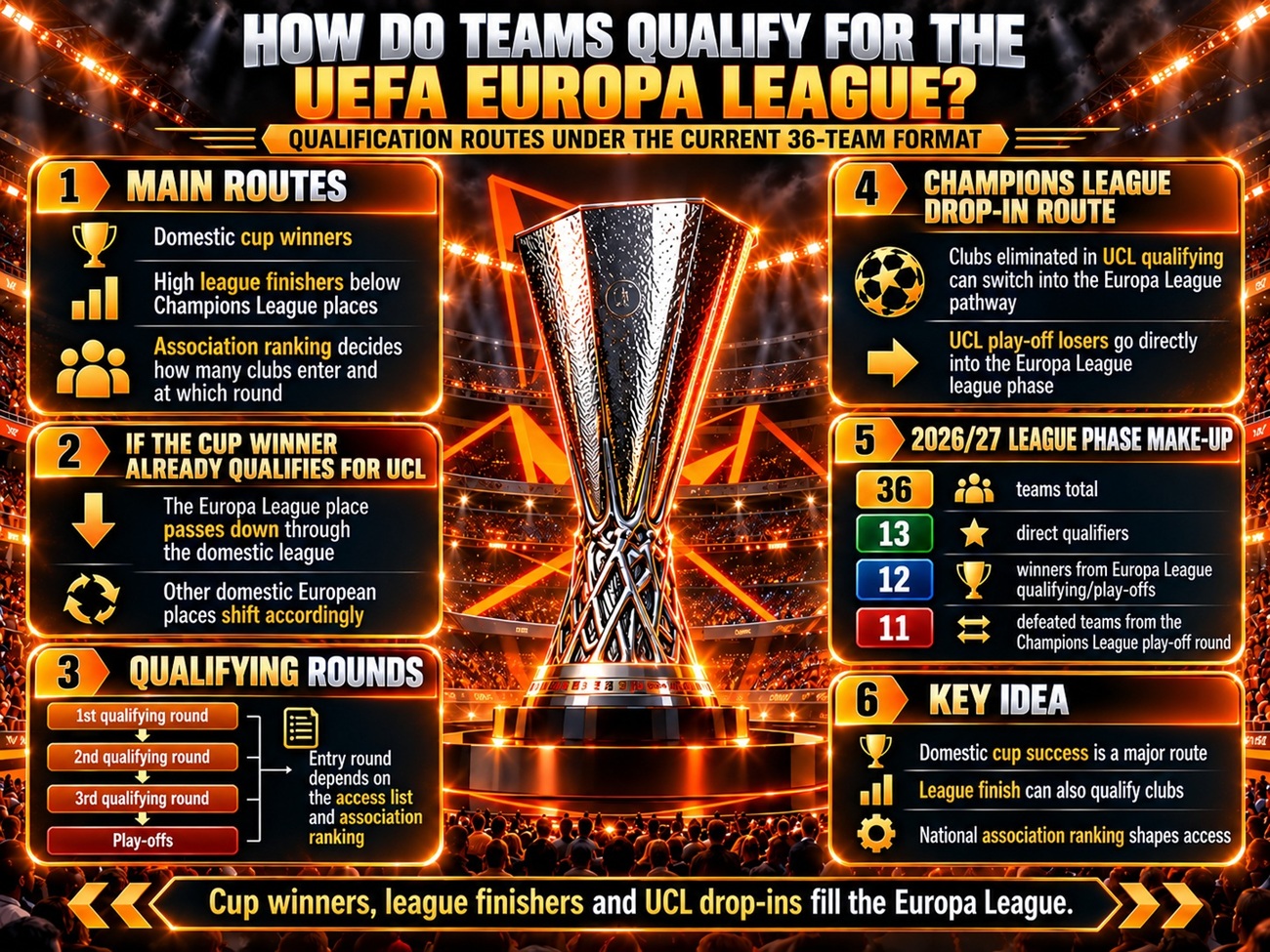
Teams can qualify for the UEFA Europa League in several ways. A club may earn a place through its domestic league, win its country's main cup competition, qualify as the reigning Conference League champion or enter after being eliminated from certain stages of Champions League qualifying.
Some clubs qualify directly for the 36-team Europa League league phase, while others must progress through qualifying rounds first. Where a club enters depends largely on its domestic qualification route and its association's position in UEFA's access list.
In this guide, I will explain each route and what happens in some of the less obvious qualification scenarios.
Read Also: Champions League vs Europa League vs Conference League: What’s the Difference?
What Are the Main Ways to Qualify for the Europa League?
The main qualification routes are:
Domestic cup qualification
Domestic league position
Winning the previous season's Conference League
Winning Europa League qualifying ties
Entering after elimination from designated Champions League qualifying rounds
These routes eventually produce the 36 clubs that compete in the Europa League league phase. For 2026/27, the final 36 included clubs that qualified directly, teams that came through Europa League qualifying and clubs that entered from Champions League qualifying.
How Does Domestic Qualification for the Europa League Work?
UEFA gives each member association places in its club competitions according to the UEFA access list. That access list is influenced by the association coefficient ranking. Depending on the association, a country can have one or more Europa League representatives.
The two main domestic routes are the country's main cup competition and its top domestic league. For associations with one Europa League representative, that place is generally allocated to the domestic cup winner.
Where an association has two representatives, the places normally go to the domestic cup winner and the highest league finisher immediately below the clubs that qualify for the Champions League.
However, the exact entry stage can differ from one association to another. Some clubs enter directly into the league phase, while others begin in qualifying.
Why Is the Domestic Cup Important for Europa League Qualification?
The domestic cup has a particularly important position in UEFA's Europa League access system. In many associations, winning the main national cup provides a Europa League place.
For example, if a country's cup winner has not qualified for a higher UEFA competition through its league position, it can use the cup route to enter the Europa League at the stage allocated to that association.
This means a club can finish outside the normal European qualification positions in its domestic league and still reach the Europa League by winning the national cup.
What Happens If the Domestic Cup Winner Also Qualifies for the Champions League?
The Europa League place is not wasted. If the domestic cup winner qualifies for the Champions League through its league position, UEFA adjusts that association's Europa League and Conference League places.
In practical terms, the European qualification positions move down the domestic league. The highest-ranked league club that has not already qualified for the Champions League or Europa League can move into the Europa League place created by the cup winner's Champions League qualification.
UEFA also adjusts the entry stages of the affected clubs according to the access list. So the cup winner qualifying for the Champions League can effectively allow another league team to enter Europe.
What If the Cup Winner Also Qualifies for the Europa League Through the League?
A similar adjustment is made. Imagine a club wins its domestic cup but has also finished in a league position that already gives it a Europa League place.
The club cannot use two Europa League places. UEFA therefore reallocates the affected position through the domestic championship and adjusts the access list accordingly.
The result is normally that another high-finishing club that has not already qualified for the Europa League gains access to the competition, while other European positions may shift as well. The important point is that one club cannot occupy two European qualification places.
Can League Position Alone Qualify a Club for the Europa League?
Yes. Some associations receive a Europa League place for a league finisher in addition to their domestic cup winner. The relevant position depends on how many Champions League and Europa League places the association receives.
For example, if an association has several Champions League places, the next eligible league finisher may qualify for the Europa League. However, there is no single league position such as "fifth place always qualifies for the Europa League" that applies across Europe.
Qualification depends on:
the association's UEFA allocation
domestic cup results
Champions League qualification
titleholder places
access-list adjustments
That is why the Europa League qualification line can differ between countries and even change within the same country from one season to another.
Does a High UEFA Coefficient Automatically Qualify a Club?
No. A high club coefficient does not normally give a club an Europa League place by itself. A club first needs to qualify through an eligible sporting route, such as its domestic league, domestic cup or another UEFA competition. Club coefficients are then important for matters such as qualifying-round seeding.
The association coefficient, on the other hand, helps determine where each national association sits on UEFA's access list and therefore how its clubs enter European competition. I explain the difference between these rankings in How Do UEFA Coefficients Work?
Does the Conference League Winner Qualify for the Europa League?
Yes. The reigning Conference League winner is guaranteed a place in the following season's Europa League league phase, even if it did not earn an Europa League place through its domestic competitions.
This gives the Conference League champion a direct route into UEFA's second-tier club competition. It does not need to go through Europa League qualifying.
What If the Conference League Winner Has Already Qualified for the Europa League?
UEFA does not create two places for the same club. If the Conference League champion has already qualified directly for the Europa League league phase through its domestic competition, its titleholder place becomes vacant.
UEFA then rebalances the access list. Under the current regulations, an eligible club with the highest UEFA club coefficient among designated teams in the Europa League qualifying system can be promoted, provided it meets UEFA's conditions.
Other qualifying rounds are then adjusted to fill the resulting vacancies. This is one reason the final Europa League access list can look slightly different from the original version published before all domestic and UEFA competitions are completed.
What If the Conference League Winner Qualifies for the Champions League?
This is a more unusual edge case. If the Conference League titleholder qualifies for the Champions League through its domestic championship, UEFA's regulations give that club the right to choose between entering the Champions League or taking its guaranteed Europa League league-phase place.
If it chooses the Champions League, the vacant Europa League place is filled through UEFA's access-list rebalancing procedure. In most circumstances, a Champions League place would naturally be the higher competition route, but the regulations specifically provide for this scenario.
Does the Europa League Winner Qualify for the Next Europa League?
Not automatically. The Europa League champion receives a place in the following season's Champions League league phase.
So winning the Europa League normally moves the titleholder into UEFA's top club competition rather than guaranteeing another Europa League campaign.
If the Europa League winner would otherwise have qualified for the Europa League through its domestic results, UEFA adjusts its association's European places accordingly.
How Does Europa League Qualifying Work?
Clubs that do not receive direct league-phase places may have to progress through qualifying. Under the 2026/27 structure, the Europa League qualifying phase includes:
first qualifying round
second qualifying round
third qualifying round
play-offs
Not every team begins in the first qualifying round. A club can enter at a later stage depending on its domestic qualification route, association ranking and UEFA's access list.
For 2026/27, 52 clubs participated in Europa League qualifying, with 12 ultimately reaching the league phase through the Europa League qualifying route.
What Is the Europa League Main Path?
The Main Path is the normal Europa League qualifying route for clubs entering through domestic qualification and for certain clubs arriving from Champions League qualifying.
It contains the first, second and third qualifying rounds. Clubs join the path at different points according to the access list. The Main Path should not be confused with the Champions Path used for certain transferred domestic champions.
What Is the Europa League Champions Path?
The Europa League also has a Champions Path, but it does not begin in the first qualifying round. Under the current format, the Europa League Champions Path operates in the third qualifying round.
It is used for domestic champions that started in Champions League qualifying but were eliminated at designated stages. This allows some champions that fail to reach the Champions League to continue their European campaign in the Europa League.
How Do Teams Move From the Champions League to the Europa League?
Clubs eliminated from certain Champions League qualifying rounds are transferred into designated stages of the Europa League. The route depends on whether the club was competing in the Champions League Champions Path or League Path and the stage at which it was eliminated.
For example, under the 2026/27 system:
A club eliminated from the Champions League second qualifying round Champions Path enters the Europa League third qualifying round Champions Path.
A club eliminated from the Champions League third qualifying round Champions Path enters the Europa League play-offs.
A club eliminated from the Champions League play-offs enters the Europa League league phase.
Certain clubs eliminated from the Champions League League Path can enter either Europa League qualifying or the Europa League league phase, depending on the round in which they were eliminated.
So losing in Champions League qualifying does not always mean elimination from UEFA competition.
Can a Team Qualify for the Europa League Without Playing Any Europa League Qualifying Matches?
Yes. There are several ways this can happen. A club may:
receive a direct league-phase place through its domestic competition
qualify as the Conference League titleholder
enter the Europa League league phase after elimination from the appropriate stage of Champions League qualifying
In these situations, the club reaches the Europa League league phase without winning an Europa League qualifying tie.
Can a Team Start in the Champions League and End Up in the Europa League League Phase?
Yes. This is common during UEFA qualifying. A club can begin the season in Champions League qualifying, lose at a stage that transfers it to the Europa League and eventually reach the Europa League league phase.
Depending on where the Champions League elimination occurs, the club may either enter an Europa League qualifying round or move directly into the league phase.
This movement only exists during the qualifying period. Once the Champions League and Europa League league phases have begun, clubs no longer drop from one competition into another.
What Happens If a Team Loses in Europa League Qualifying?
Some Europa League qualifying losers receive another opportunity in the Conference League. The destination depends on the stage at which the club is eliminated. For example, clubs eliminated from certain Europa League Main Path qualifying rounds enter the next designated Conference League qualifying stage.
A club losing in the Europa League play-offs enters the Conference League league phase. So a team's European campaign may follow a route such as: Champions League qualifying, then Europa League qualifying, then Conference League. This movement is controlled by UEFA's access list rather than chosen by the club.
Are Europa League Qualifying Ties Two-Legged?
Yes. Europa League qualifying ties are normally played over two matches, with each team playing once at home and once away. The aggregate score across the two legs determines which club advances.
If the aggregate score is level after the second leg, extra time is played. If the teams remain level after extra time, the tie is decided by penalties. The away-goals rule is not used.
How Many Teams Qualify for the Europa League League Phase?
The league phase contains 36 clubs. For 2026/27, UEFA listed those clubs under three broad routes:
13 clubs entered through direct league-phase routes, including the Conference League titleholder
12 clubs came through Europa League qualifying
11 clubs arrived through Champions League qualifying routes
Together, those routes completed the 36-team league phase. The exact split can vary between seasons because UEFA may rebalance the access list depending on titleholder qualification and other vacancies.
Does Every Country Get an Europa League Team?
No. European places depend on UEFA's access list. Not every association has the same number of direct Europa League entries, and some clubs from lower-ranked associations may primarily access the Europa League by moving across from Champions League qualifying.
UEFA uses the wider Champions League, Europa League and Conference League access system to distribute European places across its member associations.
Can One Country Have More Europa League Teams Than Originally Expected?
Yes. Several circumstances can change the number or identity of clubs representing an association. These can include:
domestic cup winners qualifying through another route
the Conference League titleholder
the Europa League titleholder moving into the Champions League
access-list rebalancing
clubs transferring from Champions League qualifying
However, an extra titleholder place does not simply mean every normal domestic qualification position stays unchanged. UEFA's regulations contain specific rebalancing rules for each situation.
Does Sporting Qualification Guarantee Entry?
Not completely. A club must first qualify on sporting merit, but it must also satisfy UEFA's admission requirements. These include obtaining the required UEFA club licence and meeting the competition's administrative and integrity rules.
For example, UEFA has rules governing situations in which clubs with certain ownership or control relationships qualify for its competitions.
So finishing in an eligible league position or winning a domestic cup establishes the sporting route, but the club must still be admitted under UEFA's competition regulations.
A Simple Europa League Qualification Example
Imagine a country receives two Europa League places. Its domestic cup winner receives one place, while the highest league finisher below its Champions League qualifiers receives the other.
If the cup winner also finishes in a Champions League position, it enters the Champions League instead. UEFA then adjusts the domestic European places, allowing the next eligible league club to move into the Europa League qualification structure.
Where those clubs enter—directly in the league phase or in a qualifying round—depends on the association's place in UEFA's access list. This is why the identity of the Europa League qualifiers may remain uncertain until both the domestic league and cup have been completed.
Common Europa League Qualification Misunderstandings
There is no universal domestic league position that qualifies for the Europa League across every country. The access list and domestic cup results matter.
Domestic cup winners have an important Europa League route. A team does not necessarily need a high league finish if it wins its country's qualifying cup competition.
A cup winner qualifying for the Champions League does not use both places. UEFA reallocates and rebalances the affected European positions.
The Conference League winner qualifies for the Europa League league phase.
The Europa League winner normally moves into the Champions League rather than automatically defending its Europa League title.
Teams eliminated from Champions League qualifying can enter the Europa League.
Not every Europa League team has played Europa League qualifying. Some qualify directly or enter from Champions League qualifying.
A high club coefficient does not by itself qualify a club for the Europa League. It mainly affects matters such as seeding after the club has secured an eligible route.
Europa League qualifying losers can still move into the Conference League at designated stages.
Final Thoughts
Europa League qualification is easier to understand once I separate the domestic routes from UEFA's qualifying system.
At domestic level, clubs mainly qualify by winning their national cup or finishing in an eligible league position. Which clubs receive those places and where they enter depend on their association's position in UEFA's access list.
The Conference League winner also receives a guaranteed Europa League league-phase place, while clubs eliminated from designated Champions League qualifying rounds can enter the Europa League at different stages.
Clubs that need to qualify through the Europa League itself may enter in the first, second or third qualifying round, or at the play-off stage. The important point is that there is no single Europa League qualification route.
A club might qualify by winning a domestic cup, finishing high enough in its league, winning the Conference League, progressing through Europa League qualifying or dropping into the competition from Champions League qualifying. All of those routes eventually lead toward the same destination: the 36-team Europa League league phase.