
Brighton & Hove Albion enter the 2026/27 season with a squad that looks deeper than ever in some areas, but Fabian Hürzeler is already discovering why squad depth cannot be measured simply by counting names.
An eighth-place Premier League finish in 2025/26 earned Brighton a place in the UEFA Conference League qualifying rounds. They have started that journey with a 0-0 draw away to Tromsø in the first leg of their play-off, meaning European league-phase football is within reach but is not yet guaranteed.
The summer has also brought significant change. Jan Paul van Hecke, Danny Welbeck, James Milner, Solly March, Adam Webster and Joel Veltman have all departed, removing considerable experience from the dressing room. Brighton have responded by adding Pascal Struijk, João Costinha and highly rated Croatian defender Luka Vušković, while Canada striker Promise David has joined on loan from Union Saint-Gilloise.
The transfer window remains open, so the squad may still change. As it stands, Brighton possess excellent numbers in defence and midfield, considerable attacking potential and several players capable of covering multiple roles. The question is whether those options can consistently replace the players Hürzeler depends on most.
Read Also: Brentford Squad Depth 2026/27: Strengths, Weaknesses and Season Outlook
Brighton’s 2026/27 Squad at a Glance
Brighton’s current first-team group can broadly be organised as follows:
Goalkeepers: Bart Verbruggen, Jason Steele, Tom McGill
Right-back options: João Costinha, Ferdi Kadıoğlu, Jack Hinshelwood, Mats Wieffer
Centre-backs: Lewis Dunk, Pascal Struijk, Olivier Boscagli, Eiran Cashin, Igor Julio, Luka Vušković, Michael Svoboda
Left-back options: Ferdi Kadıoğlu, Maxim De Cuyper, Igor Julio
Defensive/central midfield: Carlos Baleba, Mats Wieffer, Jack Hinshelwood, Pascal Groß, Yasin Ayari, Diego Gómez, Malick Yalcouyé
Advanced midfield: Georginio Rutter, Matt O’Riley, Groß, Gómez
Wide attack: Kaoru Mitoma, Yankuba Minteh, Ibrahim Osman, Amario Cozier-Duberry, Rutter
Centre-forward: Promise David, Stefanos Tzimas, Evan Ferguson, Charalampos Kostoulas
Brighton confirmed those players among their 2026/27 first-team squad numbers on August 20, although the club itself noted that further movement remains possible while the transfer window is open.
Goalkeeper Depth
Bart Verbruggen is the established first-choice goalkeeper and increasingly one of the senior pillars of Hürzeler’s side. The Dutch international gives Brighton what their possession-heavy approach demands: composure when receiving under pressure, enough passing range to help bypass the first press and the confidence to defend space behind an aggressive defensive line.
Jason Steele remains the experienced alternative. Steele understands Brighton’s buildup structure extremely well and is comfortable functioning almost as an additional outfield player during possession. That makes him a useful No. 2 even if Verbruggen has moved ahead in the hierarchy.
Tom McGill provides the third option. There would still be a noticeable quality drop if Verbruggen missed an extended period. Steele can operate within the system, but Verbruggen combines that technical comfort with the athleticism and shot-stopping expected from a goalkeeper entering his prime. Brighton are therefore secure enough in this position without possessing two equivalent No. 1s.
Depth Assessment: Strong
Defensive Depth
1. Centre-Back Options
Centre-back is where Brighton have accumulated extraordinary numbers. Losing Jan Paul van Hecke was significant. He had become one of Brighton’s most important defenders and left for Tottenham after making 131 appearances for the club. Brighton have not attempted to replace him with only one player.
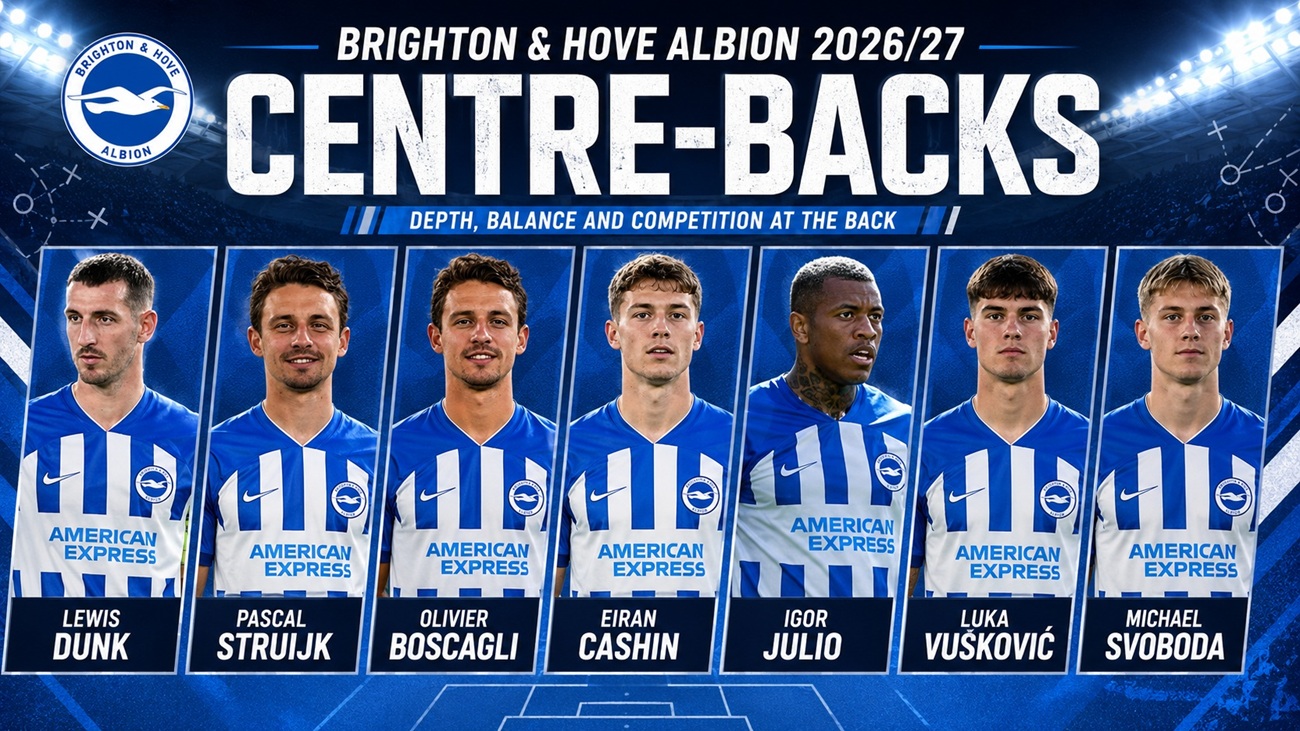
Pascal Struijk arrives with substantial Premier League experience after nearly 200 senior appearances for Leeds. He is left-footed, physically strong, and comfortable progressing possession, making him well-suited to Hürzeler’s desire to build from the back.
Luka Vušković offers a completely different type of upside. The 19-year-old Croatian arrives from Tottenham after an impressive season in Germany and gives Brighton size, aerial presence and long-term potential. He has already featured in European qualifying, starting the first leg against Tromsø.
Lewis Dunk remains enormously important despite Brighton’s younger alternatives. His positioning, passing and understanding of how Brighton defend make him difficult to reproduce simply by selecting another centre-back. Olivier Boscagli provides another experienced left-footed option, while Eiran Cashin, Igor Julio and Michael Svoboda add further depth.
The raw numbers are exceptional. The challenge is establishing hierarchy and partnerships after losing Van Hecke and Webster. Brighton should be able to survive one or even two centre-back absences without resorting to emergency solutions.
Depth Assessment: Very Strong
Read Also: AFC Bournemouth Squad Depth 2026/27: Strengths, Weaknesses and Season Outlook
2. Full-Back Options
Brighton have strengthened the right side with João Costinha. The Portuguese defender joined from Olympiacos after making 74 appearances for the Greek club and brings European experience, energy and a natural right-back profile. His arrival is particularly important following Joel Veltman’s departure.
Hürzeler also has unconventional alternatives. Ferdi Kadıoğlu can play on either side, Jack Hinshelwood has substantial experience filling full-back and midfield roles, and Mats Wieffer has already been used from right-back this season, starting there against Tromsø.
That represents genuine tactical flexibility, although only Costinha is a natural specialist among those right-sided choices. The left is also competitive. Kadıoğlu and Maxim De Cuyper both offer technical quality and attacking ambition, while Igor Julio can provide a more defensive interpretation when required.
Brighton therefore have multiple ways to construct their back four. Hürzeler can select overlapping full-backs, invert them into midfield, or use a more conservative defender depending on the opponent.
Depth Assessment: Strong
Midfield Depth
Central midfield may be Brighton’s deepest and most tactically interesting department. Carlos Baleba provides power, ball-winning, and the ability to carry possession through pressure. He has developed into one of the players whose physical profile changes what Brighton can do without the ball.
Mats Wieffer provides greater positional control and can also drop into defensive roles. Jack Hinshelwood adds another high-energy option capable of operating in midfield or defence, while Yasin Ayari offers mobility and progressive passing.
Pascal Groß remains particularly important following his return to the club in January 2026. Brighton have lost several experienced dressing-room figures this summer, leaving Groß with an even greater leadership responsibility. His passing, crossing, set-piece delivery and understanding of space also give Hürzeler a profile that the younger midfielders do not directly replicate.
Diego Gómez, Matt O’Riley and Malick Yalcouyé further increase the options. This is a good example of true depth rather than simple quantity. Hürzeler can change the characteristics of his midfield. He can use Baleba for athleticism, Groß for control, Wieffer for balance, Hinshelwood for intensity, or O’Riley and Gómez when he wants more attacking contribution.
The concern is immediate availability. Baleba will miss Brighton’s Premier League opener through injury, demonstrating how the depth will already be required rather than merely sitting unused on the bench.
Depth Assessment: Very Strong
Attacking Depth
1. Wide Options
When everyone is fit, Brighton have genuine quality on both wings. Kaoru Mitoma remains the outstanding left-sided option. His ability to receive wide, isolate defenders, and accelerate into the penalty area gives Brighton a player capable of creating opportunities without requiring elaborate buildup.
Yankuba Minteh provides similar directness from the opposite side. His speed gives Brighton a threat behind defensive lines and makes opponents reluctant to push their left-back too high. The immediate problem is that neither is available for the opening Premier League match. Mitoma and Minteh are both among four Brighton players ruled out against Aston Villa.
That will push Ibrahim Osman and potentially Amario Cozier-Duberry closer to important minutes. Georginio Rutter can also begin from a wide position, although his game naturally pulls him into central spaces rather than providing conventional touchline width. Brighton therefore have good attacking numbers, but Mitoma and Minteh remain significantly more established than the alternatives.
This is precisely where the distinction between potential and present depth matters. Osman and Cozier-Duberry are exciting players, but asking them to replace senior international wingers for a prolonged period would represent a much bigger test.
Depth Assessment: Strong when fit; Adequate during the current injuries
2. Centre-Forward Options
The departure of Danny Welbeck has created a fascinating battle at centre-forward. Welbeck brought far more than goals. His movement, pressing intelligence and ability to connect with attacking midfielders made him an important tactical reference point. He also supplied experience to an exceptionally young squad before joining Chelsea this summer.
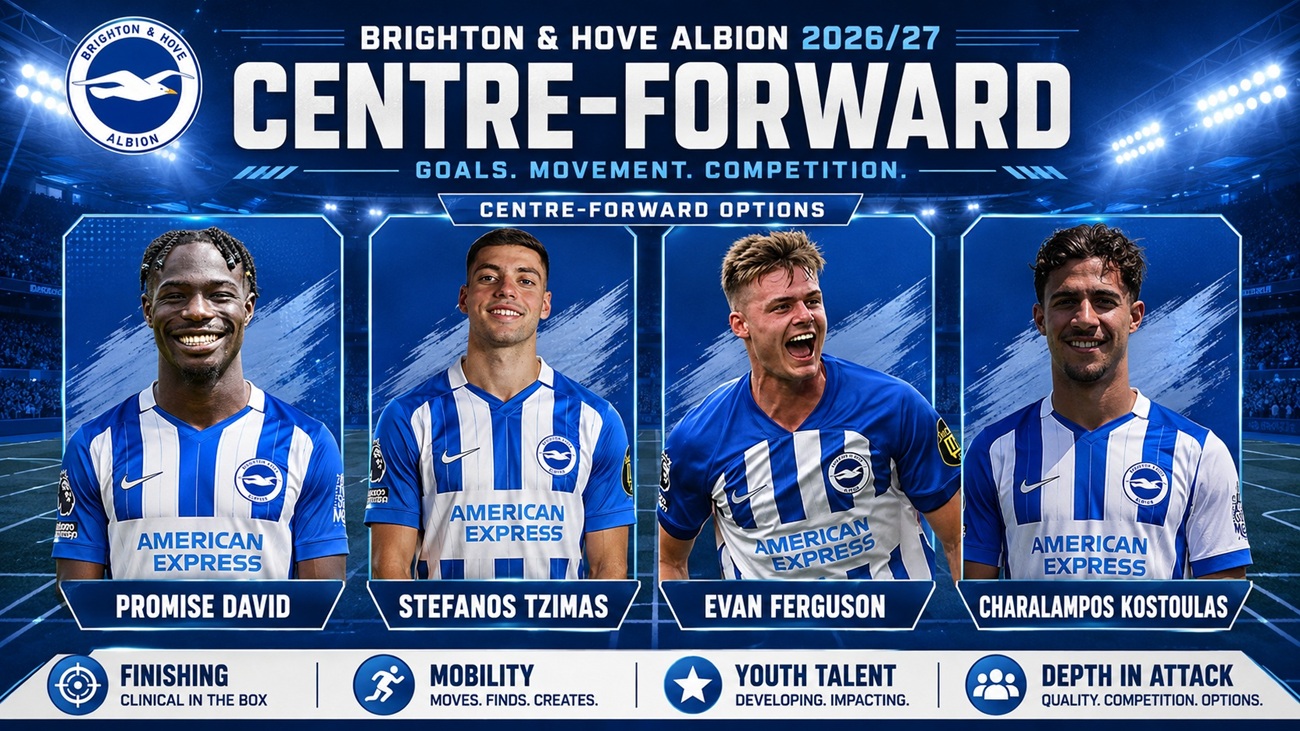
Promise David has been added to provide a more physical specialist striker. The Canada international scored 41 goals in 82 appearances for Union Saint-Gilloise and arrives on a season-long loan with an obligation to buy if certain conditions are met. Brighton specifically described him as an out-and-out striker with strong physical attributes.
Stefanos Tzimas remains another important option but is currently injured. Evan Ferguson is also back in the squad and represents one of the most intriguing variables. At his best, his size, finishing and penalty-box movement give Brighton a genuine Premier League centre-forward. The challenge is turning that talent into consistent availability and production.
Charalampos Kostoulas provides another young attacking option and has already been used in senior matches. Brighton therefore have substantial potential at striker but less certainty than they had with Welbeck.
If David adapts quickly or Ferguson re-establishes himself, the position could become a strength. If neither produces consistently and Tzimas’ availability remains disrupted, Brighton may find themselves possessing several strikers without one unquestioned first choice.
Depth Assessment: Adequate with potential to become Strong
How Much Quality Is There Beyond the Starting XI?
Brighton’s strongest XI is difficult to define because Hürzeler changes personnel and roles according to opposition. A possible fully fit side could feature Verbruggen; Costinha, Dunk, Struijk and Kadıoğlu; Baleba and Groß; Minteh, Rutter and Mitoma; with David or another striker leading the line.
Even then, players such as Vušković, Boscagli, De Cuyper, Hinshelwood, Wieffer, Ayari, O’Riley, Gómez, Ferguson and Tzimas could remain outside that team. That is substantial depth.
The key difference between Brighton and the Premier League’s richest squads is certainty. Many of Hürzeler’s alternatives are young players still developing rather than proven stars waiting on the bench. The ceiling is extremely high. The floor is less predictable.
Where the Squad Is Strongest
Centre-back is the obvious starting point. Dunk, Struijk, Boscagli, Vušković, Cashin, Igor and Svoboda give Hürzeler an unusually large pool of options.
Central midfield is similarly impressive. Brighton can lose one player without being forced to change the entire system, and several midfielders can perform multiple roles.
Left-back and left-sided defence also look particularly secure, with Kadıoğlu, De Cuyper, Struijk, Boscagli and Igor all capable of contributing in different ways.
Those numbers should be particularly useful if Brighton qualify for the Conference League league phase.
Where the Squad Looks Vulnerable
The wings become considerably thinner when Mitoma and Minteh are both unavailable. Brighton have alternatives, but the quality and experience drop-off is clearer than it is at centre-back or central midfield. Centre-forward is another question.
There are several candidates, but Welbeck’s departure means Hürzeler has lost an established player who understood exactly what was expected. David is new to English football, Tzimas is currently injured, and Ferguson is trying to re-establish himself.
Leadership should also be monitored. Milner, March, Webster, Veltman and Welbeck represented an enormous amount of experience. Hürzeler has acknowledged that those players cannot simply be replaced individually and expects others such as Verbruggen, Hinshelwood and Rutter to accept greater responsibility.
Read Also: Aston Villa Squad Depth 2026/27: Strengths, Weaknesses and Season Outlook
Key Players for Squad Stability
1. Bart Verbruggen
Brighton have an experienced backup in Steele, but Verbruggen’s combination of athletic goalkeeping and comfort in possession makes him difficult to replicate over a long run.
2. Carlos Baleba
The midfield is deep, yet Baleba provides a physical dimension that no alternative reproduces exactly. Against athletic Premier League midfields, his ability to recover possession and then carry the ball forward can transform transitions.
3. Kaoru Mitoma
Brighton have several young attackers, but Mitoma remains the most proven one-versus-one threat in the squad. His current injury shows why having attacking numbers does not automatically mean Brighton possess equivalent attacking depth.
How Positional Versatility Strengthens the Squad
Versatility is central to Brighton’s squad planning. Kadıoğlu can operate on either side of defence. Hinshelwood can play as a midfielder or full-back. Wieffer has been used in midfield and at right-back. Struijk can play centre-back, left-back or defensive midfield if required, although centre-back is clearly his primary role.
Rutter can operate as a No. 10, second striker or from wider attacking positions, while Gómez and O’Riley can move between central and advanced midfield roles. This allows Hürzeler to solve absences through structural changes rather than always relying on direct replacements.
There is still a limit. Using a midfielder at right-back because he understands the system is genuine tactical flexibility; relying on him there for months because the squad lacks specialists would be a different matter.
Young Players Who Could Add Depth
Brighton’s entire recruitment model means the distinction between “young player” and “first-team player” can become blurred. Vušković is only 19 but already has significant senior experience. Kostoulas and Tzimas are young forwards expected to contribute at first-team level rather than simply develop in the academy.
Cozier-Duberry and Osman are also close enough to senior involvement that the injuries to Mitoma and Minteh could create immediate opportunities. Malick Yalcouyé has already started in European qualifying and offers another youthful midfield solution. The depth is exciting, but Brighton must avoid expecting all of these players to mature simultaneously. Young players inevitably fluctuate in form.
How Injuries Could Test the Squad
Brighton are already dealing with exactly that issue. Baleba, Minteh, Mitoma and Tzimas are all unavailable for the opening league match against Aston Villa. One of those injuries in isolation would be relatively easy to manage. Four absences spread across midfield and attack produce a different challenge, particularly when Brighton are also playing Conference League qualifiers around the start of the domestic season.
Defensively, the squad appears capable of absorbing multiple injuries. In attack, simultaneous absences of Mitoma and Minteh immediately reduce the number of proven match-winners available. The squad therefore appears more injury-resistant through the middle and at the back than it does in wide attacking areas.
Read Also: Arsenal Squad Depth 2026/27: Strengths, Weaknesses and Season Outlook
Fixture Congestion and Rotation
Brighton’s workload depends heavily on whether they finish the job against Tromsø. They drew the away leg 0-0 and must win the return match at the Amex to progress to the Conference League league phase. If they qualify, European competition will transform the season.
Thursday-night fixtures followed by Premier League games create short recovery periods, while the FA Cup and EFL Cup add further demands. That would make Brighton’s enormous centre-back and midfield pools genuinely valuable.
Hürzeler could rotate Struijk, Vušković, Boscagli and Dunk rather than relying on one central partnership. Groß, Baleba, Hinshelwood, Wieffer, Ayari and others would allow similar changes in midfield. Attack is where workload management could become more complicated unless the injured players return quickly.
Can Brighton Compete on Multiple Fronts?
If they qualify for the Conference League, the squad appears deep enough to compete seriously without automatically sacrificing the Premier League. Brighton’s defensive and midfield numbers are well suited to European rotation, and several young players would benefit from regular continental minutes.
The Conference League could be particularly valuable for Vušković, Kostoulas, Cozier-Duberry, Yalcouyé and other developing players who need competitive football. However, Hürzeler would need to manage his established attackers carefully.
Brighton cannot expect Mitoma, Minteh and Rutter to carry the creative burden across every league and European fixture. Their ability to challenge effectively on several fronts will depend on whether David, Ferguson, Osman and the younger forwards provide consistent production.
Where the Squad Could Still Be Strengthened
Brighton do not need another centre-back simply to increase numbers. If they make another significant signing, attacking depth appears more relevant. Another proven wide player would reduce the drop-off when Mitoma or Minteh is unavailable and prevent Brighton from asking young prospects to assume too much responsibility too quickly.
The striker position could also merit attention if the club is not convinced by the current hierarchy, although David’s arrival suggests Brighton want to assess their existing options first. With the transfer window still open, departures could also change those priorities.
Overall Squad Depth Assessment
Overall Assessment: Strong Depth With Excellent Defensive and Midfield Options
Brighton possess one of the most extensive squads outside the Premier League’s traditional financial elite. Centre-back depth is exceptional. Central midfield is filled with different profiles, and the full-back positions offer flexibility. The uncertainty exists further forward.
Brighton have numerous talented attackers, but Mitoma and Minteh remain particularly difficult to replace, while the centre-forward hierarchy is still developing following Welbeck’s departure. Current injuries make that distinction especially visible.
How Squad Depth Could Shape Brighton’s 2026/27 Season
Brighton’s depth could become one of their greatest advantages if European qualification is secured. Hürzeler does not need to approach every match with the same 13 or 14 players. He can rotate substantially in defence and midfield while maintaining the principles of his system.
That creates opportunities to keep key players fresh and accelerate the development of younger members of the squad. The challenge is turning potential into dependable production. Brighton may have seven centre-backs, but they cannot solve every attacking problem by moving another defender into the team.
Their season could therefore depend on whether the second group of forwards becomes as trustworthy as the second group of defenders and midfielders. If that happens, Brighton appear equipped to balance domestic football with another European campaign.
Conclusion
Brighton’s 2026/27 squad is deep, versatile and filled with players capable of developing into much more valuable contributors as the season progresses. Centre-back and midfield are the obvious strengths. The additions of Pascal Struijk and Luka Vušković have helped compensate for Jan Paul van Hecke and Adam Webster’s departures, while João Costinha improves the specialist right-back options.
The greater uncertainty surrounds attack. Mitoma and Minteh remain difficult to replace, four important players are currently injured, and the centre-forward position is being reshaped following Welbeck’s move to Chelsea.
Overall, Brighton have strong squad depth and enough options to manage a demanding season. If they secure Conference League qualification, the size and flexibility of Hürzeler’s group should become a genuine advantage. The major question is whether Brighton’s promising attacking alternatives can provide the same reliability already visible across their defence and midfield.