
Chelsea enter 2026/27 with a new manager, another reshaped squad, and considerably more talent than their 10th-place Premier League finish last season would suggest.
Xabi Alonso officially took charge on July 1 after Chelsea ended 2025/26 with 52 points and without European qualification. That absence from Europe is significant. Alonso has a large squad but fewer matches than several direct rivals, meaning Chelsea’s challenge is not simply finding enough players — it is establishing a clear hierarchy and turning depth into consistency.
Morgan Rogers, Maxence Lacroix, Marco Palestra, Geovany Quenda, Valentin Barco, Jordan Henderson, Pep Chavarria and Danny Welbeck are among the summer additions, while Emmanuel Emegha has also joined the first-team group following his previously agreed move from Strasbourg.
There have been important departures too, including Marc Cucurella and Andrey Santos, while Alejandro Garnacho is spending the season on loan at Aston Villa. Chelsea therefore have exceptional numbers. The more useful question is whether Alonso has enough quality in the right roles — and whether he can keep such a large group productive without European football.
Read Also: Brighton & Hove Albion Squad Depth 2026/27: Strengths, Weaknesses and Season Outlook
Chelsea’s 2026/27 Squad at a Glance
Chelsea’s core first-team options currently include:
Goalkeepers: Robert Sánchez, Mike Penders, Teddy Sharman-Lowe, Gaga Slonina
Right-back/wing-back: Reece James, Malo Gusto, Marco Palestra, Josh Acheampong
Centre-back: Levi Colwill, Wesley Fofana, Maxence Lacroix, Tosin Adarabioyo, Mamadou Sarr, Aaron Anselmino, Jorrel Hato
Left-sided defence: Jorrel Hato, Pep Chavarria, Valentin Barco
Central midfield: Moisés Caicedo, Enzo Fernández, Romeo Lavia, Jordan Henderson, Dário Essugo, with James and Barco also capable of central roles
Attacking midfield/wide attack: Cole Palmer, Morgan Rogers, Pedro Neto, Jamie Gittens, Estêvão, Geovany Quenda, Mykhailo Mudryk
Centre-forward: João Pedro, Nicolas Jackson, Liam Delap, Danny Welbeck, Emmanuel Emegha
Benoît Badiashile and Marc Guiu remain contracted Chelsea players and are still listed on the club’s official player profiles, but neither was assigned a number in Chelsea’s initial 2026/27 squad-number announcement. With the transfer window still open, it is more sensible to regard their roles as unresolved rather than build the depth analysis around them.
Goalkeeper Depth

Robert Sánchez remains the most established senior option. Behind him, Mike Penders is one of Chelsea’s most highly rated young goalkeepers and has been involved throughout Alonso’s preparations. Teddy Sharman-Lowe and Gaga Slonina provide further competition.
The quantity is substantial, but goalkeeper is one of the few positions where Chelsea’s numbers are more impressive than their proven Premier League depth. Sánchez has extensive top-flight experience. The alternatives do not yet offer the same evidence over a sustained Premier League run.
Chelsea would therefore be comfortable handling cup rotation or a short absence, but losing Sánchez for an extended period would place considerable responsibility on a relatively inexperienced replacement.
Depth Assessment: Adequate
Defensive Depth
1. Centre-Back Options
Chelsea are extremely well stocked centrally. Colwill offers left-footed buildup quality and has returned after a knee ligament injury disrupted much of his 2025/26 season. His passing should be particularly valuable in Alonso’s attempts to construct attacks from deeper areas.
Fofana brings recovery speed and aggressive defending, while Lacroix adds another athletic centre-back with experience playing in proactive defensive systems. Tosin provides size and Premier League experience. Hato can operate centrally or from the left, while Sarr, Anselmino and Acheampong increase Alonso’s options further.
This is genuine depth because Chelsea can lose one or two centre-backs without immediately resorting to emergency cover. The challenge is consistency. Alonso needs to establish a dependable partnership rather than repeatedly changing combinations simply because so many defenders are available.
Depth Assessment: Very Strong
Read Also: Brentford Squad Depth 2026/27: Strengths, Weaknesses and Season Outlook
2. Full-Back and Wing-Back Options
Right-back is arguably Chelsea’s deepest defensive position. James remains the highest-level option when available, but Gusto is already a proven Premier League alternative. Palestra adds another exciting possibility after arriving from Atalanta. His speed, direct running and wing-back experience should suit Alonso particularly well if Chelsea use the 3-4-3 structure seen during parts of pre-season.
James also gives Alonso unusual tactical flexibility. He can play as a conventional right-back, wing-back or move into midfield. The left side has been rebuilt following Cucurella’s departure. Hato can play there, Chavarria provides a natural senior left-back, while Barco offers a more adventurous technical option capable of moving into midfield. Chelsea therefore have both specialist cover and tactical variety on either side.
Depth Assessment: Very Strong
Midfield Depth
Caicedo remains the foundation. His ball-winning, mobility, and ability to protect Chelsea during transitions are difficult to reproduce. Alonso can surround him with different profiles depending on the opponent. Enzo provides passing range and progression. Lavia offers press resistance and control in deeper areas, while Essugo gives Chelsea another defensive-minded option.
Henderson changes the profile of the group further. He may not be expected to start every week, but his experience and positional discipline provide a useful contrast to Chelsea’s younger midfielders. James has also been used centrally by Alonso during pre-season, including alongside Caicedo against Real Sociedad.
Chelsea therefore have enough midfield options to change system without significantly reducing overall quality. The one qualification is Caicedo. Chelsea can replace him, but none of the alternatives naturally reproduces everything he gives the team defensively.
Depth Assessment: Very Strong
Attacking Depth
1. Creative and Wide Options
This is where Chelsea’s squad becomes particularly impressive. Palmer remains the most important creative player, but the arrival of Rogers should reduce the need for almost every dangerous attack to pass through him.
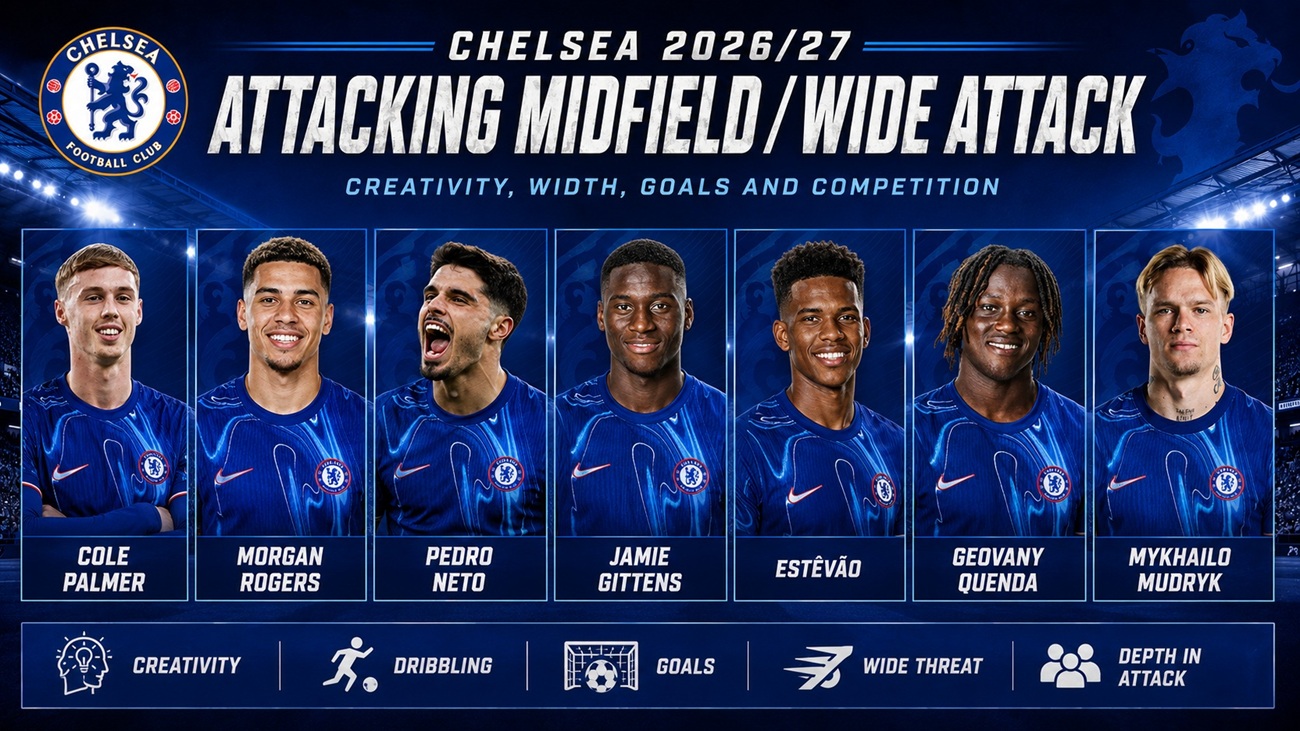
Rogers offers carrying ability, physical power and movement into the penalty area. He can play centrally or drift from the left, making him particularly interesting alongside Palmer rather than simply as his backup.
Neto provides pace and direct running. Gittens gives Alonso another natural wide threat, while Estêvão can operate from the right or in more central attacking areas. Quenda adds another left-footed option who can play as a winger or wing-back.
Mudryk has returned to first-team football after his anti-doping proceedings were resolved and has been reintegrated during pre-season. After such a long competitive absence, however, it would be premature to assume he will immediately return at his previous level.
The strength here is not simply quantity. Alonso can select different attacking profiles depending on whether Chelsea need width, ball carrying, creativity between the lines or pace behind a defence.
Depth Assessment: Elite
2. Centre-Forward Options
Chelsea also have an unusually crowded striker department. João Pedro enters the season wearing the No. 9 shirt after an excellent 2025/26 campaign and looks well suited to Alonso’s fluid attacking ideas because he can score, combine with midfielders and drop away from the defensive line.
Jackson provides running power and experience leading Chelsea’s attack. Delap is a more physical penalty-box option, while Welbeck offers experience, movement and the ability to connect play. Emegha adds another physically imposing forward to the group.
That is more centre-forward depth than Chelsea require for a season without European football. The issue is therefore not whether Alonso has alternatives. It is whether all of those forwards can receive enough meaningful minutes to remain useful. Departures before the transfer deadline would not necessarily weaken Chelsea if they leave a clearer and better-balanced hierarchy.
Depth Assessment: Very Strong
How Much Quality Is There Beyond the Starting XI?
Chelsea can make substantial changes without immediately fielding a weak team. Alonso’s final strongest XI remains uncertain, but his 3-1 pre-season win over Real Sociedad offered a useful indication. Chelsea used Sánchez behind Fofana, Lacroix and Colwill, with Palestra and Neto as wing-backs, James alongside Caicedo in midfield and Palmer and Rogers supporting João Pedro.
That still left players including Enzo, Lavia, Gusto, Hato, Chavarria, Estêvão, Gittens, Quenda and several strikers available. That is outstanding depth. It also illustrates Chelsea’s biggest squad-management problem: several players good enough to start Premier League matches will regularly miss the strongest XI.
Read Also: AFC Bournemouth Squad Depth 2026/27: Strengths, Weaknesses and Season Outlook
Where Chelsea Are Strongest
Attacking midfield and wide areas stand out. Palmer, Rogers, Neto, Gittens, Estêvão and Quenda provide quality as well as different tactical profiles.
Right-sided defence is similarly strong. James, Gusto and Palestra mean Alonso should rarely need to overwork one player.
Centre-back also has exceptional numbers, particularly following Lacroix’s arrival and Colwill’s return.
Chelsea should be capable of surviving isolated injuries across most outfield positions without dramatically changing their ambitions.
Where Chelsea Look Vulnerable
Goalkeeper is the clearest area where Chelsea do not have two proven Premier League options of similar standing. The other concern is not a shortage but imbalance. There are too many senior forwards for a team playing only domestic football.
If Alonso cannot establish a clear hierarchy, players could struggle for rhythm and opportunities. Chelsea are also particularly dependent on Caicedo’s defensive influence. Lavia, Essugo and Henderson provide alternatives, but none is an exact replacement.
Key Players for Squad Stability
1. Moisés Caicedo
Caicedo gives Chelsea the defensive security required to support so many attack-minded players. His availability will be especially important if Alonso regularly asks his wing-backs to advance.
2. Cole Palmer
Rogers gives Chelsea another elite attacking option, but Palmer remains their most established creator and one of the squad’s most reliable match-winners.
3. Levi Colwill
Chelsea have numerous centre-backs, yet Colwill’s left-footed buildup and ability to break pressure through passing give him a particularly important role in Alonso’s structure.
How Versatility Strengthens Chelsea
Alonso has already demonstrated a preference for fluid structures. James can move between defence and midfield. Hato can play left-back or centre-back. Barco can operate on the left or centrally. Rogers can attack from midfield or the flank, while Quenda can be used as a winger or wing-back.
That versatility means Chelsea do not need a direct position-for-position substitute every time someone is unavailable. It also allows Alonso to move between a back three and back four without completely changing personnel.
How Injuries Could Test the Squad
Chelsea begin the season in a relatively healthy position. Ahead of the Premier League opener against Fulham, Alonso reported no fresh injury concerns. Welbeck had been managing a minor issue but was expected back in training, while Chelsea’s players who returned later after the World Cup were available for selection.
That gives Alonso almost the opposite problem to several rivals: deciding who to leave out. Defence and attack should withstand one or two absences comfortably. Longer injuries to Caicedo or Palmer would be more significant because Chelsea would lose unique qualities, even though the squad contains players capable of occupying their positions.
Fixture Congestion and Rotation
Chelsea’s lack of European football changes how their squad should be judged. They will compete in the Premier League, FA Cup and EFL Cup, but they do not have eight European league-phase matches filling the autumn and winter schedule.
That should benefit Alonso tactically. He will have more training time and more recovery days than managers balancing Champions League, Europa League or Conference League football. It also reduces the need for such a huge first-team group.
Domestic cups will provide opportunities for younger and rotational players, but Chelsea cannot rely on European fixtures to distribute minutes across 25 or more senior options.
Can Chelsea’s Squad Support a Major Improvement?
On squad quality alone, Chelsea have enough depth to perform considerably better than last season. The defence contains multiple starting-level options. Midfield has balance and technical quality. The attack has goals, creativity and versatility. What Chelsea need is coherence.
Alonso must establish a core team rather than allowing the size of the squad to create constant changes. The absence of European football should help because he can spend more time coaching the tactical details of his system. Chelsea do not need more players simply to make the squad deeper. They need to identify which players genuinely belong in the rotation.
Overall Squad Depth Assessment
Overall Assessment: Elite Depth, but an Oversized Squad
Few Premier League teams can match Chelsea for sheer first-team options. Their strongest depth is in attack, central defence and the right side, while midfield also contains several credible combinations.
Goalkeeper represents the clearest quality drop behind the starter, and Caicedo remains unusually difficult to replace. The larger concern is squad balance. Without European football, Chelsea may actually benefit from reducing the group before the transfer window closes.
How Squad Depth Could Shape Chelsea’s 2026/27 Season
Chelsea should rarely be able to blame a single injury for significantly weakening the team. Alonso has alternatives across almost every outfield position, substitutes capable of changing matches and enough versatility to alter his tactical structure without completely rebuilding the XI. That gives Chelsea a major advantage over the course of a 38-game league campaign. The next step is turning options into consistency.
If Alonso establishes a reliable defensive unit, finds the correct balance around Caicedo and successfully combines Palmer and Rogers with Chelsea’s other attackers, squad depth should become one of the club’s greatest strengths. If the hierarchy remains unclear, the same enormous squad could instead make selection and player development unnecessarily complicated.
Conclusion
Chelsea enter 2026/27 with exceptional squad depth but also an obvious need for greater clarity. Attack is the strongest department, with Palmer, Rogers, Neto, Estêvão, Gittens and Quenda supporting a deep group of centre-forwards.
Centre-back and right-back are also extremely well covered, while Caicedo, Enzo and Lavia give Alonso a high-quality midfield foundation. The clearest weakness is the drop in proven experience behind Sánchez, while Caicedo remains particularly difficult to replace.
Overall, Chelsea have more than enough talent to handle injuries and domestic rotation. Their challenge is no longer accumulating depth. It is establishing a coherent first-choice group and ensuring that one of the Premier League’s largest squads functions like a team rather than simply a collection of options.