
Aston Villa enter 2026/27 facing a very different challenge from the one Unai Emery inherited when he arrived at Villa Park. After finishing fourth in the Premier League and winning the Europa League last season, Villa are no longer simply trying to break into the European places. They now have to maintain those standards while competing in the Champions League.
That makes squad depth increasingly important. Villa have undergone significant change during the summer. Morgan Rogers, Youri Tielemans and Lucas Digne have departed, while João Gomes, Johan Manzambi and Alejandro Garnacho have arrived to help reshape the midfield and attack. Zion Suzuki and Matteo Ruggeri have also strengthened the goalkeeper and left-back positions, while Aaron Wan-Bissaka adds another experienced option on the right.
Further change remains possible before the September 1 transfer deadline. Ezri Konsa is close to leaving for Arsenal, while the futures of Ollie Watkins and Emiliano Martínez have also attracted significant attention. Villa therefore have plenty of players, but the more important question is whether Emery still has the right balance of quality and profiles to compete effectively on several fronts.
Read Also: Arsenal Squad Depth 2026/27: Strengths, Weaknesses and Season Outlook
Aston Villa’s 2026/27 Squad at a Glance
Villa’s current senior options can broadly be organized as follows:
Goalkeepers: Emiliano Martínez, Zion Suzuki, Marco Bizot
Right-back options: Matty Cash, Aaron Wan-Bissaka
Centre-backs: Ezri Konsa, Pau Torres, Tyrone Mings, Victor Lindelöf, Modou Keba Cisse
Left-back options: Ian Maatsen, Matteo Ruggeri
Defensive/central midfield: Boubacar Kamara, João Gomes, John McGinn, Amadou Onana, Ross Barkley, Lamare Bogarde
Attacking midfield: Johan Manzambi, Emiliano Buendía, McGinn, with younger players such as George Hemmings also pushing for involvement
Wide attack: Alejandro Garnacho, Leon Bailey, Alysson, Buendía
Centre-forward: Ollie Watkins, Tammy Abraham, Brian Madjo
This is not necessarily Villa’s final squad. The open transfer window means several positions could still change before the Champions League squad is registered.
Goalkeeper Depth
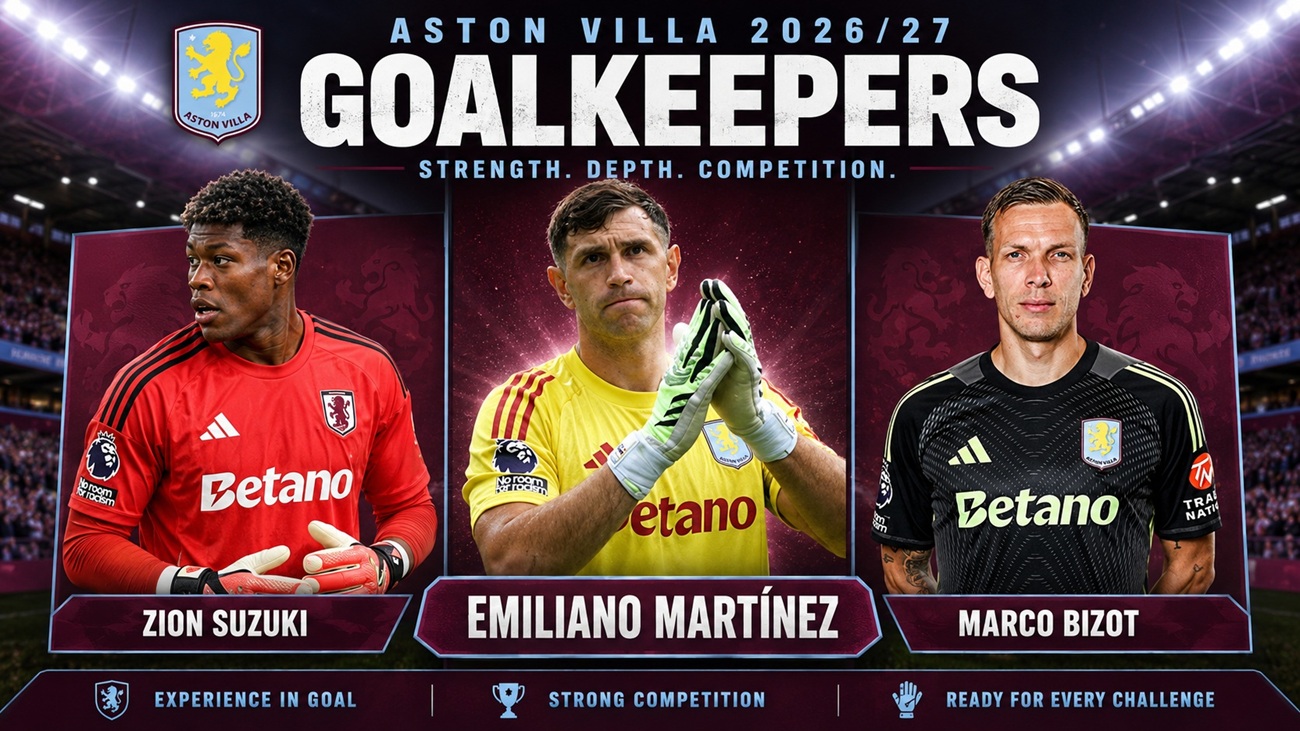
Villa currently have unusually strong numbers in goal. Emiliano Martínez has been one of the most important players of the Emery era, combining elite-level shot-stopping with experience in major matches. His command of the penalty area and willingness to defend aggressively behind Villa’s defensive line have made him particularly valuable.
The arrival of Zion Suzuki changes the situation. The Japan international joins after establishing himself in Serie A with Parma and arrives as far more than an inexperienced backup. His athleticism, physical presence and aerial confidence give Emery a goalkeeper capable of genuinely competing for Premier League minutes.
Marco Bizot provides another experienced senior option behind them. If Martínez remains, Villa arguably have more goalkeeper depth than they require. If he leaves before the transfer window closes, Suzuki appears positioned to become the long-term solution rather than Villa suddenly being left without a credible No. 1. The major uncertainty is therefore hierarchy rather than quantity.
Depth Assessment: Very Strong
Defensive Depth
1. Centre-Back Options
Central defence is considerably more uncertain. Pau Torres remains one of Emery’s most important defenders because of his ability to progress possession from the back. His left-footed distribution allows Villa to build through pressure rather than simply clearing the ball when opponents press high.
Tyrone Mings provides experience, strength and aerial presence, while Victor Lindelöf supplies another experienced central option. Modou Keba Cisse represents younger depth with significant potential, but he should not immediately be treated as the equivalent of an established Premier League starter.
Then there is Konsa. At the time of writing, he remains a Villa player, but Arsenal have agreed a deal for the England international. If the transfer is completed as expected, Villa will lose arguably their most dependable defender. That would leave reasonable numbers at centre-back but a noticeable quality question.
Pau and Mings could form a partnership, with Lindelöf and Cisse behind them, but losing Konsa removes a defender capable of handling quick attackers, defending large spaces and moving across to right-back when required. Villa may therefore have four central defenders after his departure without necessarily having four interchangeable options.
Depth Assessment: Adequate if Konsa leaves
Read Also: Rodri Joins Barcelona From Manchester City on Deal Until 2030
2. Full-Back Options
Full-back is stronger. Matty Cash has been one of Emery’s most frequently used players and provides energy, overlapping runs and familiarity with Villa’s defensive structure. Aaron Wan-Bissaka gives Villa something different. He is particularly strong in isolated one-versus-one defensive situations and should allow Emery to rotate Cash rather than asking the Poland international to absorb an extremely heavy workload.
The left side has also been rebuilt following Digne’s departure. Ian Maatsen now has a clearer route to regular football, while Matteo Ruggeri arrives from Atlético Madrid with experience in both La Liga and the Champions League. Ruggeri is also comfortable operating as a more aggressive wide defender, giving Emery tactical flexibility depending on how high he wants his left side to play. Villa have therefore lost an experienced left-back in Digne but replaced him with a younger player capable of competing directly with Maatsen.
Depth Assessment: Strong
Midfield Depth
Villa’s midfield has undergone one of the biggest transformations. Tielemans was crucial to their ability to control possession and progress through midfield last season. Replacing that influence is not simply a case of adding another midfielder. João Gomes brings a different profile. He is aggressive without the ball, covers ground quickly and offers strong ball-winning ability. Alongside Boubacar Kamara, he could give Villa one of the more combative double pivots in the Premier League.

Kamara remains particularly important because of his positioning. His ability to screen the defence and receive possession under pressure helps Villa connect their defensive and attacking units. John McGinn adds another layer. The captain can play centrally, higher up or from a wider starting position, giving Emery a reliable solution across several tactical structures.
Amadou Onana would normally make this area look exceptionally deep, but his serious knee injury suffered during the World Cup means he cannot be counted as immediate depth. Johan Manzambi is another major addition, although he is a more progressive and attacking midfielder than a direct Tielemans replacement. The Switzerland international can operate as a No. 8 and in more advanced roles, potentially giving Emery another player capable of carrying possession through midfield.
His own recovery from a World Cup knee problem means Villa’s midfield depth on paper is currently stronger than their immediately available depth. Ross Barkley and Lamare Bogarde provide further options. The numbers are good. The question is whether the new combinations can replace Tielemans’ control quickly enough.
Depth Assessment: Strong on paper; currently reduced by injuries
Attacking Depth
1. Wide and Creative Options
Losing Morgan Rogers was a major blow. His importance extended beyond goals and assists. Rogers could receive under pressure, carry the ball through midfield, attack defenders directly, and connect midfield with Watkins. That combination made him difficult to replace with one player.
Villa have instead attempted to distribute those responsibilities. Alejandro Garnacho arrives on loan from Chelsea and provides explosive carrying ability from the left. He can stretch defensive lines, attack space behind full-backs and give Villa a transition threat they sometimes lacked when opponents pushed forward.
Manzambi can provide creativity from central areas once fully available. Buendía offers another route. His preference for operating between defensive lines gives Villa a more traditional creative option, although his game is based more on combination play and passing than Rogers’ physical ball-carrying.
Leon Bailey remains capable of providing pace and one-versus-one threat from the right, while Alysson has gradually moved closer to the senior rotation. Villa therefore have several attacking options, but the key issue is profile. Replacing Rogers’ overall influence may require two or three players sharing his responsibilities rather than one obvious successor.
Depth Assessment: Adequate to Strong
2. Centre-Forward Options
As long as Ollie Watkins remains, centre-forward depth looks healthy. Watkins scored 21 goals across all competitions last season and remains the reference point of Villa’s attack. His movement behind defensive lines, pressing and ability to stretch centre-backs are fundamental to Emery’s system. Tammy Abraham provides an experienced alternative and a more physical penalty-box presence.
Behind them is one of the most intriguing young players in the squad. Brian Madjo has rapidly moved from academy prospect to credible first-team option. The 17-year-old scored against Paris Saint-Germain in the UEFA Super Cup and has the size and physicality to trouble senior centre-backs, although his development still needs to be managed carefully.
Having Abraham and Madjo means Villa are not completely dependent on Watkins for numbers. However, Watkins’ possible departure would change the assessment significantly. Abraham is experienced, but replacing Villa’s leading striker and one of the most consistent Premier League forwards of recent seasons would require more than simply promoting another player in the depth chart.
Depth Assessment: Strong while Watkins remains
How Much Quality Is There Beyond the Starting XI?
Villa still have genuine rotation options. A possible lineup could feature Suzuki or Martínez; Cash, Pau, Mings and Maatsen; Kamara and João Gomes; Bailey, Manzambi and Garnacho; with Watkins leading the attack. That could still leave Wan-Bissaka, Ruggeri, Lindelöf, McGinn, Buendía, Barkley, Abraham and Madjo available depending on injuries and tactical choices.
The problem is that several of Villa’s alternatives do not replicate the player they would replace. There is no exact substitute for Watkins’ movement. There is no simple replacement for Kamara’s positional discipline. Rogers’ ball-carrying has not been directly recreated. Villa therefore possess depth, but Emery may need to alter his tactics more frequently when key starters are unavailable.
Read Also: Ferran Torres Joins PSG: €50m Barcelona Transfer Explained
Where the Squad Is Strongest
Full-back now looks particularly well covered. Cash and Wan-Bissaka provide two experienced right-backs, while Maatsen and Ruggeri give Emery genuine competition on the left.
Goalkeeper is another obvious strength, with Martínez remaining. Suzuki gives Villa an alternative who could eventually become first choice rather than simply filling in during cup matches.
Central midfield numbers are also encouraging. Once Onana and Manzambi are fully available, Emery could choose between Kamara, João Gomes, McGinn, Onana and Manzambi without relying heavily on one fixed combination.
Where the Squad Looks Vulnerable
Centre-back could become the clearest weakness if Konsa completes his move to Arsenal. Villa would still have several defenders, but there would be a difference between numerical depth and reliable Champions League-level depth. Creativity is another area to monitor.
Tielemans and Rogers were responsible for important stages of Villa’s buildup and attacking progression. Manzambi and Garnacho bring significant talent, but both represent change rather than direct replacements. The final concern is availability. Onana is a long-term absentee, while Manzambi has also had to recover from a World Cup injury. Villa cannot immediately benefit from every midfielder listed on their squad sheet.
Key Players for Squad Stability
1. Ollie Watkins
Villa have alternatives at centre-forward but nobody who reproduces Watkins’ combination of running, goals and understanding of Emery’s system. His departure or prolonged absence would significantly alter the attack.
2. Boubacar Kamara
Kamara gives Villa defensive balance. João Gomes can win possession aggressively, but Kamara’s positional intelligence and calm buildup play remain particularly important when Villa face strong pressing teams.
3. Pau Torres
If Konsa leaves, Pau becomes even more important. His passing provides Villa with a route through the first line of pressure, and there is no obvious equivalent left-footed distributor among the other centre-backs.
How Positional Versatility Strengthens the Squad
McGinn remains one of Villa’s most useful players because he can operate centrally, from the right or closer to the striker. Manzambi’s ability to play as an advanced midfielder or deeper No. 8 could also become extremely valuable once he is fully fit.
Bogarde can provide midfield cover while also being used defensively when required, while Wan-Bissaka and Cash give Emery different interpretations of the right-back role. Villa have useful versatility, but they should avoid allowing it to hide genuine specialist shortages. A midfielder being capable of filling in defensively is not the same as having another established centre-back.
Academy and Young Players Who Could Add Depth
Brian Madjo is the obvious player to watch. He is no longer simply being included to gain experience. His Super Cup performance against PSG demonstrated that Emery is prepared to use him at senior level, although expecting a 17-year-old to carry major attacking responsibility would still be unrealistic.
George Hemmings has also pushed closer to first-team involvement after an encouraging summer and can operate in midfield or advanced areas. Young defender Modou Keba Cisse could receive opportunities following the defensive changes, but his immediate role should still be viewed as developmental depth rather than guaranteed first-team quality.
How Injuries Could Test the Squad
Central midfield is already providing an example of the difference between theoretical and available depth. A fully fit combination of Kamara, João Gomes, Onana, McGinn and Manzambi looks excellent. Without Onana and with Manzambi working back toward full availability, the immediate rotation picture is narrower.
Defence could become more sensitive. One centre-back absence would be manageable. Two simultaneous injuries after a Konsa departure could force Emery to rely heavily on Cisse or shift other players away from their natural roles. The attacking unit appears more resilient, especially while Watkins, Abraham and Madjo are all available centrally.
Fixture Congestion and Rotation
Villa’s Champions League return significantly changes the demands on the squad. The league-phase format guarantees eight European matches between September and January before any knockout games are considered. Add 38 Premier League fixtures, the FA Cup and EFL Cup, and Villa could comfortably move beyond 50 competitive matches if they progress deeply in several competitions.
That makes rotation unavoidable. Cash no longer needs to play almost every important game because Wan-Bissaka is available. Maatsen can rotate with Ruggeri. Abraham can reduce Watkins’ workload, while Villa’s midfield should eventually offer several combinations. The real test will come during Champions League weeks when Emery wants to rest important players without lowering the level of the team dramatically.
Can Aston Villa Compete on Multiple Fronts?
The squad appears capable of handling a multi-competition season, but there are more questions than there were before the summer rebuild began. Villa have strengthened several areas and lowered the average age of the group. Suzuki, João Gomes, Manzambi, Garnacho and Ruggeri provide both immediate ability and longer-term value. However, Rogers, Tielemans and Digne represent proven performance within Emery’s system.
If Konsa also leaves, Villa will have lost four major players from a side that finished fourth and won the Europa League. The quality of the replacements is not necessarily the issue. The challenge is how quickly they become a functioning unit. Emery’s ability to reorganize teams tactically should help, but Champions League opponents will punish weaknesses more severely than most Europa League sides.
Where the Squad Could Still Be Strengthened
Centre-back should become the priority if Konsa’s transfer is completed. Villa would benefit from another defender comfortable defending a high line and capable of starting major Premier League and Champions League matches immediately. The attacking situation depends heavily on Watkins. If he remains, another striker is not essential.
If he leaves before the deadline, replacing his goals and movement would become one of the most important pieces of business Villa could make. Another creative midfielder could also help if Manzambi’s recovery takes time, although Villa already have enough numbers that any addition should improve the quality of the group rather than simply increase its size.
Overall Squad Depth Assessment
Overall Assessment: Good Depth With Important Uncertainties
Villa have a larger and more flexible squad than the list of summer departures might initially suggest. Goalkeeper and full-back depth are particularly strong, the midfield contains several high-level options, and Watkins, Abraham and Madjo provide a useful range of centre-forward profiles. The concerns are concentrated rather than widespread.
Konsa’s expected departure could weaken central defence, while Villa must replace the creative influence lost through Rogers and Tielemans. Injuries to Onana and Manzambi also mean the available squad is currently shallower than the theoretical squad. The transfer window therefore remains important.
How Squad Depth Could Shape Aston Villa’s 2026/27 Season
Villa’s success may depend less on whether their new signings are individually talented and more on whether Emery can integrate them quickly. The squad contains enough options to rotate through ordinary Premier League weeks. The challenge becomes greater when league matches are placed around Champions League fixtures and the strongest players cannot start three times within a short period.
Having Wan-Bissaka, Ruggeri, Abraham, Buendía and eventually a fully fit group of midfielders should help Emery manage those demands. What Villa cannot afford is for weaknesses to become concentrated. A defensive injury crisis after Konsa’s departure or the loss of Watkins without an adequate replacement could expose the difference between having a large squad and having true depth. If those situations are avoided, Villa have enough quality and tactical flexibility to remain competitive across a demanding schedule.
Conclusion
Aston Villa’s 2026/27 squad is undergoing evolution rather than simple expansion. The arrivals of João Gomes, Johan Manzambi, Alejandro Garnacho, Zion Suzuki, Matteo Ruggeri and Aaron Wan-Bissaka have refreshed a group that needed greater depth for Champions League football. Full-back and goalkeeper are particularly well covered, while the midfield could become a major strength once injured players return.
The biggest questions surround central defence, creativity and the unresolved future of Watkins. Losing Konsa after already parting with Rogers, Tielemans and Digne would place considerable pressure on Villa’s new signings to settle quickly.
As the squad currently stands, Emery has enough options to rotate and compete on several fronts. Whether that depth remains sufficient will depend heavily on Villa’s final business before the transfer window closes.