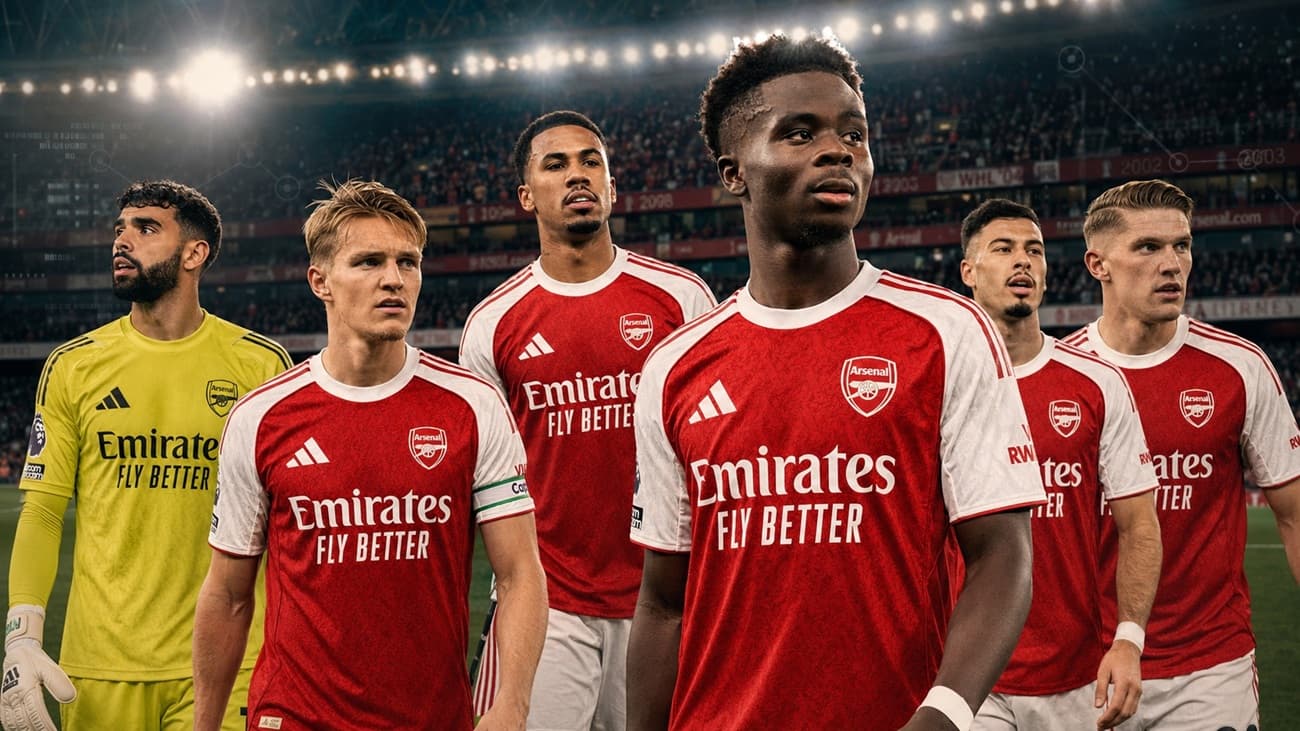
Arsenal enter the 2026/27 season in a position they have not experienced for more than two decades: as defending Premier League champions. Mikel Arteta’s side finally converted years of progression into the league title in 2025/26, while also reaching the Champions League final, raising the expectations surrounding what this squad can achieve next.
The response has been to strengthen an already formidable group. Bruno Guimarães has arrived from Newcastle United, Christos Tzolis has added another attacking option, Piero Hincapié’s move from Bayer Leverkusen has been made permanent, and Illan Meslier has joined the goalkeeping department. Leandro Trossard, Jakub Kiwior and Christian Nørgaard are among the notable departures.
The important question, however, is not whether Arsenal can name an excellent starting XI. They clearly can. The real measure of Arsenal’s squad depth in 2026/27 is what happens when Arteta has to rotate that XI during a season involving the Premier League, Champions League and domestic cups.
With the transfer window still open until September 1, the group may change further. For now, Arsenal appear exceptionally deep in some areas but are already being reminded that depth on paper and immediately available depth are not always the same thing.
Read Also: Premier League Injury Updates 2026/27: All 20 Clubs
Arsenal’s 2026/27 Squad at a Glance
Arsenal’s current senior options can broadly be organized as follows:
Goalkeepers: David Raya, Kepa Arrizabalaga, Illan Meslier
Right-back options: Jurriën Timber, Ben White
Centre-backs: William Saliba, Gabriel Magalhães, Cristhian Mosquera, Piero Hincapié
Left-back options: Riccardo Calafiori, Hincapié, Myles Lewis-Skelly
Defensive/central midfield: Declan Rice, Martín Zubimendi, Bruno Guimarães, Mikel Merino, Lewis-Skelly
Advanced midfield: Martin Ødegaard, Eberechi Eze, with Ethan Nwaneri among the additional options, while his future remains unresolved
Right wing: Bukayo Saka, Noni Madueke
Left wing: Christos Tzolis, Gabriel Martinelli, with Eze capable of operating from the left
Centre-forward: Viktor Gyökeres, Kai Havertz, Gabriel Jesus
Max Dowman is also emerging as a genuine young attacking option rather than simply an academy name, having been involved with Arteta’s senior group. The transfer window means some fringe players could still leave, so it would be premature to treat every player currently under contract with Arsenal as guaranteed season-long depth.
Goalkeeper Depth
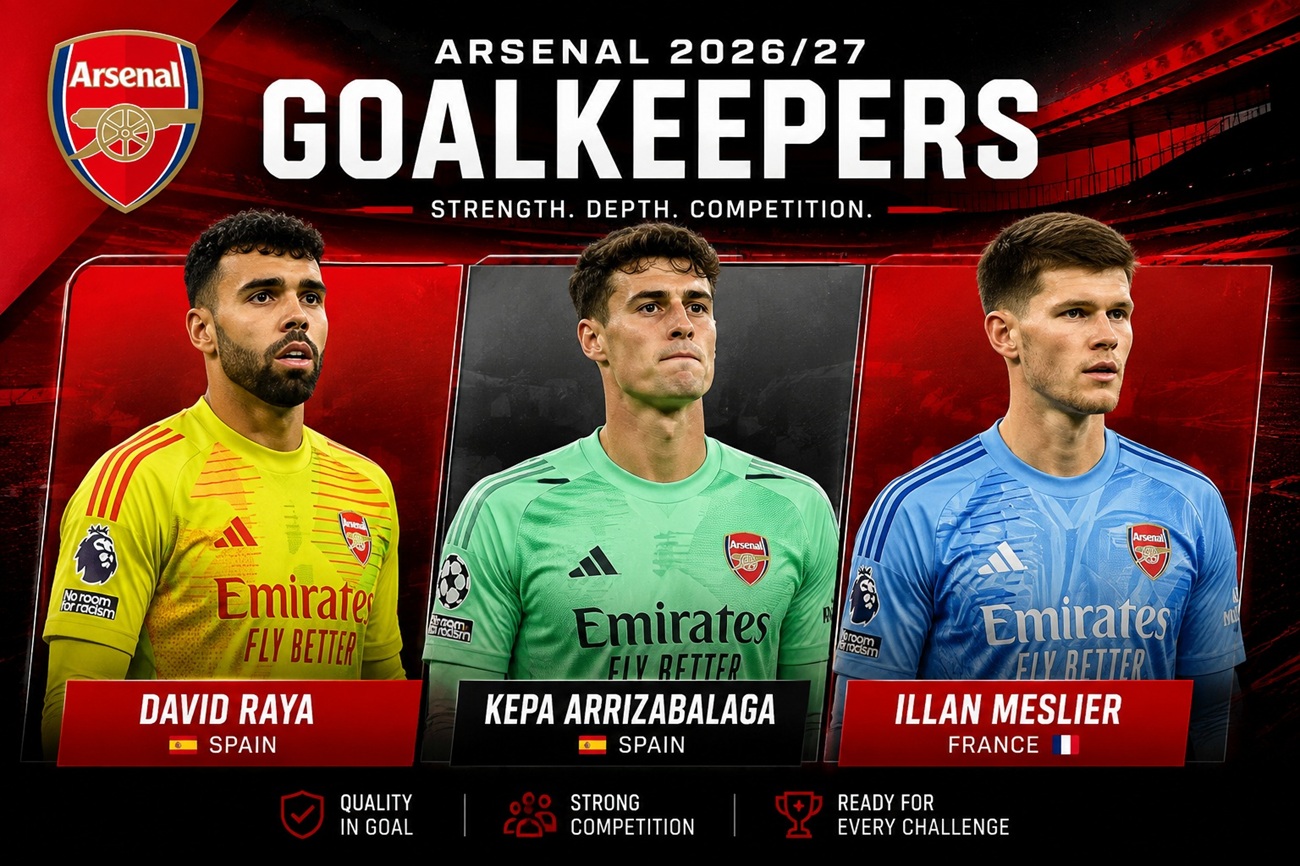
David Raya remains the clear first-choice goalkeeper and suits Arteta’s possession structure particularly well. His calm distribution gives Arsenal another player during buildup, while his ability to defend space behind a high defensive line is important to the way the team controls territory.
Behind him, Kepa Arrizabalaga provides substantial senior experience. Arsenal have also added Illan Meslier on a free transfer, giving Arteta another established goalkeeper rather than relying entirely on an inexperienced academy option.
That is more than enough numerical cover, although a Raya absence would still change the quality of Arsenal’s buildup and decision-making from the back. The reassuring point is that Arsenal would at least be turning to goalkeepers with significant top-level experience.
Depth Assessment: Strong
Defensive Depth
1. Centre-Back Options
A fully fit Arsenal have one of the strongest collections of centre-backs in England. Saliba and Gabriel remain the benchmark partnership. Their combination of recovery pace, physical strength, aerial security and comfort defending large spaces was central to a 2025/26 Arsenal side that produced outstanding defensive numbers. Arsenal kept 32 clean sheets across all competitions during the title-winning campaign and allowed fewer goals and shots on target than any other Premier League side as the season entered its final weekend.
Mosquera offers genuine cover rather than emergency depth, while Hincapié can play centrally or on the left. Calafiori also has experience at centre-back, although using him there would remove one of Arsenal’s stronger left-sided options. The current problem is availability.
Saliba suffered a back injury during the World Cup and is expected to miss an extended period, while Timber is still recovering from a groin problem and was not ready to return to full training before the start of the league season. That leaves Arsenal’s theoretical defensive depth looking much healthier than their immediate depth. Gabriel and Mosquera can form a credible central partnership, but another injury would quickly reduce Arteta’s choices.
Reports on August 19 indicated that Arsenal had agreed a deal with Aston Villa for Ezri Konsa, whose ability to cover both centre-back and right-back would directly address this issue. Until that transfer is completed, however, he cannot be counted as part of Arsenal’s squad.
Read Also: Ligue 1 Injury Updates 2026/27: Latest News for All 18 Clubs
2. Full-Back Options
When everyone is available, Arteta has considerable tactical variety. Timber and White can both operate at right-back, with Timber particularly valuable because of his ability to move inside during possession and defend aggressively in one-versus-one situations.
The left side provides even more variety. Calafiori offers attacking ambition and the ability to move into central areas, Hincapié provides a more defensively secure profile, and Lewis-Skelly can invert into midfield. That last option is especially important because Lewis-Skelly is no longer simply a left-back who happens to understand midfield.
He played centrally during important matches in Arsenal’s title run and has shown that the role is a genuine senior option. The concern is concentrated on the right while Timber remains unavailable. White becomes extremely important, and moving Mosquera across would simultaneously weaken centre-back depth.
Depth Assessment: Strong on paper; Adequate while Saliba and Timber are unavailable
Midfield Depth
This is arguably the strongest part of Arsenal’s squad. Arteta already had Rice, Zubimendi, Ødegaard, Eze and Merino before adding Bruno Guimarães. The Brazilian’s arrival gives Arsenal another midfielder capable of receiving under pressure, progressing possession, competing physically and contributing in advanced areas.
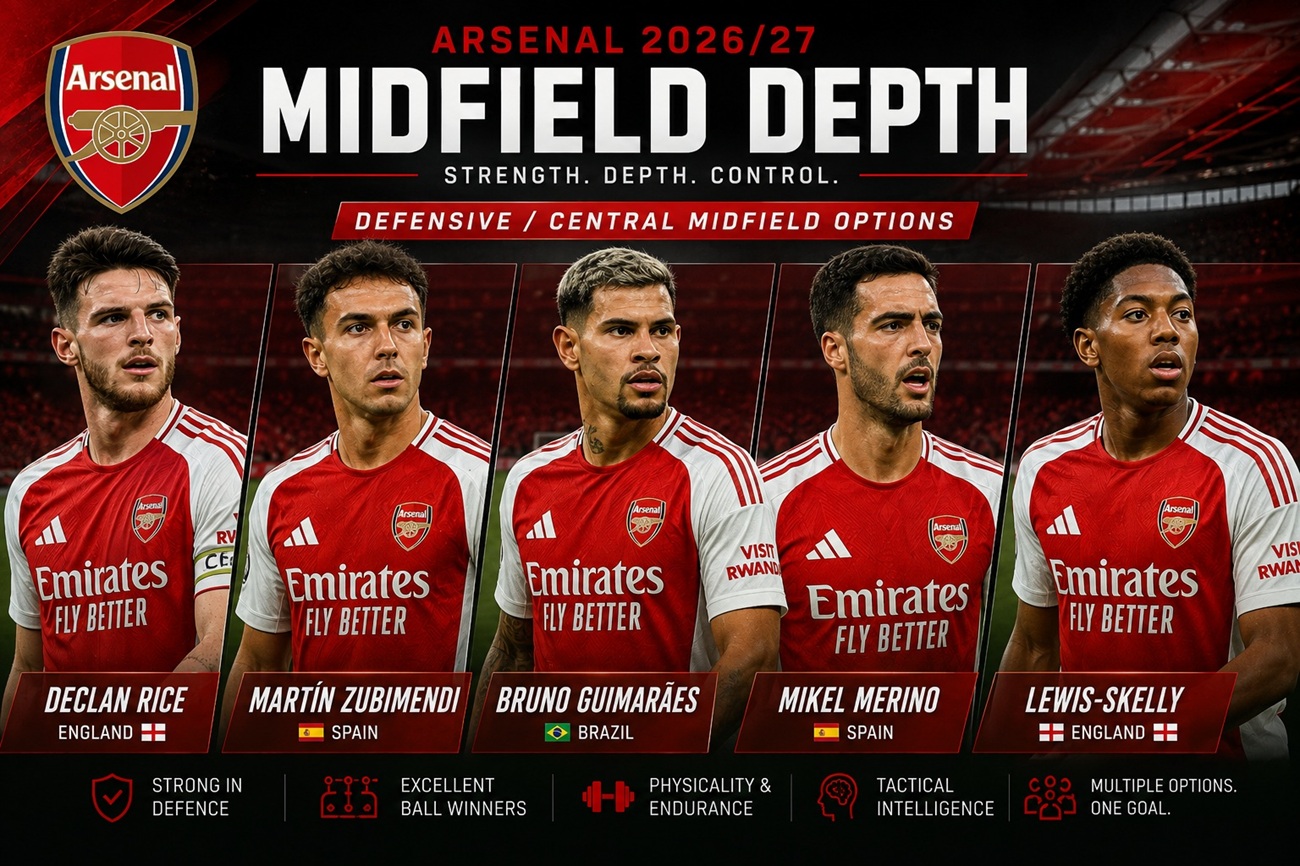
The significance of the signing is not simply that Arsenal have added another good midfielder. It changes how much quality Arteta can preserve while rotating. Rice can operate as a No. 6, a powerful No. 8 or within a double pivot. Zubimendi provides controlled distribution from deeper positions.
Bruno can play deeper or move forward. Merino supplies physicality and aerial strength, while Ødegaard and Eze offer different forms of creativity closer to the attack. Arsenal also discovered another solution last season through Lewis-Skelly. Arteta increasingly used a double-pivot structure in 2025/26 rather than relying exclusively on his traditional 4-3-3, with Rice, Zubimendi and Lewis-Skelly all featuring in deeper combinations.
The 3-0 Community Shield win over Manchester City offered an early illustration of the new depth. Bruno started alongside Lewis-Skelly, while Rice, Zubimendi and Eze were available from the bench. Losing one midfielder no longer automatically forces Arsenal into an obvious downgrade.
Depth Assessment: Very Strong
Attacking Depth
1. Wide Options
Bukayo Saka remains Arsenal’s most important natural right winger, but the addition of Noni Madueke in 2025 transformed the cover available behind him. Madueke offers direct dribbling, pace, and the ability to attack defenders rather than merely maintaining Arsenal’s possession structure.
On the opposite side, Tzolis has effectively replaced Trossard in the squad. He arrived after an outstanding campaign with Club Brugge in which he recorded 17 goals and 23 assists in the Belgian Pro League. Tzolis gives Arteta a more direct left-sided threat and has already shown his creative potential, including an assist for Havertz in Arsenal’s Community Shield victory.
Martinelli remains another major option as things stand, although his future has attracted speculation during the open transfer window. Eze can also start from the left and drift into central areas, giving Arteta a completely different attacking profile. The key improvement is variety. Arsenal can use Saka’s combination play, Madueke’s one-versus-one aggression, Tzolis’ directness, Martinelli’s running behind, or Eze’s preference for finding pockets inside.
Depth Assessment: Very Strong
2. Centre-Forward Options
Arsenal also have genuine variety through the middle. Gyökeres provides the specialist striker profile: physical, direct and capable of attacking space behind a defence. Havertz offers something different. His movement, aerial ability and combination play allow Arsenal to use the centre-forward position more fluidly, and he started there during the Community Shield before scoring against Manchester City.
Gabriel Jesus remains at the club at the time of writing, although his future is uncertain amid transfer interest. If Jesus remains, three experienced centre-forward options would represent substantial depth. If he leaves, Gyökeres and Havertz would still provide a strong first two choices, although the margin for injuries would become smaller.
Depth Assessment: Strong
How Much Quality Is There Beyond the Starting XI?
This may be Arsenal’s biggest advantage. A possible strongest team could include Raya; Timber, Saliba, Gabriel and Calafiori; Bruno, Rice and Ødegaard; Saka, Gyökeres and Tzolis. That would still leave players such as White, Hincapié, Mosquera, Lewis-Skelly, Zubimendi, Merino, Eze, Madueke and Havertz outside that particular XI.
The exact lineup is debatable, which is precisely the point. Arsenal are reaching the stage where rotation does not necessarily mean fielding a weakened team. Arteta can change the characteristics of his side while retaining international-level quality. The difference is most obvious in midfield and attack. Defensively, injuries to Saliba and Timber show how quickly even an apparently deep unit can become stretched.
Read Also: La Liga Injury Updates 2026/27: Latest News for All 20 Clubs
Where the Squad Is Strongest
Central midfield is Arsenal’s clearest strength. Rice, Bruno, Zubimendi, Ødegaard, Eze, Merino and Lewis-Skelly give Arteta control, athleticism, creativity and several possible combinations.
Wide attack has also improved. Saka no longer carries the same responsibility to provide virtually every elite right-sided action, while Tzolis and Martinelli offer different threats from the left.
Left-sided defensive flexibility is another advantage. Calafiori, Hincapié and Lewis-Skelly can all occupy the left-back position without performing the role in the same way.
Where the Squad Looks Vulnerable
The immediate weakness is right-sided defence. With Timber still recovering and Saliba unavailable, White has become difficult to rotate. Using Mosquera at right-back would reduce the available centre-back pool, creating a domino effect from one injury. There is also a difference between having alternatives to Saka and actually replacing Saka.
Madueke provides legitimate right-wing depth, but Saka’s combination of creativity, goals, set-piece delivery and understanding with Ødegaard remains difficult to reproduce. Finally, some of Arsenal’s attacking depth could change before the transfer deadline. Martinelli and Jesus remain Arsenal players, but both have been linked with moves, while Nwaneri’s future has also attracted significant attention.
Key Players for Squad Stability
1. William Saliba
Arsenal have good centre-backs, but Saliba’s recovery speed and comfort defending large spaces allow the entire team to play more aggressively. His current absence is already testing whether Arsenal can reproduce that security without him.
2. Declan Rice
Arsenal are better equipped than before to survive a Rice absence, particularly after signing Bruno, but no other midfielder provides the same combination of defensive range, physical power, carrying ability and set-piece quality.
3. Bukayo Saka
Madueke means Arsenal finally have credible specialist cover on the right. Even so, replacing Saka’s overall influence remains extremely difficult. Depth can reduce Arsenal’s dependence on him without making him replaceable.
How Positional Versatility Strengthens the Squad
Versatility is central to Arteta’s squad construction. Hincapié can cover centre-back and left-back. Timber can operate across the defence. White can play right-back or centrally. Calafiori can move between left-back and centre-back. Lewis-Skelly can move from left-back into midfield.
Rice can perform several midfield functions, Eze can operate centrally or from the left, and Havertz can play through the middle while also dropping into attacking midfield zones. This flexibility allows Arsenal to solve problems without making a direct position-for-position substitution every time.
The danger is using versatility to hide a shortage of specialists. White being capable of playing centre-back, for example, does not help if moving him there leaves Arsenal without a natural senior right-back while Timber is injured.
Academy and Young Players Who Could Add Depth
Lewis-Skelly should now be considered part of the established senior squad rather than academy cover. Max Dowman is the more relevant emerging prospect. The 16-year-old has been involved throughout Arsenal’s senior preparations and was included on the bench for the Community Shield, suggesting Arteta is willing to keep him close to the first team.
Nwaneri is a different case. He returned from a loan spell at Marseille and possesses established senior experience, but reports suggest his future could be decided before the transfer window closes. It would therefore be premature to assume he will provide Arsenal with season-long depth.
How Injuries Could Test the Squad
Arsenal are already receiving an early test. One missing centre-back would ordinarily be manageable. Saliba being out at the same time Timber is unavailable creates a more complicated problem because Timber covers both centre-back and right-back.
Gabriel and Mosquera can form a strong partnership, with Hincapié available centrally, but another defensive injury could force Arteta to move players away from their strongest roles. Further forward, Arsenal look considerably more resilient. Rice, Bruno and Zubimendi provide multiple deep-midfield combinations.
Ødegaard can be replaced creatively by Eze. Saka has Madueke behind him, while Gyökeres and Havertz provide two distinct centre-forward profiles. The squad is therefore much better positioned to absorb injuries in midfield and attack than it is to withstand several simultaneous absences in defence.
Fixture Congestion and Rotation
Arsenal’s schedule will make that depth necessary. They are defending the Premier League title while entering the Champions League directly in the league phase. The Champions League format guarantees eight league-phase matches before any knockout football is considered, with fixtures running from September through January.
The FA Cup and EFL Cup create additional demands, while international breaks will add travel and minutes for a squad containing numerous senior internationals. If Arsenal progress deeply in several competitions, a 50-plus-match season is entirely realistic.
Arteta therefore cannot approach the season with eleven starters and a collection of emergency substitutes. Players such as Eze, Madueke, Mosquera, Hincapié, Merino and Lewis-Skelly may be essential to maintaining performance levels rather than merely useful reserves.
Can Arsenal Compete on Multiple Fronts?
On current squad depth, Arsenal appear equipped to do so. The midfield is deep enough to rotate without surrendering control. The attack contains multiple players capable of starting major matches, while the defence is potentially excellent once Saliba and Timber return.
There is also more tactical variety than Arsenal possessed earlier in Arteta’s project. They can use a 4-3-3, operate with a double pivot, invert either full-back, introduce a more creative left-sided attacker or use a different type of centre-forward depending on the opposition.
Their main concern is whether defensive availability can survive the opening part of the campaign. The quality exists, but two injuries have already compressed what originally looked like substantial depth.
Where the Squad Could Still Be Strengthened
Another defender capable of playing both centre-back and right-back would make sense. That is why the reported move for Konsa fits Arsenal’s current needs particularly well. He would not necessarily arrive to remove Saliba, Gabriel or Timber from the strongest XI.
His value would come from preventing injuries in one defensive position from creating problems elsewhere. Beyond defence, Arsenal do not have an obvious numerical shortage. Any further attacking recruitment would be more about raising the ceiling of the squad or preparing for departures than filling an empty position.
Overall Squad Depth Assessment
Overall Assessment: Very Strong Depth
Arsenal have moved beyond simply assembling a high-quality first XI. Their midfield may be among the deepest in European football, the attack offers credible alternatives across all three positions, and Arteta can change tactical structures without relying solely on emergency solutions.
The main qualification comes in defence. Arsenal have strong defensive depth when everyone is fit, but the simultaneous absence of Saliba and Timber exposes how quickly the right-back and centre-back positions can become interconnected problems. If another defender arrives before the window closes, that weakness could be significantly reduced.
How Squad Depth Could Shape Arsenal’s 2026/27 Season
Arsenal’s depth should give Arteta more freedom to manage workloads than he has had during earlier title challenges. Saka does not need to start every match simply because there is no natural alternative. Rice can be rested without dismantling the midfield. Ødegaard and Eze offer different creative solutions. Gyökeres and Havertz allow Arsenal to change the way they attack the penalty area.
That matters across a season in which Arsenal are expected not only to defend their Premier League title but also to remain competitive in Europe. The biggest danger is not the overall size of the squad. It is whether injuries become concentrated in one area. If Arsenal can maintain reasonable defensive availability, there is enough quality beyond the strongest XI for rotation to become a genuine strength rather than something Arteta has to fear.
Conclusion
Arsenal’s 2026/27 squad is deeper, more flexible and less dependent on a small group of players than it was during the earlier stages of Mikel Arteta’s rebuild. Central midfield stands out as the strongest department, with Bruno Guimarães joining Rice, Zubimendi, Ødegaard, Eze, Merino and Lewis-Skelly to give Arsenal exceptional tactical choice.
Wide attacking depth has also improved through Tzolis and Madueke, while Gyökeres and Havertz offer contrasting centre-forward options. The main vulnerability is currently defence, where Saliba and Timber’s injuries have reduced Arteta’s room for further absences.
As the squad currently stands, Arsenal appear well equipped to rotate and remain competitive across multiple competitions. The true test will come when fixture congestion forces Arteta to rely repeatedly on that depth rather than simply having it available on the bench.