
Brentford begin the 2026/27 Premier League season looking to build on an impressive first campaign under Keith Andrews. The Bees finished ninth in 2025/26, matching their highest Premier League finish and missing European qualification only on goal difference.
Andrews achieved that while reshaping the team after major changes the previous summer, developing a side that remained direct and dangerous in transition while becoming more compact defensively. Brentford have strengthened again. Mamadou Sangaré has arrived from Lens for a club-record fee, Jaidon Anthony has joined from Burnley, experienced striker Callum Wilson has been added on a free transfer, and young centre-back Jannik Schuster has moved from Red Bull Salzburg.
Jordan Henderson and Frank Onyeka are among the departures. With no European football, Brentford do not face the same fixture burden as several clubs around them. That makes their squad-depth question slightly different: can Andrews rotate when necessary without weakening the team significantly, and is there enough quality to turn another top-half challenge into something more?
The transfer window remains open until September 1, so the group may still change before Brentford settle on their final squad.
Read Also: AFC Bournemouth Squad Depth 2026/27: Strengths, Weaknesses and Season Outlook
Brentford’s 2026/27 Squad at a Glance
Brentford’s current senior options can broadly be organised as follows:
Goalkeepers: Caoimhín Kelleher, Hákon Valdimarsson
Right-back options: Michael Kayode, Aaron Hickey, Kristoffer Ajer
Centre-backs: Nathan Collins, Sepp van den Berg, Ethan Pinnock, Kristoffer Ajer, Ji-soo Kim, Jannik Schuster
Left-back options: Rico Henry, Aaron Hickey, Keane Lewis-Potter
Central midfield: Mamadou Sangaré, Vitaly Janelt, Yehor Yarmoliuk, Mathias Jensen, Josh Dasilva, Antoni Milambo
Attacking midfield: Mikkel Damsgaard, Fábio Carvalho, Jensen, Milambo
Wide attack: Dango Ouattara, Kevin Schade, Jaidon Anthony, Lewis-Potter, Carvalho
Centre-forward: Igor Thiago, Callum Wilson, Kaye Furo
Brentford possess considerable positional overlap, particularly in defence and attack. The important issue is whether that versatility represents genuine depth or merely allows Andrews to cover shortages temporarily.
Read Also: Aston Villa Squad Depth 2026/27: Strengths, Weaknesses and Season Outlook
Goalkeeper Depth
Caoimhín Kelleher has established himself as a clear first choice. His first full Premier League campaign after leaving Liverpool justified Brentford’s investment. Kelleher recorded 10 clean sheets, made 110 saves and stopped three penalties in 2025/26. He finished as the second-highest-scoring goalkeeper in Fantasy Premier League, but more importantly for Brentford, he provided the consistency and authority that the club wanted from a permanent No. 1.
His distribution also suits Andrews’ willingness to attack space quickly. Brentford are comfortable bypassing pressure rather than insisting on short buildup, so Kelleher’s ability to find teammates further up the pitch has tactical value beyond conventional shot-stopping. Hákon Valdimarsson remains the principal senior alternative.
The difference is experience. Valdimarsson has international football behind him but has not accumulated anything close to Kelleher’s Premier League workload. An extended absence for the Irishman would therefore represent a meaningful test. Nevertheless, Brentford have a proven first choice and a legitimate senior backup rather than relying on an academy goalkeeper.
Depth Assessment: Strong
Defensive Depth
Centre-Back Options
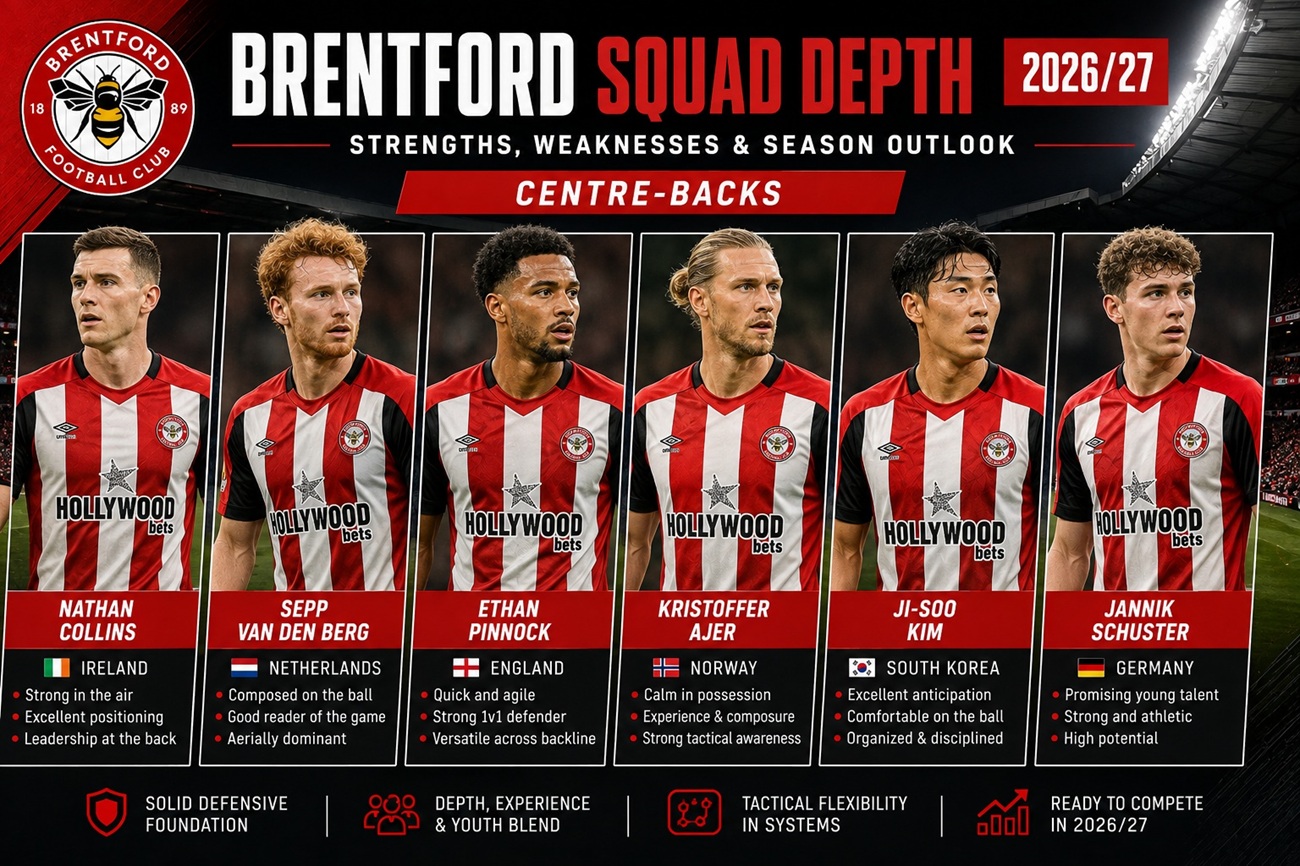
Centre-back is one of Brentford’s best-covered positions numerically. Nathan Collins and Sepp van den Berg provide a strong starting foundation. Both are physically suited to Premier League football, capable in the air and comfortable defending when Brentford play directly and contest second balls.
Ethan Pinnock remains an experienced alternative, while Kristoffer Ajer provides valuable flexibility because he can operate centrally or at full-back. The addition of Jannik Schuster strengthens the long-term picture further. The Austrian arrived from Red Bull Salzburg after making 29 senior appearances in 2025/26 and gaining Europa League experience.
At 19, he should not automatically be treated as equivalent to Collins or van den Berg, but he already has considerably more senior football behind him than a typical developmental signing. Ji-soo Kim adds further cover. The key advantage is that one centre-back injury should not force Andrews into a makeshift solution. Even two absences would leave established alternatives available.
The more difficult question is whether every option can reproduce the same level against elite opposition. Brentford have excellent numbers, but Collins in particular has become extremely important to the defensive structure.
Depth Assessment: Very Strong
Read Also: Arsenal Squad Depth 2026/27: Strengths, Weaknesses and Season Outlook
Full-Back Options
Right-back is another well-covered area. Michael Kayode developed into a major attacking weapon last season. His athleticism, dribbling and long throws make him much more than a conventional defensive full-back, and those characteristics fit Brentford’s preference for creating pressure through direct play and set pieces.
Aaron Hickey provides a different profile and can play on either side. Ajer can also move across when Andrews wants a more physically imposing defensive structure. Left-back is less straightforward. Rico Henry is the natural specialist, but injury interruptions over recent seasons have meant Brentford cannot simply assume he will play every week.
Hickey is capable of switching sides, while Lewis-Potter has spent significant time operating as a left-sided defender despite being naturally more attack-minded. His performances there have made the role more than emergency cover, but he still offers different defensive qualities from a specialist full-back.
That versatility gives Andrews options, although Premier League analysis following last season identified left-back as one of the few areas Brentford could clearly improve, with Henry, Hickey and Lewis-Potter all used there during 2025/26.
Depth Assessment: Strong overall, but left-back remains the least settled defensive position
Midfield Depth
Midfield has undergone the most significant summer change. Jordan Henderson supplied experience and passing range last season, but his departure opened a major role in the centre of the pitch. Brentford have responded aggressively by signing Mamadou Sangaré.
The Mali international arrives after an outstanding season with Lens. He ranked among Ligue 1’s leading players for tackles won, ground duels and interceptions while also contributing to progression through passing and dribbling. That combination makes him particularly suited to Brentford because Andrews needs midfielders who can compete physically before quickly turning regained possession into attack.
Alongside him, Vitaly Janelt provides positional discipline and experience, while Yehor Yarmoliuk has developed into an increasingly important first-team midfielder. Mathias Jensen offers a different quality. His passing and set-piece delivery give Brentford greater control when they need to play through opponents rather than attack almost exclusively through transitions.
Josh Dasilva’s return to pre-season action after another lengthy rehabilitation increases the numbers, while Antoni Milambo remains an exciting longer-term option as he works back from the serious injury that interrupted his first Brentford season. The midfield is therefore deep in profiles as well as numbers. Sangaré can win and carry, Janelt can protect, Jensen can dictate, while Yarmoliuk brings energy. The main uncertainty is how quickly the group adapts to life without Henderson’s experience.
Depth Assessment: Strong
Attacking Depth
1. Creative and Wide Options

Brentford have quietly assembled one of the more varied attacking groups outside the Premier League’s traditional elite. Dango Ouattara and Kevin Schade give Andrews exceptional pace in transition. Schade scored eight league goals last season, while Ouattara added seven goals and three assists and became increasingly influential as a creator during the closing months.
Jaidon Anthony increases the competition further. The former Burnley winger arrives after scoring eight times and supplying four assists in the Premier League last season. He can attack defenders directly but also works aggressively without the ball, an important requirement in Andrews’ system.
Lewis-Potter can move forward when he is not required defensively, while Fábio Carvalho offers another option from wide or central starting positions. Mikkel Damsgaard remains the most important creative connector. His ability to receive between lines and find runners gives Brentford something different from their collection of powerful, direct forwards.
The strength here is variety. Andrews can use Schade to attack space, Ouattara to carry possession, Anthony to provide width, or Damsgaard to create through central areas.
Depth Assessment: Very Strong
2. Centre-Forward Options
Igor Thiago is the undisputed reference point. His 2025/26 campaign was exceptional. The Brazilian scored 22 Premier League goals, finishing behind only Erling Haaland, while also ranking near the top of the division for shots inside the box, attempts on target and expected goals.
His physical presence is crucial because Brentford can play directly into him, compete for the second ball and immediately bring their quick wide players into the attack. The question last season was what happened when Thiago was unavailable.
Callum Wilson provides a credible answer. The 34-year-old arrives with extensive Premier League experience and scored seven league goals for West Ham despite making the majority of his appearances from the bench. His finishing record means Andrews can now rest Thiago without automatically handing the position to an inexperienced player.
Kaye Furo provides developmental depth behind them. Wilson’s age and injury history mean Brentford should not expect him to handle a full season as first choice, but that is not the role required. As an alternative to Thiago, he significantly improves the squad.
Depth Assessment: Strong
How Much Quality Is There Beyond the Starting XI?
A possible strongest Brentford lineup could feature Kelleher; Kayode, Collins, van den Berg and Henry; Sangaré and Janelt; Ouattara, Damsgaard and Schade; with Thiago leading the attack. That would still leave Ajer, Pinnock, Hickey, Schuster, Yarmoliuk, Jensen, Carvalho, Anthony, Lewis-Potter and Wilson available.
That is meaningful depth for a club without European commitments. Andrews can change several players without being forced to select inexperienced prospects, and many of the alternatives offer tactical differences rather than simply being weaker copies of the starter. The biggest drop-offs are probably from Kelleher in goal, Collins in defence, Damsgaard creatively and Thiago at centre-forward.
Where the Squad Is Strongest
Centre-back is exceptionally well stocked. Collins, van den Berg, Pinnock, Ajer, Schuster and Kim give Andrews enough options to cope with injuries and tactical changes.
Wide attack is another major strength. Schade, Ouattara, Anthony and Lewis-Potter provide speed and physicality, while Carvalho can supply a more technical alternative.
Central midfield has become deeper following Sangaré’s arrival. Brentford can now field several combinations without asking one player to perform every midfield function.
Where the Squad Looks Vulnerable
Left-back remains the least convincing area. Brentford have several players capable of filling the position, but that is different from having two established specialists competing at the same level. The squad is also highly dependent on certain unique profiles.
Wilson provides striker depth, but he does not completely replace Thiago’s ability to dominate centre-backs and act as the focal point for direct attacks. Damsgaard presents a similar issue creatively. Brentford have numerous midfielders and attackers, but fewer players naturally provide his ability to operate between lines and connect the midfield to the front three.
Key Players for Squad Stability
1. Igor Thiago
Twenty-two league goals explain his importance, but Thiago’s value extends beyond finishing. His presence allows Brentford to play forward early, occupy centre-backs and create space for Schade and Ouattara. Wilson gives Andrews stronger cover than last season, but the system is still most dangerous when Thiago is available.
2. Mikkel Damsgaard
Brentford possess plenty of athleticism. Damsgaard provides imagination. Without him, Andrews can still field a strong team, but breaking down opponents who defend deep could become considerably more difficult.
3. Nathan Collins
The centre-back group is deep, but Collins has become a leader within the defensive structure. His aerial ability, physicality and consistency make him more difficult to replace than Brentford’s raw number of defenders might suggest.
How Positional Versatility Strengthens the Squad
Versatility is one of Brentford’s biggest strengths. Ajer can play centre-back or right-back. Hickey can operate on either side. Lewis-Potter can move between left-back and the attacking line. Carvalho can play centrally or wide, while Damsgaard can operate as a No. 10 or deeper creative midfielder.
Andrews also showed last season that he is willing to change formations rather than force the same system every week. Brentford used both 4-2-3-1 and back-five structures, particularly when adapting to stronger opponents. That means depth is not limited to simple position-for-position replacements.
How Injuries Could Test the Squad
Brentford are in a much better position than they were during several injury-heavy periods in recent seasons. One defensive absence should be manageable because of the number of centre-backs and full-back alternatives. A midfield injury should also be easier to absorb following Sangaré’s arrival and Dasilva’s return to action.
The more damaging scenarios involve unique players. A lengthy Thiago absence would place significant responsibility on Wilson. Losing Damsgaard could reduce creativity, while Kelleher remains clearly ahead of the other goalkeepers in terms of sustained Premier League experience.
The squad is therefore resilient numerically, but simultaneous injuries to structurally important players would still change how Andrews has to set up.
Fixture Congestion and Rotation
This is an area where Brentford possess an advantage over several rivals. They have no European competition in 2026/27, meaning their guaranteed schedule consists primarily of the 38 Premier League matches alongside the FA Cup and EFL Cup. That gives Andrews more time on the training ground and reduces the need for constant midweek rotation.
It also makes the depth available to him particularly valuable in cup competitions. Brentford can potentially rest Thiago and start Wilson, rotate a centre-back without dramatically weakening the defence, or introduce Anthony, Carvalho and Jensen without abandoning their established style. Unlike clubs playing in Europe, they should rarely need to make six or seven changes purely because of recovery time.
Can Brentford Compete on Multiple Fronts?
For their schedule, yes. The squad appears capable of sustaining another top-half Premier League challenge while taking domestic cup competitions seriously. Brentford do not have the resources or depth of the title contenders, but that is not the appropriate comparison.
What matters is whether the second group can contribute without a major drop in competitiveness. In many positions, the answer is increasingly yes. Wilson, Anthony, Schuster and Sangaré have strengthened different levels of the team, while players returning from injuries increase Andrews’ options further. A domestic cup run should therefore not automatically compromise the league campaign.
Where the Squad Could Still Be Strengthened
Left-back remains the most obvious area. Signing another natural option would prevent Brentford from depending on Hickey’s versatility or moving Lewis-Potter away from attack whenever Henry is unavailable.
Another creative midfielder could also provide additional protection behind Damsgaard, although Carvalho, Jensen and Milambo mean this is less urgent than the left-back situation. There is little need to add players simply for quantity. Brentford already have substantial numbers. Any further signing should address a specific profile rather than enlarge the squad unnecessarily.
Overall Squad Depth Assessment
Overall Assessment: Strong Depth
Brentford’s 2026/27 squad appears better balanced than the group that finished ninth last season. Kelleher provides stability in goal, centre-back is exceptionally well covered, Sangaré adds quality and physicality to midfield, Anthony increases the attacking options, and Wilson gives Andrews an experienced alternative to Thiago.
The main concern remains left-back, while several key players still possess characteristics that cannot be reproduced perfectly by their backups. For a club without European football, however, the overall depth is impressive.
How Squad Depth Could Shape Brentford’s 2026/27 Season
Brentford’s depth should allow Andrews to maintain competition for places without relying on constant rotation. Players such as Anthony, Jensen, Carvalho, Hickey and Wilson may not all begin the season in the strongest XI, but each is capable of starting Premier League matches without fundamentally weakening the team.
That matters over 38 games. It also gives Andrews more tactical freedom. He can use another centre-back against stronger opposition, introduce additional pace when chasing a match or replace Thiago with an experienced striker rather than changing the entire attacking structure.
Brentford narrowly missed European football last season. Their squad depth alone does not guarantee they will improve on ninth place, but the current group appears better equipped to handle injuries, maintain internal competition and sustain performance levels over a full campaign.
Conclusion
Brentford enter 2026/27 with one of the more balanced squads of Keith Andrews’ tenure. Centre-back and wide attack stand out as the deepest departments, while Mamadou Sangaré significantly strengthens a midfield that lost Jordan Henderson. Callum Wilson also gives Brentford the experienced centre-forward cover that was previously missing behind Igor Thiago.
Left-back remains the clearest area where the available numbers slightly exaggerate the true specialist depth, and players such as Thiago, Damsgaard, Collins and Kelleher remain particularly difficult to replace.
Overall, Brentford appear well equipped for another demanding Premier League campaign. Without European fixtures stretching the squad, Andrews should have enough quality beyond his strongest XI to rotate when necessary, manage injuries and give domestic cup competitions serious attention without dramatically weakening his league side.