
Fulham enter 2026/27 with a new head coach and a squad beginning to move away from the group that became established under Marco Silva. Álvaro Arbeloa was appointed in July on a three-year contract after Fulham finished 11th in the 2025/26 Premier League with 52 points. His coaching background points toward an aggressive press and proactive football, but adapting those ideas to a new league and squad will be one of Fulham’s central challenges.
The summer has brought important changes. Raúl Jiménez, Harry Wilson, Saša Lukić and Issa Diop have left, while Gonzalo García and César Palacios have arrived from Real Madrid and Shea Charles has joined from Southampton. Gonzalo effectively refreshes the centre-forward department, while Charles helps replace the midfield depth lost with Lukić.
Fulham do not have European football this season, so they do not require an enormous squad. The more relevant question is whether Arbeloa has enough quality in each position to absorb injuries and tactical changes without a major drop in performance.
Read Also: Coventry City Squad Depth 2026-27: Strengths, Weaknesses and Season Outlook
Fulham’s 2026/27 Squad at a Glance
Fulham’s main first-team options currently include:
Goalkeepers: Bernd Leno, Benjamin Lecomte
Right-back: Kenny Tete, Timothy Castagne
Centre-back: Joachim Andersen, Calvin Bassey, Jorge Cuenca
Left-back: Antonee Robinson, Ryan Sessegnon
Central midfield: Sander Berge, Shea Charles, Harrison Reed, Tom Cairney
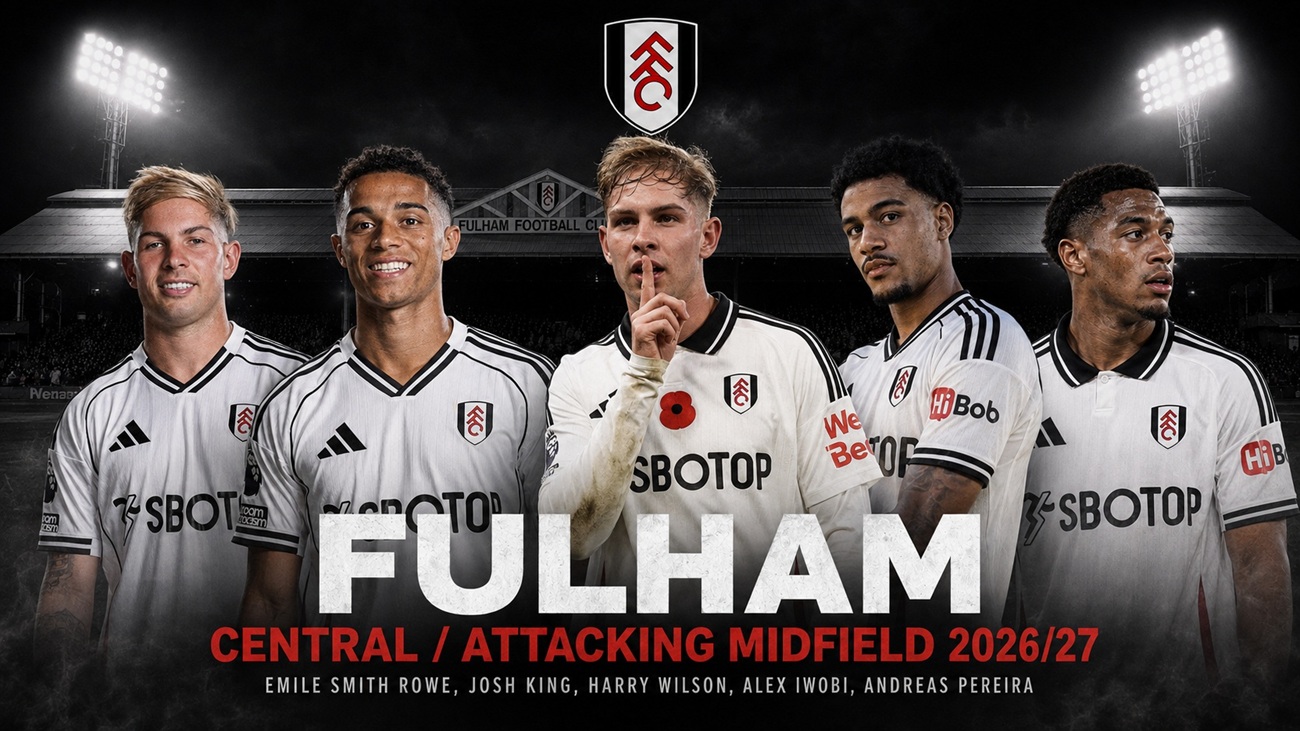
Central/attacking midfield: Emile Smith Rowe, Josh King, César Palacios, Alex Iwobi
Wide attack: Oscar Bobb, Kevin, Iwobi, Smith Rowe, Palacios
Centre-forward: Gonzalo García, Rodrigo Muniz, Jonah Kusi-Asare
Fulham’s current first-team listings confirm that much of the established core remains intact, while Gonzalo, Palacios and Charles have joined the group during August.
Goalkeeper Depth
Bernd Leno remains the clear first choice. His Premier League experience and shot-stopping give Fulham stability in a position where continuity matters, particularly while Arbeloa introduces a new tactical structure.
Benjamin Lecomte provides experienced senior cover, but there is a clear hierarchy. Fulham should be comfortable managing cup rotation or a short Leno absence. A prolonged spell without the German would produce a more noticeable drop because there is no second goalkeeper with the same recent Premier League role.
Depth Assessment: Adequate
Defensive Depth
1. Centre-Back Options
This is arguably Fulham’s biggest depth concern. Joachim Andersen and Calvin Bassey provide a strong potential first-choice pairing. Andersen brings aerial strength, experience and distribution, while Bassey supplies pace and physicality. Jorge Cuenca offers another natural centre-back and made regular appearances last season. The issue is what comes after those three.
Issa Diop has joined Ipswich, reducing the senior numbers. Fulham can move Castagne inside if necessary, but doing so would weaken the full-back rotation rather than provide a genuine specialist replacement. That means one centre-back absence is manageable. Two simultaneously could become a significant problem. Andersen will also miss the opening match against Chelsea through suspension, offering an immediate example of why depth matters.
Depth Assessment: Thin
2. Full-Back Options
Fulham are much stronger at full-back. Antonee Robinson remains one of the team’s most important players. His pace, recovery defending, and overlapping ability give Fulham a major outlet on the left. Ryan Sessegnon provides credible cover and can also be used higher up the pitch.
On the right, Kenny Tete and Timothy Castagne give Arbeloa two experienced Premier League options. Castagne’s ability to play on either side and cover centrally adds further flexibility. Fulham therefore have genuine competition rather than emergency cover in both full-back positions.
Depth Assessment: Strong
Read Also: Everton Squad Depth 2026-27: Strengths, Weaknesses and Season Outlook
Midfield Depth
The midfield has changed but still contains a useful mix of profiles. Sander Berge provides size, defensive coverage and composure in deeper areas. Shea Charles is an important addition. The Northern Ireland international arrives from Southampton and gives Arbeloa another midfielder capable of operating at the base of the team.
Harrison Reed offers Premier League experience and energy, while captain Tom Cairney remains a valuable technical option when available. Cairney is currently recovering from a minor knee procedure and is expected to return to training after the September international break, so he cannot be considered immediate depth at the start of the campaign.
Further forward, Smith Rowe, Josh King and Palacios provide more creative profiles. Palacios is particularly interesting because Arbeloa already knows him from Real Madrid’s system. He made limited senior appearances for Madrid last season, so he should be viewed as a talented option with development ahead rather than an automatic Premier League starter.
Depth Assessment: Strong
Attacking Depth
1. Wide and Creative Options
Fulham have several technically gifted attackers without being overloaded. Oscar Bobb gives them a left-footed player who prefers starting from the right and moving inside. He can also operate on the opposite flank or behind a striker. Kevin supplies greater acceleration and one-versus-one threat from wide areas, while Iwobi remains one of the most versatile players in the squad.
Smith Rowe can move between attacking midfield and wider positions, while Palacios adds another player comfortable between midfield and attack. Losing Harry Wilson removes proven Premier League goals and creativity from the group, but Fulham have enough alternatives to share those responsibilities rather than depending on one direct replacement. The question is consistent end product. Several players can create; Arbeloa needs enough of them to score as well.
Depth Assessment: Strong
Read Also: Crystal Palace Squad Depth 2026-27: Strengths, Weaknesses and Season Outlook
2. Centre-Forward Options
Gonzalo García is the major addition. The Spain international joined from Real Madrid after scoring eight goals in 39 appearances last season and should compete immediately to lead the attack. Rodrigo Muniz remains an established alternative and offers a more physical Premier League-tested option. Jonah Kusi-Asare provides developmental depth after his loan was converted into a permanent transfer.
The 6ft 5in striker made 10 first-team appearances during his loan spell and remains a longer-term option rather than someone Fulham should rely on to carry the attack immediately. Raúl Jiménez’s departure removes experience, but Fulham still have three natural centre-forwards. The success of the position will depend heavily on how quickly Gonzalo adapts.
Depth Assessment: Strong
How Much Quality Is There Beyond the Starting XI?
A likely Fulham XI could include Leno; Tete or Castagne, Andersen, Bassey and Robinson; Berge and Charles; Bobb, Smith Rowe and Iwobi or Kevin; with Gonzalo leading the attack. That would still leave players such as Castagne or Tete, Sessegnon, Cuenca, Reed, King, Palacios and Muniz available.
For a team without European competition, that is a reasonable level of rotation quality. Fulham can change their midfield and attack without immediately turning to inexperienced players. The weakness is central defence, where the bench becomes considerably thinner once Andersen, Bassey or Cuenca is unavailable.
Where Fulham Are Strongest
Full-back is the clearest strength. Robinson, Sessegnon, Tete and Castagne give Arbeloa specialist options on both sides.
Attacking midfield and wide areas also offer useful variety through Bobb, Kevin, Iwobi, Smith Rowe and Palacios.
Centre-forward has been refreshed effectively. Gonzalo, Muniz and Kusi-Asare offer three different stages of experience and development.
Where Fulham Look Vulnerable
Centre-back is the obvious concern. Fulham have three clear senior specialists after Diop’s departure. That is enough when everyone is available but leaves little protection against simultaneous injuries or suspensions. There is also uncertainty around replacing some of the experience lost during the summer.
Jiménez, Wilson and Lukić understood the Premier League and Fulham’s previous system. Their replacements have significant ability, but Gonzalo, Palacios and Charles must now adapt to a new club while the entire squad learns Arbeloa’s methods.
Key Players for Squad Stability
1. Antonee Robinson
Fulham can replace Robinson positionally with Sessegnon, but reproducing his combination of recovery speed and attacking running is much harder.
2. Calvin Bassey
The shortage of centre-back numbers increases Bassey’s importance. His athleticism also allows Fulham to defend more aggressively.
3. Sander Berge
With Lukić gone and Cairney temporarily unavailable, Berge becomes particularly important in controlling central areas and protecting the defence.
How Injuries Could Test Fulham
Fulham begin the season with relatively good overall availability. Cairney is the only current injury absence confirmed by Arbeloa ahead of the Chelsea opener, while Andersen is unavailable because of suspension rather than injury.
Midfield should be able to absorb Cairney’s absence because Charles, Berge and Reed are available. Andersen’s suspension is more revealing. Fulham can use Bassey and Cuenca, but there is little specialist centre-back cover behind them. That is the positional group where an injury cluster would be most damaging.
Fixture Load and Rotation
Fulham finished 11th last season and did not qualify for Europe. Their schedule therefore centres on 38 Premier League matches plus the FA Cup and EFL Cup. That is useful for a manager beginning his first Premier League job. Arbeloa should have more training time than coaches managing European campaigns and less need for wholesale rotation.
Fulham’s current squad is therefore large enough for their workload. They do not need another six players for quantity. They need targeted improvement where the depth is weakest.
Where the Squad Could Still Be Strengthened
Another centre-back is the clearest requirement. A fourth established specialist would give Arbeloa greater protection and prevent Fulham from moving Castagne away from full-back whenever injuries occur centrally.
Beyond that, the squad is reasonably balanced. Another attacker would only be necessary if an existing forward leaves before the transfer deadline. Midfield already contains sufficient numbers following Charles’ arrival.
Overall Squad Depth Assessment
Overall Assessment: Good Depth With a Clear Centre-Back Weakness
Fulham have enough quality to rotate effectively during a domestic-only season. Full-back is strong, midfield has several profiles, and the attack contains a useful combination of established Premier League players and new arrivals. The main weakness is central defence, where three senior specialists leave little margin for multiple absences. There is also an adaptation factor. Arbeloa is changing the coaching structure while several important newcomers adjust to English football.
Conclusion
Fulham’s 2026/27 squad is not among the Premier League’s largest, but it does not need to be. Álvaro Arbeloa has inherited a strong core and added Gonzalo García, César Palacios and Shea Charles to refresh important areas after the departures of Jiménez, Wilson and Lukić.
Full-back and attacking midfield offer useful depth, while Gonzalo and Muniz give Fulham credible competition at centre-forward. The main concern is centre-back. Andersen, Bassey and Cuenca form a solid group, but there is little proven specialist cover beyond them.
For a season without European football, Fulham appear to have enough depth across most positions. Adding another reliable central defender would make the squad considerably better balanced before the transfer window closes.