Everton enter 2026/27 with a deeper midfield, greater competition in attack and a clear opportunity to improve on last season’s 13th-place Premier League finish. David Moyes remains in charge after Everton collected 49 points in 2025/26, but expectations have increased as the club continues establishing itself at Hill Dickinson Stadium.
The summer has brought several important additions. Hayden Hackney, Christian Nørgaard and Brennan Johnson have joined, while Everton have made the previous loan moves of Merlin Röhl and Tyrique George permanent. Dwight McNeil has moved to Crystal Palace, while Idrissa Gana Gueye and Seamus Coleman have also left.
Everton opened the new league season with a 2-0 victory over Crystal Palace, with Kiernan Dewsbury-Hall and Thierno Barry scoring. The result showed some encouraging depth, but it also highlighted a major issue at right-back that could still shape Everton’s remaining transfer business.
Read Also: Crystal Palace Squad Depth 2026-27: Strengths, Weaknesses and Season Outlook
Everton’s 2026/27 Squad at a Glance
Everton’s main senior options currently include:
Goalkeepers: Jordan Pickford, Mark Travers
Right-back: Nathan Patterson, with Merlin Röhl and Jake O’Brien capable of covering
Centre-backs: Jarrad Branthwaite, James Tarkowski, Jake O’Brien, Michael Keane
Left-back: Vitalii Mykolenko, Adam Aznou
Central midfield: James Garner, Kiernan Dewsbury-Hall, Hayden Hackney, Christian Nørgaard, Merlin Röhl, Harrison Armstrong, Tim Iroegbunam, Charly Alcaraz
Wide/attacking midfield: Iliman Ndiaye, Brennan Johnson, Tyrique George, Tyler Dibling, Dewsbury-Hall, Alcaraz
Centre-forward: Thierno Barry, Beto
The transfer window remains open, so this should be viewed as Everton’s current squad rather than their final 2026/27 group.
Goalkeeper Depth
Jordan Pickford remains one of Everton’s most dependable players. His shot-stopping was important again in the opening victory over Palace, including a major early save that prevented Everton from falling behind. His distribution and experience also make him central to how Moyes manages matches.
Mark Travers provides experienced Premier League cover and is a credible No. 2, but Pickford remains clearly ahead. Everton are therefore well protected for occasional rotation, although an extended Pickford absence would still represent a noticeable drop because of how important he has become to the team.
Depth Assessment: Strong
Defensive Depth
1. Centre-Back Options
Central defence remains one of Everton’s more reliable areas. Jarrad Branthwaite and James Tarkowski provide a strong first-choice partnership combining physicality, aerial strength and penalty-box defending.
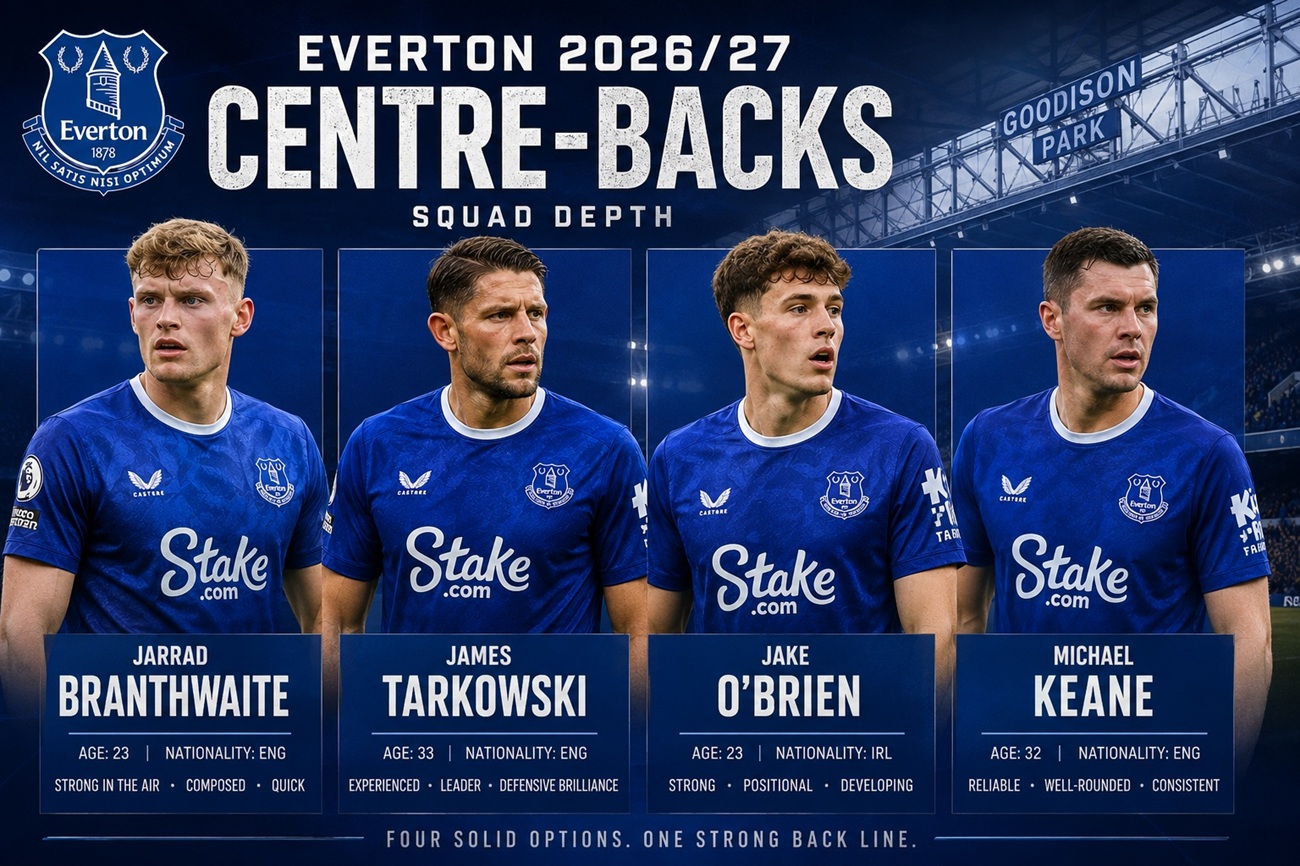
Branthwaite has returned after the hamstring problem that affected the end of last season, while Tarkowski remains one of the experienced leaders in the squad. Jake O’Brien is a credible alternative and gives Moyes another physically imposing defender. Michael Keane provides additional senior cover.
That means one centre-back absence should be manageable without significantly changing Everton’s structure. The depth is not elite, but there are four established senior players for two positions, and the first-choice partnership is clearly defined.
Depth Assessment: Strong
Read Also: Chelsea Squad Depth 2026/27: Strengths, Weaknesses and Season Outlook
2. Full-Back Options
Left-back is relatively straightforward. Mykolenko is the established starter, while young Adam Aznou provides the main specialist alternative. Right-back is much more concerning.
Nathan Patterson remains the only obvious senior specialist, yet Moyes started midfielder Merlin Röhl at right-back against Palace while Patterson was among the substitutes. Röhl helped Everton win 2-0, but using a central midfielder there in the opening league match says something about the current hierarchy.
O’Brien can also defend from the right in a more conservative role, but that is different from possessing another natural Premier League right-back. Everton have enough players capable of filling the position. They do not currently have enough proven specialist depth.
Depth Assessment: Strong centrally, Thin at right-back
Midfield Depth
This is where Everton have improved most significantly. Garner and Dewsbury-Hall remain important after strong individual campaigns last season, while Hackney arrives after being named the Championship Player of the Season.
Nørgaard adds positional discipline and substantial Premier League experience after joining from Arsenal. His ability to sit in front of the defence gives Moyes a natural replacement for the defensive qualities lost when Gueye departed.
Röhl can operate centrally despite being used at right-back in the opener, while Harrison Armstrong impressed against Palace and gives Moyes another energetic young option. Iroegbunam and Alcaraz increase the numbers further.
Everton can now construct their midfield in several ways. Nørgaard can provide defensive security, Hackney and Garner can progress possession, Dewsbury-Hall can attack from a more advanced role, and Armstrong supplies mobility.
Nørgaard and Iroegbunam missed the opening match through injury, yet Moyes was still able to start Hackney and Armstrong with Dewsbury-Hall ahead of them. That is a strong early demonstration of the squad’s improved central depth.
Depth Assessment: Very Strong
Attacking Depth
1. Wide and Creative Options
Iliman Ndiaye remains Everton’s most important attacking player. He can start from the left, move centrally, and carry possession through pressure. His cross for Barry’s goal against Palace demonstrated the creative responsibility he continues to hold.
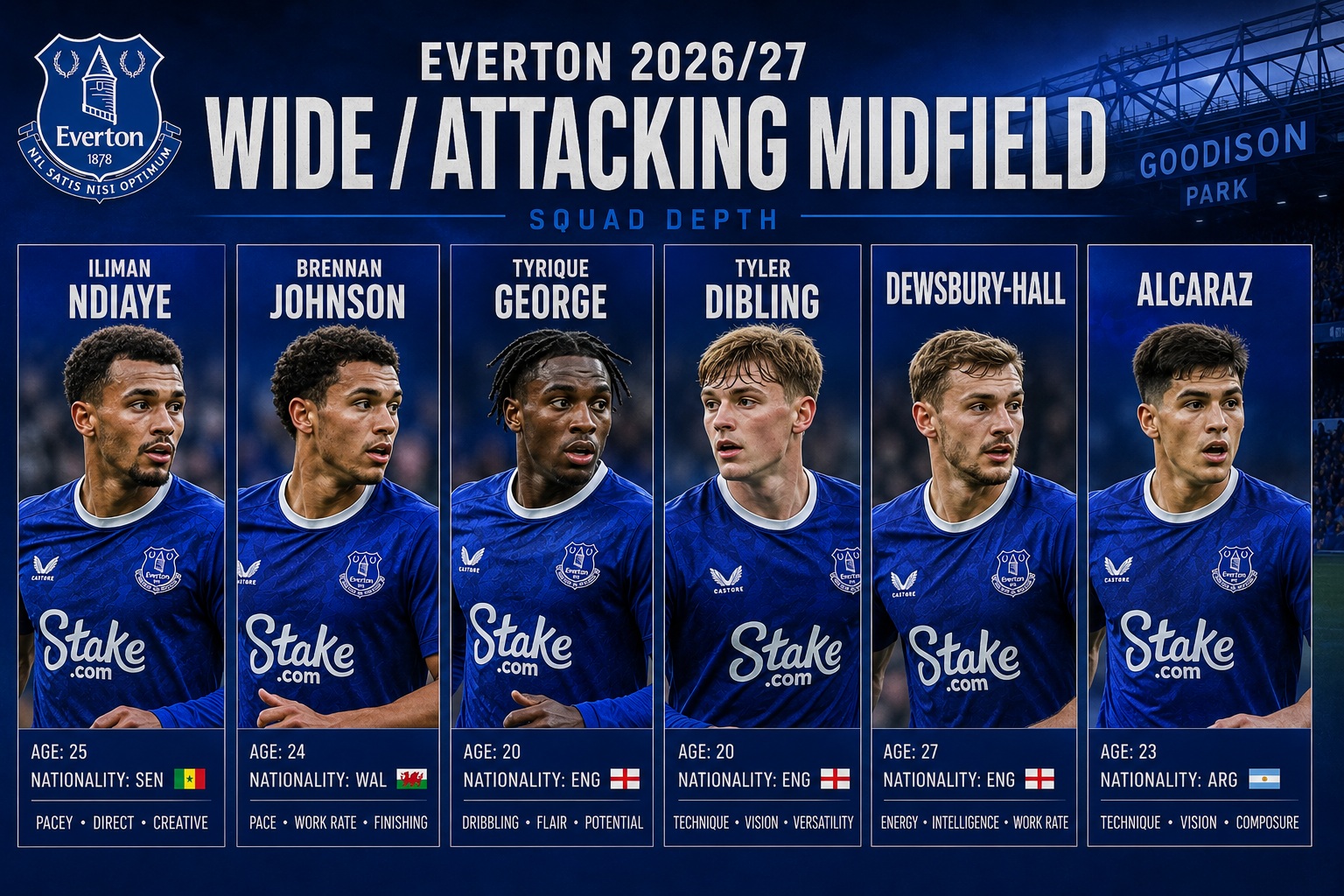
Brennan Johnson gives Moyes another proven Premier League runner capable of attacking space behind defences. His arrival from Crystal Palace was part of the deal that took McNeil in the opposite direction. Tyrique George provides another direct wide option after completing a permanent move from Chelsea following his loan spell at Everton last season.
Tyler Dibling adds technical ability and ball carrying from the right, while Dewsbury-Hall and Alcaraz can operate in advanced central positions. There is now enough variety for Moyes to change his attacking midfield without simply moving Ndiaye from one position to another.
Depth Assessment: Strong
Read Also: Brighton & Hove Albion Squad Depth 2026/27: Strengths, Weaknesses and Season Outlook
2. Centre-Forward Options
Thierno Barry begins the season with an opportunity to establish himself as Everton’s leading striker. His headed goal against Palace was an encouraging start, and his physical presence gives Moyes a forward capable of occupying centre-backs and providing a target when Everton play more directly.
Beto remains the main senior alternative. The Portuguese striker offers strength, running and penalty-box presence, but neither forward has yet established the kind of consistent Premier League scoring record that would make centre-forward one of Everton’s strongest areas.
The numbers are adequate. The greater question is whether Barry or Beto can deliver enough goals over an entire campaign. Everton therefore have depth at striker without necessarily having proven high-level production.
Depth Assessment: Adequate
How Much Quality Is There Beyond the Starting XI?
Everton’s improved midfield gives Moyes considerably more freedom than he had in previous seasons. Against Palace, Garner, Johnson, Dibling, Alcaraz, Beto, O’Brien, Patterson and Keane were all outside the starting XI. Nørgaard and Iroegbunam were unavailable.
That is meaningful depth for a club without European football. Moyes should be able to rotate two or three positions without dramatically weakening the team. The biggest concerns remain at right-back and centre-forward, where the difference between having alternatives and having equivalent alternatives is more obvious.
Where Everton Are Strongest
Central midfield is now the squad’s deepest area. Hackney, Garner, Nørgaard, Dewsbury-Hall, Röhl, Armstrong and others give Moyes more combinations than he is likely to need in a normal league week.
Centre-back is also secure. Branthwaite, Tarkowski, O’Brien and Keane provide experience and physical strength.
Wide attack has improved following the additions of Johnson and George, particularly because Everton no longer need to rely so heavily on Ndiaye to provide every form of attacking progression.
Where Everton Look Vulnerable
Right-back is the obvious weakness. Patterson is the only natural senior option, and beginning the Premier League season with Röhl there underlines why Everton could still strengthen the position before the transfer window closes. Reuters also reported after the Palace win that Moyes remains keen to add to the squad, with right-back a concern.
Centre-forward is less of a numerical problem but remains a quality question. Barry and Beto give Everton two specialists, yet the club still needs one of them to become a dependable source of league goals. There is also a clear dependency on Pickford and Ndiaye, whose strongest qualities are not easily recreated by their replacements.
Key Players for Squad Stability
1. Jordan Pickford
Everton have goalkeeper cover, but Pickford’s experience and ability to produce important saves make him difficult to replace.
2. Jarrad Branthwaite
Branthwaite’s athleticism gives Everton defensive security that allows Tarkowski and the players ahead of him to operate with greater confidence.
3. Iliman Ndiaye
Everton have added more attacking options, but Ndiaye remains their most reliable combination of ball carrying, creativity and individual threat.
How Injuries Could Test Everton
The opening weekend offered a useful early test. Nørgaard and Iroegbunam were unavailable, while Garner had only recently been managing a groin problem. Everton were still able to field a functional midfield and keep Garner among the substitutes.
That suggests the midfield can handle multiple absences. The same cannot be said at right-back. Losing Patterson would not create a numerical crisis because Röhl and O’Brien can cover, but both would be playing away from their strongest positions.
A prolonged absence for Pickford, Branthwaite or Ndiaye would also test Everton more severely because each provides qualities that are difficult to reproduce directly.
Fixture Load and Rotation
Everton have no European football this season after finishing 13th in 2025/26. Their schedule therefore consists primarily of the Premier League alongside the FA Cup and EFL Cup. That should work in Moyes’ favour.
Everton have enough midfielders and attackers to rotate during cup matches without weakening the league side substantially, but they do not need the type of enormous squad required by clubs playing every three or four days in Europe. Their current depth is therefore better judged against injuries and competition for places rather than extreme fixture congestion.
Where the Squad Could Still Be Strengthened
A specialist right-back is the clearest need. Adding one would allow Röhl to return to midfield permanently and prevent Moyes from depending on makeshift solutions if Patterson is unavailable or out of form.
Beyond that, another proven goalscorer could raise the ceiling of the attack, although Barry deserves the opportunity to establish himself after an encouraging start. Everton do not need additional midfielders simply for numbers. That part of the squad is already crowded.
Overall Squad Depth Assessment
Overall Assessment: Good Depth With a Clear Right-Back Weakness
Everton have improved the balance of their squad. Central midfield is now genuinely deep, centre-back is reliable, and the additions of Johnson and George give Moyes more attacking choices. The concerns are concentrated rather than widespread.
Right-back lacks convincing specialist competition, while centre-forward still requires either Barry or Beto to demonstrate consistent Premier League scoring. For a club without European football, however, Everton have enough overall depth to manage injuries and rotate effectively across domestic competitions.
Conclusion
Everton’s 2026/27 squad is stronger in depth than the team that finished 13th last season, particularly through midfield and the attacking positions behind the striker. Hayden Hackney and Christian Nørgaard increase the midfield options, while Brennan Johnson and Tyrique George give Moyes more ways to support Ndiaye and Barry.
Central defence also remains dependable through Branthwaite, Tarkowski, O’Brien and Keane. The obvious weakness is right-back, where using Röhl in the opening Premier League match highlighted the absence of strong specialist competition for Patterson. Centre-forward also remains an area where Everton need greater consistency rather than simply more numbers.
Overall, Moyes has a squad capable of handling a domestic-only campaign comfortably. If Everton address the right side of defence and receive reliable goals from their existing forwards, their depth should be an asset rather than a limitation.