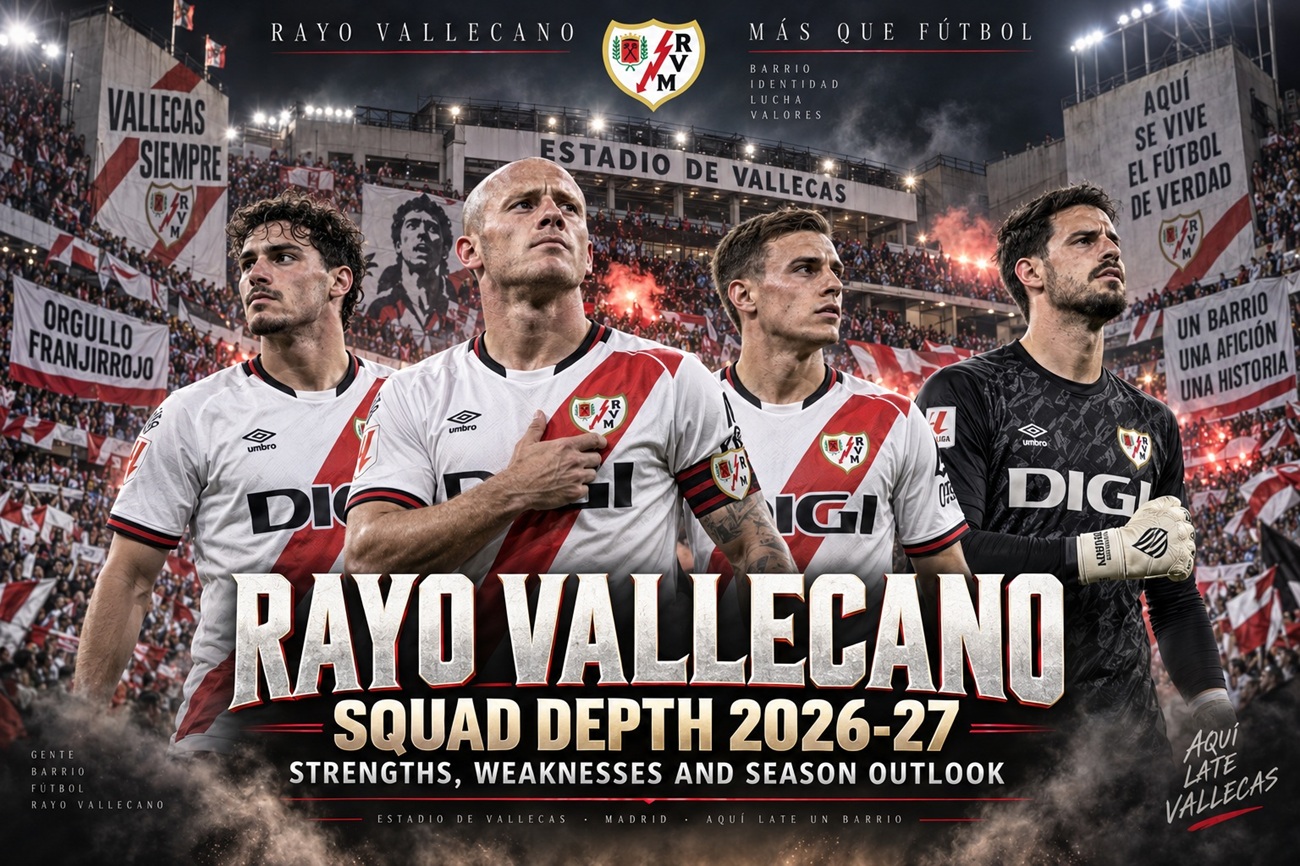
Rayo Vallecano enter 2026/27 with a new head coach, several important squad changes and a very different schedule from last season. Beñat San José replaced Íñigo Pérez after Rayo reached the Conference League final in May.
The club did not qualify for European competition this season, meaning the focus is now primarily on La Liga and the Copa del Rey. That reduced workload should help a squad that has already been heavily tested by injuries.
Adrià Pedrosa, Mujaid Sadick and Emil Audero were among the late additions, while Giorgi Tsitaishvili and other new or returning players have increased Beñat’s options. At the same time, Óscar Trejo retired, Pep Chavarría left, and several loan players from last season did not remain.
Rayo have seven points from six league matches. They have scored 10 goals but conceded 15, which provides a useful early indication of both their attacking threat and the work still required defensively.
Read Also: Real Madrid Squad Depth 2026-27: Strengths, Weaknesses and Season Outlook
Rayo Vallecano’s 2026/27 Squad at a Glance
The main senior options include:
Goalkeepers: Augusto Batalla, Emil Audero, Dani Cárdenas
Centre-backs: Florian Lejeune, Mujaid Sadick, Marash Kumbulla, Luiz Felipe, Pelayo Fernández, Jozhua Vertrouwd
Full-backs: Andrei Rațiu, Iván Balliu, Adrià Pedrosa
Central midfield: Óscar Valentín, Pathé Ciss, Unai López, Pedro Díaz, Gnangoro Bouaré
Wide attack: Isi Palazón, Álvaro García, Jorge de Frutos, Fran Pérez, Giorgi Tsitaishvili
Centre-forward: Sergio Camello, Alemão, Randy Nteka, Raúl de Tomás
There are also younger players around the senior group, but Rayo’s depth should primarily be judged through the players Beñat can realistically trust for regular La Liga minutes.
Goalkeeper Has Become More Competitive
Augusto Batalla entered the season as the established goalkeeper after becoming an important part of Rayo’s previous campaign. His current injury has changed the situation.
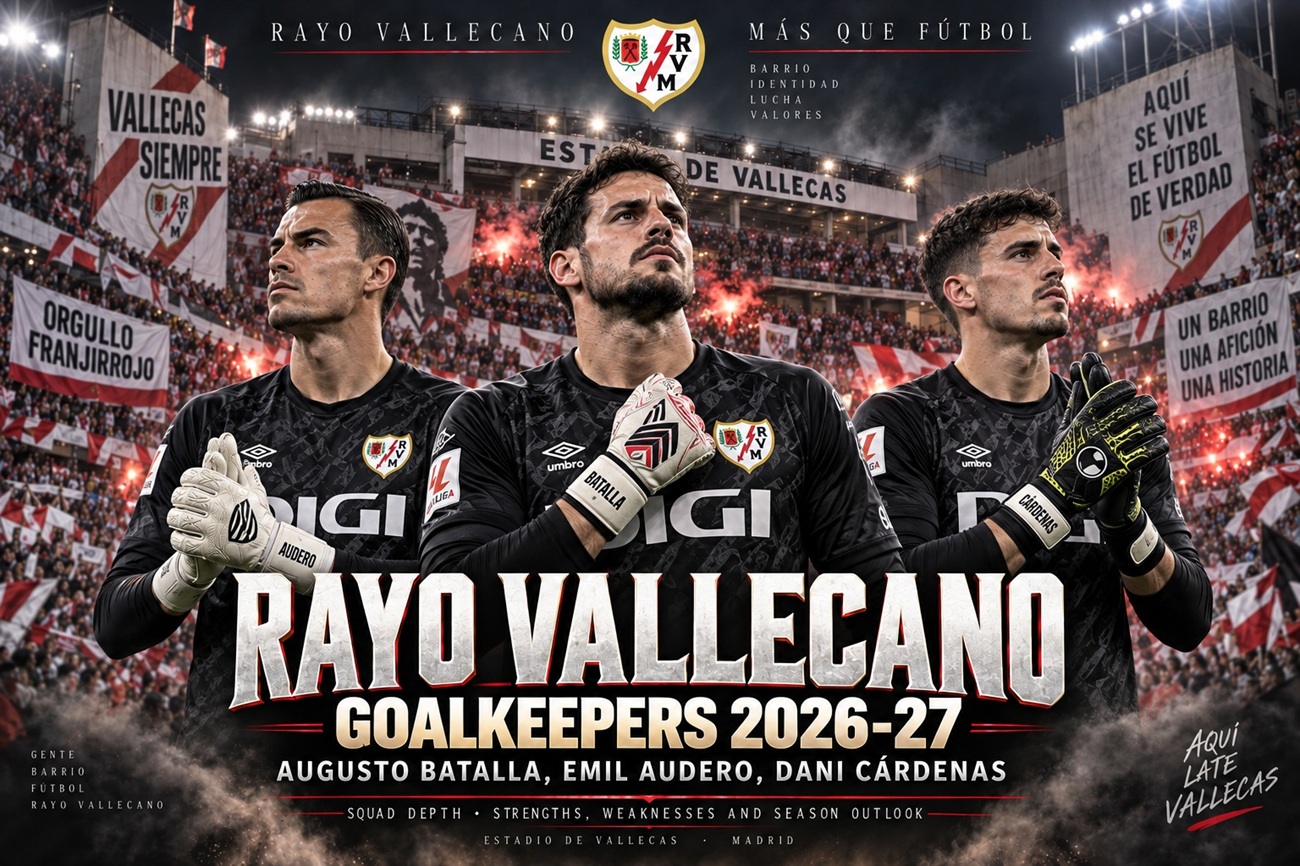
Dani Cárdenas initially stepped in, while deadline signing Emil Audero has now been introduced and started the 2-1 victory over Espanyol. Audero gives Beñat considerably more security than simply relying on one inexperienced reserve.
He has senior experience in Serie A and provides a legitimate alternative even after Batalla returns. That leaves Rayo with three usable senior goalkeepers. The question may eventually become who starts rather than whether there is sufficient cover.
Read Also: Real Betis Squad Depth 2026-27: Strengths, Weaknesses and Season Outlook
Centre-Back Numbers Are Good, but Injuries Matter
Florian Lejeune remains the most established figure in central defence. His experience, aerial strength and passing range are valuable for a team that wants its centre-backs to start attacks rather than simply defend their penalty area.
Mujaid Sadick arrived late in the transfer window and has already moved into the starting XI. Marash Kumbulla provides another experienced option, while Pelayo Fernández gives Beñat a younger defender capable of handling meaningful first-team minutes.
On paper, this is a reasonably deep group. The current problem is availability. Luiz Felipe and Jozhua Vertrouwd have both been sidelined, reducing the number of combinations available to Beñat.
Rayo can currently cope because Lejeune, Mujaid, Kumbulla and Pelayo remain options. Another centre-back injury, however, would make the situation considerably less comfortable. The depth is therefore better than the current injury list makes it look, but not unlimited.
Pedrosa Solves an Important Left-Back Problem
Pep Chavarría’s departure created a clear need on the left. Adrià Pedrosa addresses it. The former Espanyol and Sevilla defender brings pace, attacking ambition and considerable La Liga experience.
He has already made an immediate contribution, scoring against his former club in Rayo’s 2-1 win over Espanyol. His ability to push high up the pitch also suits Beñat’s preference for aggressive full-backs.
The right side is better protected through Rațiu and Balliu. Rațiu remains the first-choice option and scored against Racing Santander. Balliu provides an experienced alternative and has recently returned to the squad after injury.
The imbalance is that Rayo have two established natural right-backs but less equivalent specialist depth behind Pedrosa on the left. If Pedrosa is unavailable, Beñat may need to adjust another defender’s role rather than make a straightforward replacement.
Read Also: Racing Santander Squad Depth 2026-27: Strengths, Weaknesses and Season Outlook
Midfield Has Continuity
One advantage Beñat inherited is an established central-midfield group. Óscar Valentín remains one of the defensive organisers. Pathé Ciss provides physicality, aerial strength and the ability to protect ground in transition.
Pedro Díaz offers greater technical quality and can contribute further forward, while Unai López remains important for progression and chance creation.
Gnangoro Bouaré adds another younger midfield option and has already received league minutes. This is not the deepest midfield in La Liga, but it contains enough different profiles for a domestic season.
Beñat can use Valentín when greater defensive structure is required, Ciss for physicality, Pedro Díaz to move the ball forward, and Unai López when more creativity is needed. The real concern would come if two or three central midfielders were unavailable simultaneously.
Losing Óscar Trejo Changes the Creative Structure
Trejo’s retirement removed more than a squad number. For years, he provided Rayo with a natural player between midfield and attack who understood when to slow the game, draw pressure, or make the final pass.
There is no direct replacement. Instead, the creative responsibility is distributed. Unai López can create from midfield. Isi Palazón remains one of the most talented attacking players in the squad when fit. Pedro Díaz can contribute from deeper positions.
Tsitaishvili and Álvaro García offer more direct attacking qualities. That can make Rayo less dependent on one creator, but it also means Beñat needs several players contributing together when opponents defend compactly. Isi’s current injury makes that issue more noticeable.
Read Also: CA Osasuna Squad Depth 2026-27: Strengths, Weaknesses and Season Outlook
The Wings Have Good Variety
Rayo have several credible wide options. Álvaro García remains one of the most direct attackers in the squad. His pace and willingness to run behind full-backs make him particularly valuable when Rayo attack quickly.
He was excellent against Espanyol, scoring the opening goal and creating Pedrosa’s second. Jorge de Frutos provides another major attacking threat and should return to availability after completing his two-match suspension.
Fran Pérez is also available again after serving his one-game ban. Tsitaishvili can play from either side and started against Espanyol while Rayo were missing several attacking players.
Isi brings greater creativity and shooting ability when healthy. That means the winger department is deeper than it appeared during the heavily depleted trip to Real Madrid. Beñat has different types of players rather than four similar wingers.
Sergio Camello Has Become the Attacking Reference
Camello’s start to the season has been outstanding. He has scored six goals in the first six La Liga matches. That includes two against Barcelona, two against Racing Santander and another at the Santiago Bernabéu. His movement has been particularly important.
Camello does not need to remain between the centre-backs waiting for crosses. He can drop into combinations, attack channels and press from the front. The concern is obvious: Rayo cannot assume that level of scoring will continue every week. Fortunately, there are alternatives. Alemão offers greater size and physical presence.
Nteka can operate as a striker or supporting forward when fit. Raúl de Tomás has been registered after spending much of the summer training separately, although his exact role under Beñat is still less established.
Rayo therefore have numbers at centre-forward. What they do not currently have is another striker producing anything close to Camello’s level.
The Injury List Has Already Tested the Squad
Rayo went into the recent matches without several important players. Batalla, Luiz Felipe, Vertrouwd and Isi have been injured, while Nteka has also been dealing with fitness problems. Balliu has only recently returned.
Suspensions simultaneously removed De Frutos and Fran Pérez during part of that period. This created an unusually difficult test so early in the season. The squad handled it unevenly. Rayo conceded four against Real Madrid, but responded by beating Espanyol despite still missing several senior players.
That is encouraging. It suggests Beñat has enough alternatives to remain competitive when injuries occur, even if losing several starters at the same time inevitably lowers the overall level.
The Defensive Record Needs Improvement
Rayo have conceded 15 goals in six league matches. Five came against Barcelona and four against Real Madrid, so the number requires context. Still, nine goals conceded in those two matches alone exposed a vulnerability when Rayo’s press is bypassed, and their defenders are forced to protect larger spaces.
The issue is not simply centre-back quality. Beñat’s approach requires coordination between the midfield press, full-backs and central defence. New players such as Mujaid and Pedrosa are still developing those relationships.
Having more defenders helps with rotation, but reducing the goals conceded will depend more on collective organisation than adding another player to the squad.
No European Football Changes the Depth Requirement
Last season Rayo had to balance domestic football with a long Conference League campaign that reached the final. There is no equivalent European workload this season. That makes the current squad much more manageable.
Beñat does not need two separate starting XIs. He needs enough alternatives to survive injuries, suspensions and fluctuations in form while giving younger players opportunities in the Copa del Rey.
With three senior goalkeepers, several centre-backs, an established midfield and multiple wide and centre-forward options, the squad is large enough for that purpose. The question is less about quantity and more about the quality difference behind certain important players.
Overall Squad Depth Assessment
Overall Assessment: Solid Depth for a Domestic Season, With Some Important Dependencies
Rayo have credible alternatives in most departments. Goalkeeper is now well covered through Batalla, Audero and Cárdenas. Centre-back has sufficient numbers once the injured players return. The midfield retains useful continuity, while the wide positions contain enough pace, creativity and directness for Beñat to alter his attack.
The clearest issues are specialist left-back cover and dependence on certain attacking players. Pedrosa has no equally established natural backup on the left. Isi remains difficult to replace creatively.
Most importantly, Camello is currently carrying a very large share of the goalscoring burden. Those are manageable weaknesses for a team without European football, but they explain where injuries or loss of form would have the greatest impact.
Conclusion
Rayo Vallecano’s 2026/27 squad has enough depth to handle a domestic season, even though injuries have made the opening weeks look more difficult than the underlying squad suggests.
Emil Audero and Mujaid Sadick improve the defensive alternatives, while Adrià Pedrosa gives Beñat San José an important new option at left-back. Midfield remains familiar, and Rayo have good variety through Álvaro García, Jorge de Frutos, Isi Palazón, Fran Pérez and Giorgi Tsitaishvili.
The biggest early development is Sergio Camello. His six goals have made him the clear attacking reference, but Rayo will need contributions from Alemão, De Frutos, Isi and the wider forward group if they want their attack to remain sustainable over 38 matches.
For now, the squad looks appropriately built for La Liga and the Copa del Rey. The priority is not adding more numbers, but getting injured players back and turning the defensive options into a more consistent collective unit.