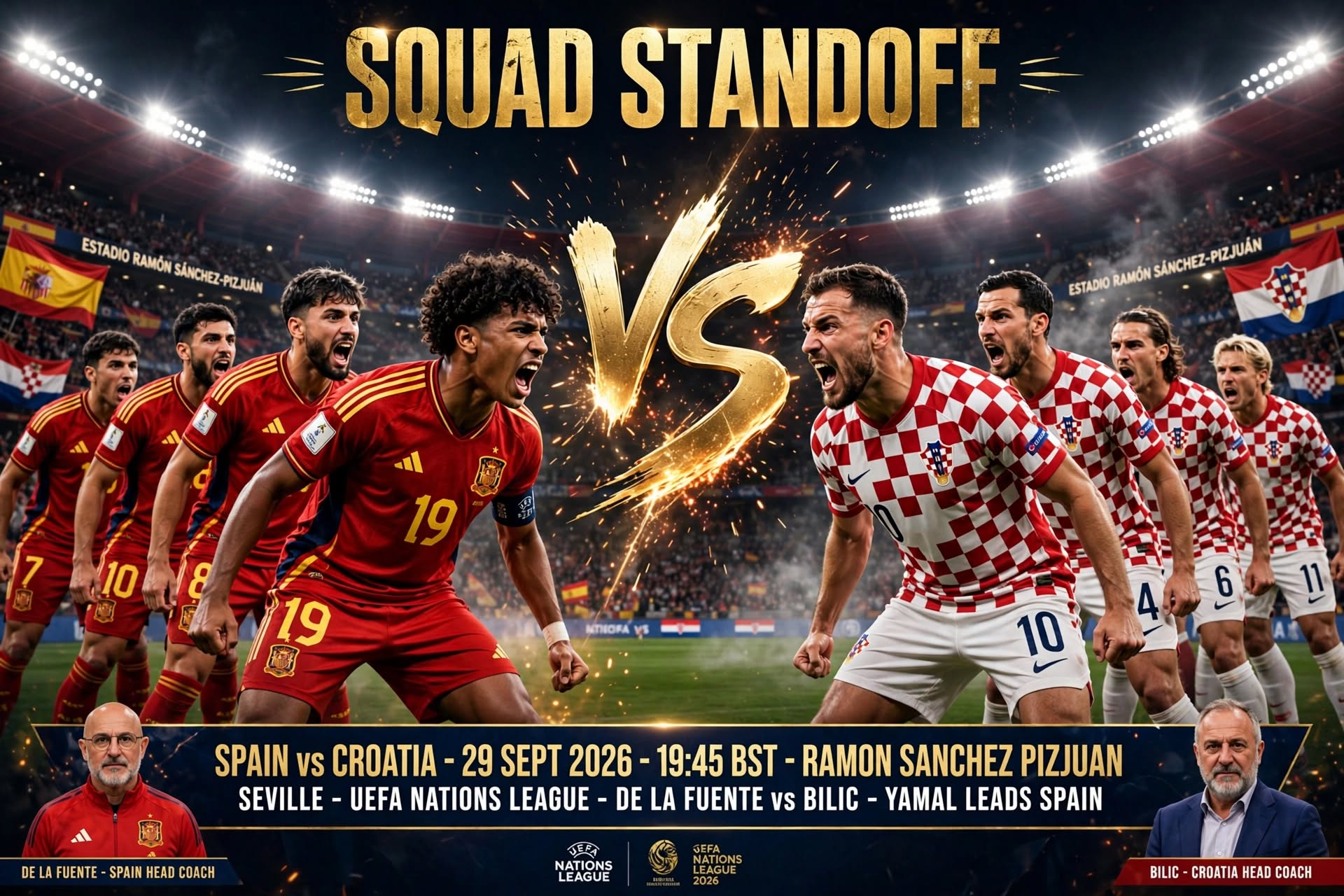
Head-to-Head Summary
Spain hold the overall advantage in this matchup.
Before Euro 2024, the countries had met 10 times, with Spain recording five wins, Croatia three and two games ending level. Spain's 3-0 victory in Berlin increased their overall advantage to six wins from 11 meetings.
The broader numbers now stand at:
Spain wins: 6
Croatia wins: 3
Draws: 2
Spain goals: 23
Croatia goals: 12
The competitive meetings have produced several very different types of games. Spain won 6-0 in the Nations League in 2018, Croatia answered with a 3-2 victory later that year, and their Euro 2020 knockout meeting finished 5-3 to Spain after extra time.
Their 2023 Nations League final was completely different. Neither side scored across 120 minutes before Spain won the penalty shootout 5-4.
That history suggests the matchup can shift dramatically depending on how much control either midfield establishes.
Last 10 Meetings
June 15, 2024 — Euro 2024: Spain 3-0 Croatia
June 18, 2023 — Nations League Final: Croatia 0-0 Spain — Spain won 5-4 on penalties
June 28, 2021 — Euro 2020: Croatia 3-5 Spain after extra time
November 15, 2018 — Nations League: Croatia 3-2 Spain
September 11, 2018 — Nations League: Spain 6-0 Croatia
June 21, 2016 — Euro 2016: Croatia 2-1 Spain
June 18, 2012 — Euro 2012: Croatia 0-1 Spain
June 7, 2006 — Friendly: Spain 2-1 Croatia
February 23, 2000 — Friendly: Croatia 0-0 Spain
May 5, 1999 — Friendly: Spain 3-1 Croatia
Spain have won six of these 10 encounters in regulation or extra time, while Croatia have won twice and two finished level before any shootout.
The recent trend favours Spain even more strongly. Croatia's last victory came in November 2018, meaning Spain are unbeaten in their last three meetings.
However, two of those three required extra time or penalties. The 3-0 Euro 2024 victory was the exception rather than the usual pattern of recent Spain-Croatia games.
Spain Current Form
Spain enter the Nations League as world champions after an outstanding 2026 World Cup.
Their last five completed internationals are:
July 19 — Spain 1-0 Argentina after extra time
July 14 — France 0-2 Spain
July 10 — Spain 2-1 Belgium
July 6 — Portugal 0-1 Spain
July 2 — Spain 3-0 Austria
Spain won all five and conceded only once.
Their wider World Cup run was even more impressive. After a goalless opening game against Cabo Verde, Spain won seven consecutive matches to lift the trophy, including knockout victories over Austria, Portugal, Belgium, France and Argentina.
The defensive record stands out as much as the attacking quality. Spain kept clean sheets in four of their final five World Cup games.
De la Fuente has retained most of that successful core for the Nations League. Rodri, Pedri, Martín Zubimendi, Fabián Ruiz, Lamine Yamal, Nico Williams and Mikel Oyarzabal remain central figures, while players such as Fermín López and Dean Huijsen have returned to the group.
That continuity makes Spain particularly difficult to face immediately after a major tournament.
Croatia Current Form
Croatia's last five completed internationals produced three wins and two defeats.
July 3 — Portugal 2-1 Croatia
June 27 — Croatia 2-1 Ghana
June 24 — Panama 0-1 Croatia
June 17 — England 4-2 Croatia
June 7 — Croatia 2-1 Slovenia
Their World Cup campaign was competitive without developing into another deep tournament run.
Croatia recovered from the opening defeat to England by beating Panama and Ghana, which secured progression from the group. Portugal then eliminated them 2-1 in the round of 32.
The tournament also marked another milestone for Luka Modrić, who made his 200th international appearance against Panama.
Croatia remain experienced, but there has been an important coaching change. Slaven Bilić is now in charge and has selected a squad that combines established players such as Modrić, Mateo Kovačić, Ivan Perišić and Andrej Kramarić with younger options including Luka Vušković, Martin Baturina and the Sučić brothers.
The challenge is finding the right balance between that experience and the next generation.
Spain Team News and Injuries
Spain's squad has changed slightly from the group that won the World Cup.
Joan García is unavailable after suffering a knee injury, with Inter goalkeeper Josep Martínez called into the senior squad. Gavi was also left out, while Fermín López returned after missing the World Cup because of a foot problem.
Pedro Porro subsequently withdrew after suffering another injury with Tottenham. Iván Fresneda was promoted from the Under-21 squad as a replacement.
De la Fuente still has considerable defensive depth. Pau Cubarsí, Dean Huijsen, Aymeric Laporte, Dani Vivian, Marc Cucurella, Alejandro Grimaldo and Eric García are among the available options.
The midfield remains Spain's greatest area of strength.
Rodri, Pedri, Zubimendi, Fabián Ruiz, Mikel Merino, Fermín and Álex Baena give De la Fuente several combinations without forcing him to change the team's technical identity.
Spain's match against England on September 26 could naturally create additional availability issues before Croatia, so the final team news should be reassessed after Wembley.
Croatia Team News and Injuries
Bilić named an experienced squad for Croatia's opening four Nations League matches.
Dominik Livaković, Joško Gvardiol, Josip Stanišić, Josip Šutalo, Luka Modrić, Mateo Kovačić, Mario Pašalić, Ivan Perišić, Andrej Kramarić and Ante Budimir are all included.
There are also several younger players who could become increasingly important during this cycle.
Luka Vušković is included among the defenders, while Martin Baturina, Luka Sučić and Petar Sučić strengthen the midfield options. Franjo Ivanović and Dion Drena Beljo provide additional competition in attack.
Croatia did not announce a major injury withdrawal alongside the original squad announcement. However, their Matchday 1 trip to Czechia comes only three days before Spain, so Bilić may need to manage both fitness and workload carefully.
The four-game international window is particularly demanding for an experienced squad containing several players in their mid-to-late thirties.
Tactical Match Analysis
Spain should control more possession.
De la Fuente's team have become excellent at positioning midfielders between opposition lines while maintaining enough width to stretch compact defensive structures. Rodri or Zubimendi can dictate from deeper positions, with Pedri and Fabián receiving further forward.
Croatia must prevent those midfield combinations from becoming comfortable.
That is where Kovačić and the Sučić brothers could become particularly important. Croatia cannot simply retreat around their own penalty area because Spain are too comfortable sustaining possession and moving opponents until an opening appears.
Bilić may instead look for selective pressing moments.
When Spain play toward one side, Croatia can compress the pitch and try to force possession backwards or create a turnover. Modrić still provides the quality to turn those recoveries into controlled attacks rather than hopeful clearances.
The wide areas present another major challenge.
Lamine Yamal can attract two defenders on Spain's right. If Croatia double up too aggressively, Pedri or another midfielder can exploit the space created inside.
Nico Williams offers a different threat on the opposite side through direct running and acceleration.
Spain therefore force opponents to defend the entire width of the pitch.
Croatia's strongest route may be through transitions and switches of play. Perišić can still provide width, while Kramarić is comfortable moving away from the centre-forward position to connect attacks.
Gvardiol's ability to carry possession from defence may also help Croatia escape Spain's press.
The key is avoiding turnovers in central midfield. Spain's counter-press can turn one poor pass into a chance within seconds.
Key Players to Watch
Lamine Yamal
Yamal remains one of Spain's most difficult attacking problems for any opponent.
His ability to receive wide, beat a defender and then create or shoot with his left foot often forces opponents to send additional cover toward him. Croatia need to prevent those situations from becoming repetitive.
Pedri
Pedri gives Spain control between the lines.
His positioning can pull Croatia's midfield away from its preferred shape, while his combination play with Yamal and Spain's overlapping defenders can create overloads around the penalty area.
Luka Modrić
Even at this stage of his career, Modrić remains central to Croatia's ability to control difficult matches.
His experience is particularly valuable against Spain because Croatia need someone who can retain possession under pressure rather than allowing the game to become a constant defensive exercise.
Joško Gvardiol
Gvardiol will have an important role both defensively and in possession.
Croatia need him to handle Spain's movement in wide areas while also using his passing and ball carrying to help break the first line of pressure.
What the Numbers Tell Us
Spain have won six of the 11 previous meetings.
Croatia have won three, with two draws.
Spain lead 23-12 on aggregate goals.
Spain are unbeaten in the last three H2Hs.
Spain won all of their final seven matches at the 2026 World Cup.
Croatia won two of their three World Cup group matches but exited in the round of 32.
Spain conceded only one goal across their final five World Cup matches.
The current evidence strongly favours Spain.
Croatia still possess enough midfield experience and defensive quality to make the fixture difficult, particularly if they can slow the pace and prevent Spain from generating repeated attacks from the wings.
Who Has the Statistical Edge?
Spain have the clear statistical advantage.
They are world champions, have home advantage and enter the Nations League after seven consecutive World Cup victories. Their recent defensive numbers are exceptional, while the H2H also leans in their favour.
Croatia's experience means the gap should not be exaggerated.
They have beaten Spain three times historically and pushed them to extra time or penalties in two of their last three meetings before Euro 2024. Modrić, Kovačić, Gvardiol and Kramarić give Bilić enough quality to manage difficult phases.
A draw is possible if Croatia can keep Spain away from central areas and slow the match down.
However, Spain's midfield depth, wide attacking quality and current defensive record make them significantly stronger on the available evidence.
Conclusion
Spain vs Croatia has developed into one of Europe's most familiar international matchups, with the countries meeting repeatedly across major tournaments and Nations League campaigns.
Spain currently hold the stronger position.
De la Fuente's side arrive as world champions after winning seven consecutive matches to finish the 2026 World Cup. They have retained most of that squad and continue to combine midfield control with dangerous wide players such as Yamal and Nico Williams.
Croatia remain experienced and competitive under Slaven Bilić. Modrić, Kovačić, Gvardiol, Perišić and Kramarić provide a strong senior core, while several younger players are beginning to take on greater responsibility.
Recent history shows Croatia can make this matchup difficult, but Spain's current level is exceptionally high.
The H2H, home advantage, World Cup form and defensive numbers all give Spain the clear statistical edge, although Croatia have enough midfield quality to keep the contest competitive if they can prevent the hosts from establishing their preferred tempo.