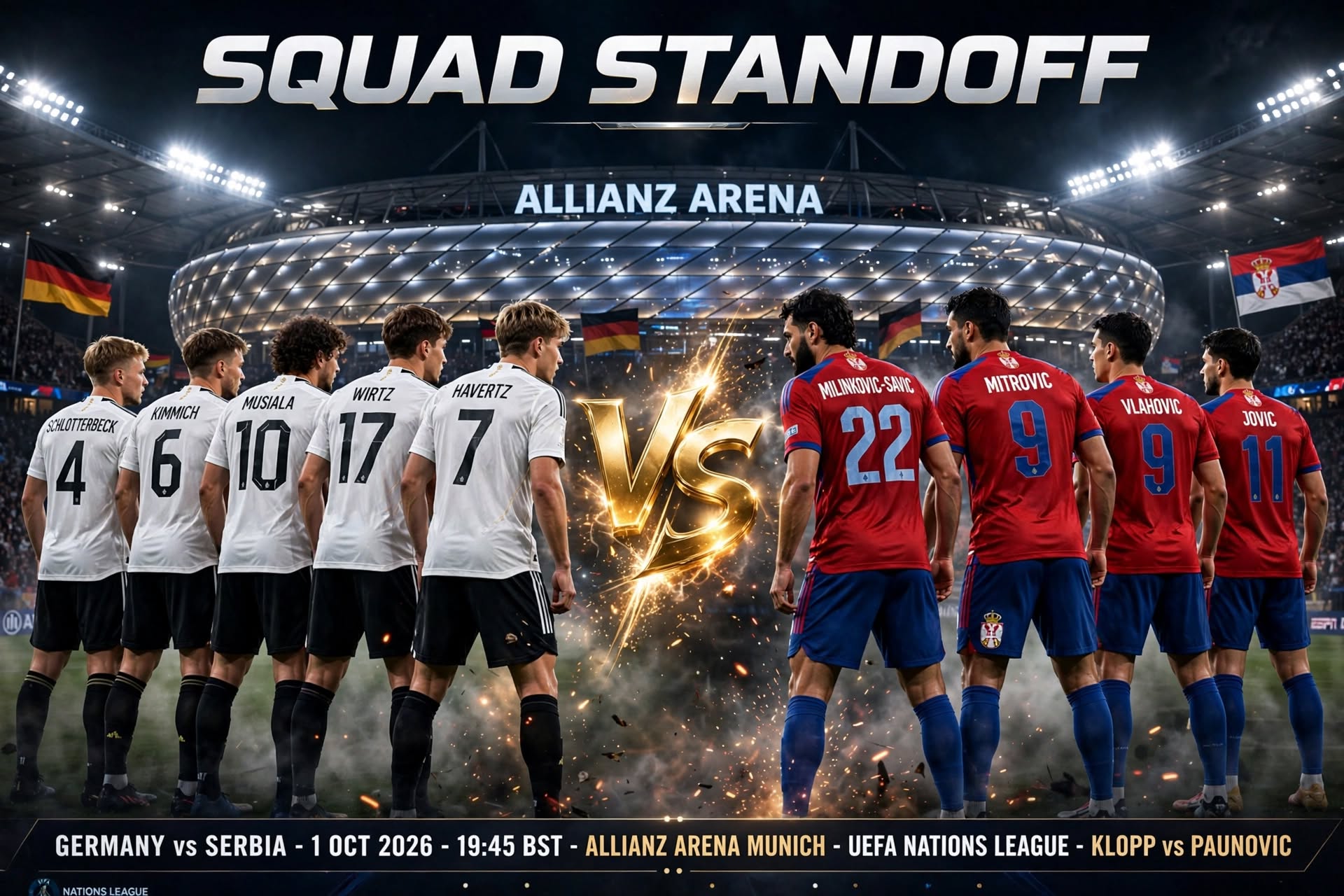
Germany host Serbia at the Allianz Arena in Munich on October 1 in Matchday 3 of the 2026/27 UEFA Nations League. Both teams have already begun their campaigns.
Germany opened the Jürgen Klopp era with a 1-1 draw away to the Netherlands, while Serbia suffered a 2-1 home defeat against Greece after taking an early lead through Andrija Živković.
Both sides play again on September 27 before meeting in Munich. Germany host Greece, while Serbia face the Netherlands in Belgrade. With the Netherlands and Greece completing Group A2, the standings could change considerably before Matchday 3.
Read Also: Denmark vs Portugal 2026-27 Nations League Matchday 3: H2H, Form and Team News
Germany vs Serbia Match Details
Competition: 2026/27 UEFA Nations League
League: League A
Group: A2
Stage: Matchday 3
Date: October 1, 2026
Kick-off: 20:45 local time
Venue: Allianz Arena, Munich
Germany coach: Jürgen Klopp
Serbia coach: Veljko Paunović
Germany travel to Greece three days after this fixture, while Serbia face another difficult away game against the Netherlands.
Germany vs Serbia Head-to-Head Record
There has been very little between Germany and Serbia since Serbia became an independent national team. They have met three times:
Germany 1-1 Serbia – March 2019
Germany 0-1 Serbia – June 2010
Germany 2-1 Serbia – May 2008
That gives each country one victory, with one draw. The most important meeting was at the 2010 World Cup. Milan Jovanović scored the only goal as Serbia defeated Germany 1-0 after Miroslav Klose had been sent off in the first half.
Their most recent meeting was a friendly in Wolfsburg in 2019. Luka Jović put Serbia ahead before Leon Goretzka equalised for Germany. This will therefore be their first competitive meeting in more than 16 years.
Read Also: Spain vs Croatia 2026-27 Nations League Matchday 2: H2H, Form and Team News
Germany Recent Form
Germany's latest five matches are:
Netherlands 1-1 Germany
Germany 1-1 Paraguay – Paraguay won on penalties
Ecuador 2-1 Germany
Germany 2-1 Côte d'Ivoire
Germany 7-1 Curaçao
Germany topped their World Cup group after victories over Curaçao and Côte d'Ivoire, despite losing their final group match to Ecuador. Their tournament ended much earlier than expected when Paraguay eliminated them on penalties in the Round of 32. That defeat ended Julian Nagelsmann's time as coach and opened the door for Klopp.
His first match produced a point in Amsterdam, but the Nations League is clearly being used for more than short-term results. Germany are also assessing a much wider group of players as Klopp begins building towards the next major tournament cycle.
Serbia Recent Form
Serbia's latest five matches are:
Serbia 1-2 Greece
Mexico 5-1 Serbia
Cape Verde 3-0 Serbia
Serbia 2-1 Saudi Arabia
Spain 3-0 Serbia
It has been a difficult period. Serbia failed to qualify for the 2026 World Cup and then suffered heavy friendly defeats against Cape Verde and Mexico during the summer. Their Nations League opener followed a similar pattern of frustration.
Živković gave Serbia an early advantage against Greece, but they were unable to protect the lead and eventually lost 2-1. Paunović therefore needs more defensive stability, particularly with Germany and the Netherlands providing two demanding matches immediately after the Greece defeat.
Read Also: Czechia vs England 2026-27 Nations League Matchday 2: H2H, Form and Team News
Germany Team News
Klopp has taken an unusual approach to his first international window. Germany selected 44 players across two groups rather than relying on one conventional squad for all four Nations League matches. The first group is being used primarily for the Netherlands and Greece matches.
After the Greece game, 20 additional players are scheduled to join the camp for the matches against Serbia and Greece, while many members of the original group return to their clubs.
The players joining for the second half of the window include Noah Atubolu, Jonathan Burkardt, Maximilian Mittelstädt, Ridle Baku, Brajan Gruda, Saïd El Mala, Tom Bischof and several senior-team newcomers. Finn Jeltsch, Felix Keidel, Vitaly Janelt, Mika Baur and Derry Scherhant are among those receiving their first senior opportunities.
That makes predicting Germany's exact lineup against Serbia unusually difficult. What is clear is that Klopp is using the Nations League to widen Germany's player pool rather than depending entirely on the same established core.
Serbia Team News
Paunović selected 28 players for Serbia's opening four Nations League matches. Vanja Milinković-Savić, Djordje Petrović and Filip Stanković are the goalkeeping options. Strahinja Pavlović, Strahinja Eraković, Srđan Babić, Kosta Nedeljković and Aleksa Terzić are among the defenders.
The midfield contains considerable experience. Sergej Milinković-Savić, Nemanja Gudelj, Saša Lukić, Nemanja Maksimović, Dušan Tadić, Lazar Samardžić, Filip Kostić and Andrija Živković are all included. Aleksandar Stanković, Vanja Dragojević, Stefan Džodić and Vasilije Kostov provide younger options.
Dušan Vlahović leads the forward group alongside Luka Jović, Dejan Joveljić, Mihajlo Cvetković and Jovan Milošević. There are also notable names missing from the selection, including Aleksandar Mitrović and Nikola Milenković. Serbia still has plenty of individual quality, but the bigger question is whether Paunović can create enough defensive structure around it.
Read Also: Türkiye vs Italy 2026-27 Nations League Matchday 2: H2H, Form and Team News
Key Players
Jonathan Burkardt
Burkardt is one of the players joining Germany for the second half of the Nations League window. His movement, pressing, and willingness to attack space make him an interesting option in Klopp's system.
Against Serbia's physical centre-backs, Germany may benefit from a forward who constantly changes position rather than remaining a fixed target.
Tom Bischof
Bischof represents the younger direction Germany are exploring. He is comfortable receiving possession under pressure and can help Germany move the ball quickly through midfield.
A match against experienced opponents such as Milinković-Savić and Gudelj would provide a significant test if he receives minutes.
Dušan Vlahović
Vlahović remains Serbia's biggest central goal threat. His strength, movement and finishing mean Germany cannot allow him to receive regular service inside the penalty area.
Serbia's challenge is creating enough situations where he can attack the goal rather than asking him to spend long periods isolated.
Sergej Milinković-Savić
Milinković-Savić can influence the match physically and technically. He provides aerial strength, progression through midfield and the ability to arrive around the penalty area.
Against a potentially inexperienced German midfield, Serbia may look to use his experience to slow the game and establish control.
Tactical Battle
Germany's exact structure is difficult to predict because Klopp is changing so many players between the first and second halves of the international window. The principles should be easier to recognise.
Germany are likely to press aggressively, move the ball forward quickly and try to recover possession high up the pitch. That approach could create problems for Serbia.
Paunović's side have experienced midfielders, but they have struggled defensively when matches become stretched. Serbia therefore need to avoid unnecessary turnovers close to their own penalty area.
At the same time, Germany's aggressive positioning could offer Serbia opportunities. If Tadić, Samardžić or Milinković-Savić can play through the first press, Vlahović and Serbia's wide players may find space against a German defence moving forward.
Where the Match Could Be Decided
Germany's new combinations
Germany's rotation is the biggest unusual factor. Fresh players can bring intensity, but international combinations normally take time to develop. Serbia may be able to exploit moments where Germany's positioning and communication are not yet automatic.
Serbia playing through Germany's press
Serbia cannot afford to simply clear the ball every time Germany applies pressure. Milinković-Savić, Lukić, Tadić and Samardžić need to give the visitors a way to retain possession. If Serbia repeatedly surrender the ball, Germany can build sustained pressure.
Germany defending Vlahović
Vlahović gives Serbia an obvious target. Germany need to prevent good service into him, particularly from Kostić, Tadić and Živković. Allowing Vlahović repeated touches inside the penalty area would create unnecessary problems.
Serbia's defensive transitions
This is one of the biggest concerns from their recent matches. Serbia have conceded heavily against Spain, Cape Verde and Mexico and then allowed Greece to come from behind in their Nations League opener. Germany will look to attack immediately after turnovers, so Serbia need much better protection behind the ball.
What the H2H Record Tells Me
The head-to-head record is unusually balanced. One victory each and one draw from three meetings means neither side has established control of this fixture. Serbia also has the most important victory, beating Germany at the 2010 World Cup.
But those games provide very little guidance for 2026. The last meeting was seven years ago; Germany has a new coach and Serbia's squad has also changed significantly. Current form and Germany's unusual squad rotation are much more relevant.
Final View
For me, this match is primarily a test of Germany's new direction under Klopp and Serbia's ability to stabilise after a difficult period. Germany have already started the Klopp era with a point in Amsterdam, but the team that faces Serbia could look considerably different because of the planned squad changes.
That creates uncertainty, but it also gives Germany fresh energy. Serbia's situation is clearer. They have enough individual quality through Vlahović, Milinković-Savić, Tadić, Samardžić and Živković to cause problems, but recent defensive performances have been concerning.
Their 2-1 opening defeat to Greece increased the pressure to collect points from a difficult group. For Serbia, controlling Germany's press and protecting defensive transitions will be crucial. For Germany, the challenge is producing a coherent performance despite using so many players who have had limited time together.
The historical record offers little separation between the countries. The current context is much more revealing: Germany are experimenting from a position of depth, while Serbia need to turn individual quality into a more stable collective performance.
With the Netherlands and Greece also in Group A2, this Matchday 3 meeting could become an important early test in the race for the Nations League quarter-finals.