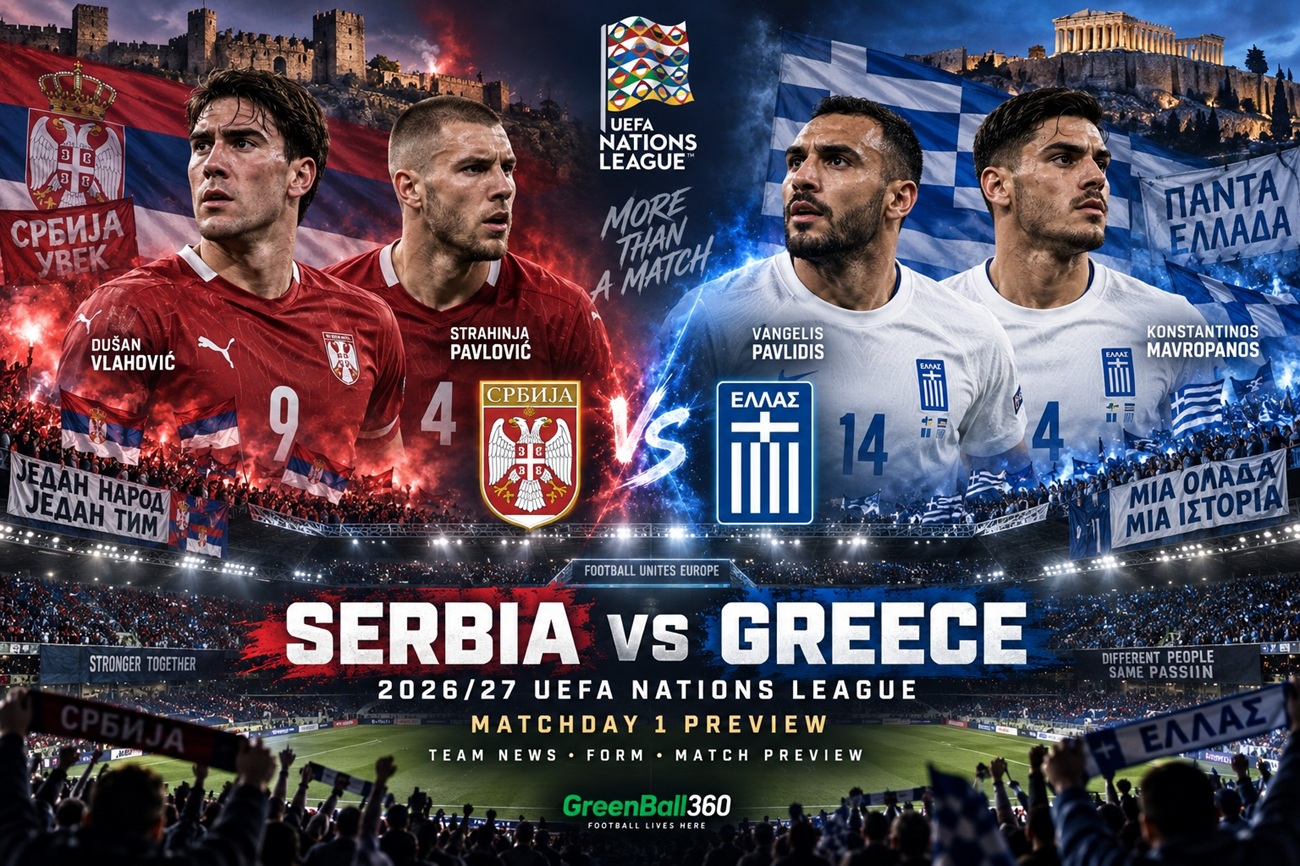
Serbia and Greece begin their 2026/27 UEFA Nations League campaigns at the Rajko Mitić Stadium in Belgrade on September 24.
This is an important opening fixture in League A Group A2, which also contains Germany and the Netherlands. Greece are playing in the Nations League's top division for the first time, while Serbia are looking to establish themselves again at this level under Veljko Paunović.
Read Also: Netherlands vs Germany: 2026-27 UEFA Nations League Group A2 Matchday 1 Preview
Serbia vs Greece Match Details
Competition: 2026/27 UEFA Nations League
League: League A
Group: A2
Stage: Matchday 1
Date: September 24, 2026
Kick-off: 20:45 local time
Venue: Rajko Mitić Stadium, Belgrade
Serbia coach: Veljko Paunović
Greece coach: Ivan Jovanović
The top two teams in every League A group advance to the quarter-finals, so Serbia and Greece are competing not only against each other but also against Germany and the Netherlands for two knockout places.
Serbia vs Greece Head-to-Head Record
Surprisingly, these two national teams have little direct history in their current forms. Since Serbia became an independent national team, they have met Greece only twice. Both games were friendlies.
Greece won 1-0 in Belgrade in August 2010, with Dimitris Salpingidis scoring the only goal. Serbia responded four years later with a 2-0 victory in Greece in November 2014.
That leaves the record perfectly balanced: one Serbia win, one Greece win and no draws. More importantly, this will be their first competitive meeting. For me, that makes the old H2H record less useful than their current squads and recent performances.
Read Also: Real Madrid Squad Depth 2026-27: Strengths, Weaknesses and Season Outlook
Serbia Recent Form
Serbia's most recent international window was difficult. They lost 3-0 to Cape Verde on May 31 before suffering a 5-1 defeat against Mexico in Toluca on June 5. Serbia did use a relatively young and experimental group during those friendlies, particularly against Mexico, so I would be careful about treating those scores as a complete reflection of the team that will face Greece.
Paunović has selected a much more experienced squad for the Nations League. Dušan Vlahović, Luka Jović, Sergej Milinković-Savić, Nemanja Gudelj, Saša Lukić, Lazar Samardžić, Filip Kostić, Andrija Živković and Dušan Tadić are among those called up.
Strahinja Pavlović provides experience in defence, while Vanja Milinković-Savić and Đorđe Petrović are among the goalkeeping options. That changes the picture considerably from June.
Serbia now have more experience, creativity and finishing quality available, but Paunović still needs to show that the team can become more stable defensively after conceding eight goals across those two summer friendlies.
Greece Recent Form
Greece enter this competition after earning promotion to League A through the 2024/25 Nations League play-offs. Their 3-0 away victory over Scotland was one of the strongest performances of Ivan Jovanović's tenure and demonstrated the progress being made by a younger generation of players.
Their 2026 friendly results have been less convincing. Greece lost 1-0 to Paraguay in March, drew 0-0 with Hungary, drew 2-2 away to Sweden in June and then lost 1-0 to Italy. That means they enter the Nations League without a win in their four matches played in 2026.
I would not read too much into those friendlies, though. Greece's rise to League A has been built over a longer period, and their squad now contains several talented young players competing at a high European level.
Read Also: Real Betis Squad Depth 2026-27: Strengths, Weaknesses and Season Outlook
Serbia Team News
Paunović announced his Serbia squad on September 18 for the first four Nations League fixtures. The attacking options are strong. Vlahović, Jović, Dejan Joveljić, Mihajlo Cvetković and Jovan Milošević give Serbia different types of centre-forwards.
Sergej Milinković-Savić, Samardžić and Tadić provide creativity, while Živković and Kostić can offer width and crossing quality.
One player I will be watching closely is Aleksandar Stanković. Serbia has several experienced midfielders, but younger players such as Stanković, Vanja Dragojević and Vasilije Kostov allow Paunović to gradually refresh the team.
Greece Team News
Greece's final official match squad had not yet been published by UEFA when this preview was prepared, so I would avoid making claims about injuries or late withdrawals before they are confirmed.
UEFA's current national-team pool includes established players such as Odysseas Vlachodimos, Konstantinos Koulierakis, Konstantinos Mavropanos, Kostas Tsimikas, Tasos Bakasetas and Vangelis Pavlidis. The younger group is particularly interesting.
Konstantinos Karetsas, Giannis Konstantelias, Christos Tzolis, Christos Mouzakitis and goalkeeper Konstantinos Tzolakis represent an important part of Greece's development.
UEFA highlighted Karetsas, Konstantelias, Tzolakis and Tzolis when assessing Greece's first League A campaign. That mixture of experience and youth gives Jovanović several ways to approach Serbia.
Read Also: Barcelona Squad Depth 2026-27: Strengths, Weaknesses and Season Outlook
Key Players
Dušan Vlahović
Vlahović gives Serbia a clear focal point in attack. His movement inside the penalty area, physical presence, and finishing can be particularly important if Serbia spend long periods attacking a compact Greek defence.
Lazar Samardžić
Samardžić can provide the creativity Serbia sometimes lacks when opponents defend deep. His ability to receive between the lines and create from central areas could be important against Greece.
Konstantinos Karetsas
Karetsas is one of the most exciting players in this Greek generation. His technical quality and willingness to attack defenders give Greece a player capable of creating something even when space is limited.
Christos Tzolis
Tzolis offers direct running and a genuine scoring threat from wider positions. Serbia will need to manage the space behind their full-backs or wing-backs whenever they push forward.
The Tactical Battle
I expect Serbia to try to use their physical advantage and attacking experience. With Vlahović available, Serbia can play directly when necessary, but they also have enough technical quality through Samardžić, Milinković-Savić and Tadić to build through midfield.
Their main challenge is balance. Serbia cannot afford to commit too many players forward and leave large spaces for Greece to counterattack. Greece may be more comfortable allowing Serbia periods of possession before attacking quickly through players such as Karetsas and Tzolis.
Jovanović also has Pavlidis as a central striker who can occupy defenders and connect attacks. For me, Serbia's defensive transition is therefore one of the most important parts of this game.
Where the Match Could Be Decided
Serbia's ability to create chances against an organised defence will be important. Greece have enough defensive quality to make central areas difficult to penetrate, so Serbia may need width and quick combinations rather than relying only on crosses towards Vlahović.
At the other end, Greece can hurt Serbia if they recover possession and move the ball forward quickly. Karetsas and Tzolis have the speed and technique to attack spaces before Serbia can reorganise.
Midfield will also be important. Serbia have greater experience through players such as Milinković-Savić, Gudelj and Lukić, while Greece possess a younger and increasingly energetic midfield. The side that controls second balls and prevents easy transitions should gain an important advantage.
What the Head-to-Head Record Tells Me
Very little separates these teams historically because they have met only twice, as Serbia and Greece. More importantly, neither of those games was competitive, and the most recent took place in 2014.
I therefore see current form, home advantage, squad quality and tactical execution as far more relevant than the historical H2H record. Serbia have the advantage of playing in Belgrade and have recalled many of their senior players after using a younger squad in June.
Greece, however, have already demonstrated that they can perform away from home. Their 3-0 Nations League play-off victory in Scotland is a good example of what this young team can produce when its pressing and transition game works.
Final View
I see this as one of the most important fixtures for both teams in Group A2. Germany and the Netherlands make this a difficult group, so Serbia and Greece will both recognise the value of taking points from each other.
Serbia have home advantage and more established attacking experience, particularly with Vlahović, Milinković-Savić and Samardžić available. Greece offer a different threat through a younger group led by players such as Karetsas and Tzolis.
For Serbia, the key is controlling the match without becoming vulnerable when possession is lost. For Greece, the opportunity will be to stay organised and use their speed when Serbia leave space.
Their historical H2H record is balanced, but this match should tell us far more about where the two national teams currently stand. It is their first competitive meeting and an important early test in a Group A2 campaign where every point against a direct rival could matter.