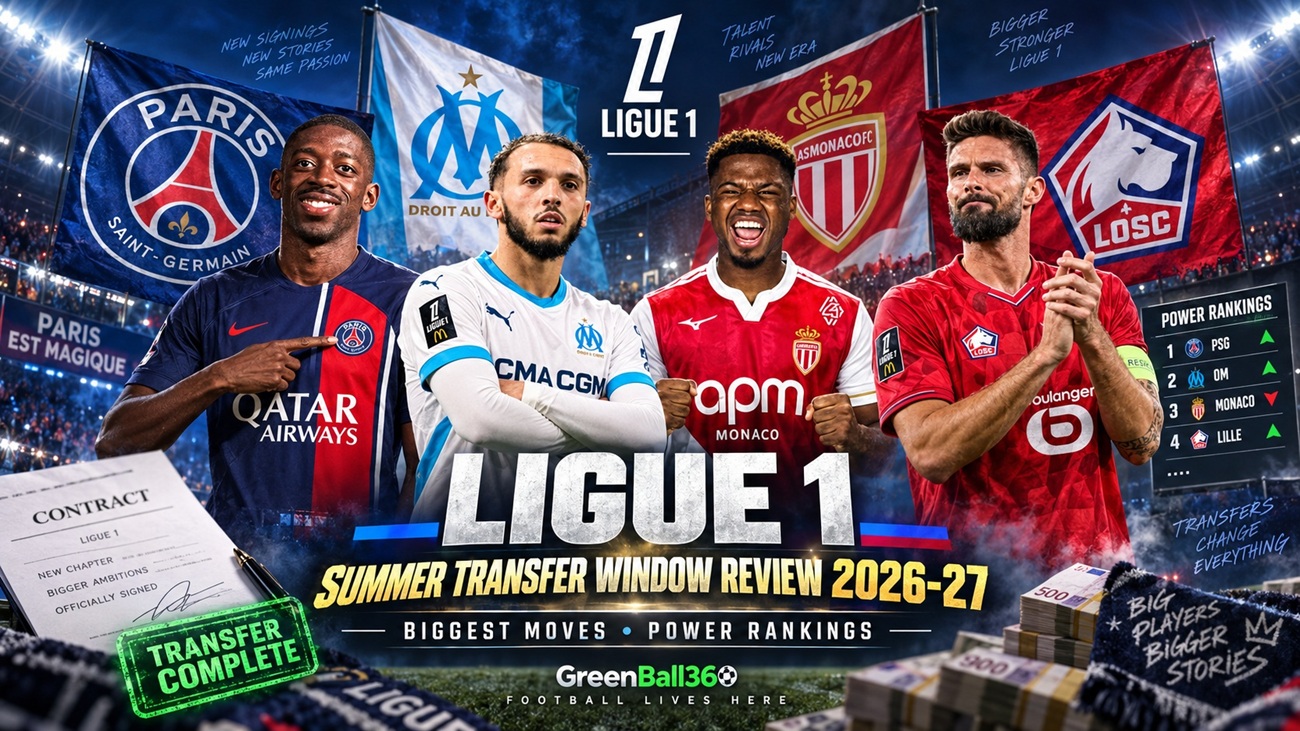
The 2026-27 Ligue 1 summer transfer window was shaped by two competing realities. French clubs continued to lose valuable players to richer leagues, but several also reinvested intelligently. Paris Saint-Germain strengthened an already elite squad despite selling Bradley Barcola.
Lens prepared for a return to the Champions League with experienced additions. Lille replaced two of their most valuable young players late in the window. Rennes built greater depth for Europe, while Paris FC continued an ambitious project by spending heavily on younger talent.
Across the league, 47 senior internationals arrived during the summer, while clubs recruited players from 33 different competitions. Strasbourg alone signed 17 players as part of another enormous squad turnover. The transfer window opened on June 15 and officially closed in France at 19:59 local time on September 1.
As with my Premier League, La Liga, Serie A and Bundesliga reviews, I am not ranking clubs according to spending or transfer reputation alone. Last season provides my starting point. PSG won Ligue 1 again, Lens finished second and Lille third, while Lyon narrowly missed the podium.
Marseille finished fifth after an inconsistent campaign and Monaco ended the season seventh. From there, I am adjusting for arrivals, departures, squad depth, positional balance, and whether each club actually solved its most important problems.
Read Also: 2026-27 Bundesliga Summer Transfer Window Review & Power Rankings
PSG Lost Barcola but Still Added More Elite Quality
Paris Saint-Germain did something few clubs can manage. They sold a major attacking player without making the squad look obviously weaker. Bradley Barcola joined Liverpool during the summer, while Ibrahim Mbaye completed a permanent move to Aston Villa on deadline day.
Mbaye had progressed through PSG's academy and already accumulated significant senior experience despite being only 18. Those departures removed significant attacking potential. PSG's response was aggressive.
Maghnes Akliouche arrived from Monaco, Ferran Torres joined from Barcelona, Mika Godts came from Ajax, Lucas Digne returned to Paris, and young goalkeeper Alessandro Longoni arrived from AC Milan. For me, Akliouche is particularly important.
He already understands Ligue 1 and provides another technically excellent player capable of operating between midfield and attack. He does not need to become Barcola stylistically because PSG already have Désiré Doué, Khvicha Kvaratskhelia and Ousmane Dembélé providing different forms of attacking threat.
Ferran adds another player comfortable across the front line and immediately demonstrated his goal threat at the beginning of the season. Godts gives Luis Enrique another young wide attacker with significant development potential.
Digne may be the least glamorous signing, but he provides experienced cover in an area where PSG have often depended heavily on Nuno Mendes. This squad was already the strongest in France. I think the gap became harder, rather than easier, for the rest of Ligue 1 to close.
Read Also: 2026-27 Serie A Summer Transfer Window Review & Power Rankings
Lens Prepared Properly for the Champions League
Lens finished second last season and also won the Coupe de France. That changes expectations. They are no longer simply an overachieving side trying to maintain momentum. They now need enough depth to compete domestically while managing Champions League football.
Their recruitment reflects that. Jean-Clair Todibo arrived on loan from West Ham on deadline day. Thorgan Hazard returned to French football, Michaël Cuisance joined permanently, and Franjo Ivanović arrived on loan from Benfica. Saud Abdulhamid's move was made permanent, while Junior Kadile provided another late attacking addition.
Todibo is the move that stands out to me. Lens already had a strong defensive identity. Adding a France international centre-back who understands Ligue 1 gives them exactly the kind of high-level experience required for European football.
Hazard provides another creative option, while Ivanović gives them a younger centre-forward capable of developing. There were important departures. Adrien Thomasson joined Rennes, and Wesley Saïd also left, while other pieces of last season's squad moved on during the summer.
Replacing Thomasson's creativity will not be straightforward. Even so, I think Lens handled the transition intelligently. The squad still looks capable of competing near the top four while dealing with European demands.
Read Also: 2026-27 La Liga Summer Transfer Window Review & Power Rankings
Lille Had to Replace Two Huge Sales
Lille's summer became much more difficult during its final week. They had already lost experience in defence, including Thomas Meunier, Aïssa Mandi and Chancel Mbemba. Then Manchester City signed Ayyoub Bouaddi for a reported £86 million, and Newcastle completed a deal worth a reported £51.4 million for Matias Fernandez-Pardo.
Those are not ordinary departures. Bouaddi was one of Europe's most valuable young midfielders. Fernandez-Pardo had become an important part of Lille's attack. To their credit, Lille reacted.
Ayase Ueda arrived from Feyenoord after finishing as the Eredivisie's top scorer with 25 goals. Dilane Bakwa returned to France, Maurits Kjaergaard joined from Salzburg, Başar Önal arrived earlier in the summer, and Tanguy Nianzou strengthened central defence.
Ueda may prove especially important. Lille already have Olivier Giroud, but Ueda offers a very different profile and arrives at the peak of his career rather than as a long-term development project.
Kjaergaard gives them midfield potential, while Bakwa adds another direct attacking option. I still think Lille ended the window weaker in pure talent because Bouaddi and Fernandez-Pardo were exceptional assets. But they did enough to remain a serious Champions League contender.
Read Also: 2026-27 Premier League Summer Transfer Window Review: Biggest Moves, My Verdict and Power Rankings
Lyon Took a Calculated Gamble on Openda
Lyon's transfer window reflects the financial reality surrounding the club. They were not in a position to simply accumulate expensive players. Instead, the strategy focused on younger talent, loans and selected opportunities.
Loïs Openda arrived on loan from Juventus and immediately became the headline signing. The Belgian already proved what he can do in Ligue 1 during his previous spell with Lens before scoring heavily in Germany. Lyon also added Julien Duranville, Zachary Athekame and several younger players during the summer.
Then, after the window had technically closed, OL completed the signing of Keito Nakamura from Reims as a joker. The deal includes a modest initial fee with significant potential bonuses. That gives Paulo Fonseca another useful attacking option.
The problem is what left. Afonso Moreira departed, Endrick returned after his loan, and Malick Fofana eventually moved to Sunderland. Ainsley Maitland-Niles was another deadline-day departure. That is significant attacking turnover. My assessment of Lyon therefore depends heavily on Openda.
If he returns to the level that made him one of Ligue 1's most dangerous forwards at Lens, Lyon still have enough attacking quality around him, Ernest Nuamah and Corentin Tolisso, to challenge near the Champions League places. If he struggles, the departures become much harder to absorb.
Monaco Replaced Akliouche With More Direct Attacking Options
Monaco's biggest loss was obvious. Maghnes Akliouche joined PSG after developing into one of the most technically gifted French attackers in the league. That type of player is extremely difficult to replace directly. Monaco chose not to try.
Instead, Matthis Abline arrived from Nantes after producing eight goals and seven assists last season. Ansu Fati's loan from Barcelona became permanent, while Flávio Nazinho strengthened the left-back position and Sadibou Sané arrived for central defence. Young winger Mathys Detourbet also joined on loan from Manchester City.
I like Abline's signing. He already understands Ligue 1, can play across the front line, and should enter an environment where he is surrounded by considerably more attacking quality than he had at Nantes. Fati is the higher-risk piece.
He scored 11 Ligue 1 goals during his loan last season, which was enough for Monaco to make the transfer permanent. If he stays fit, he gives them another player capable of producing decisive moments.
Monaco finished only seventh last season, so there was room for improvement regardless. I still think losing Akliouche lowers their creative ceiling, but the squad now has greater directness and several different attacking combinations.
Rennes Built One of the Deepest Squads Outside PSG
Rennes are one of my favourite windows in Ligue 1. Their recruitment does not contain one enormous superstar signing, but almost every move makes sense. Adrien Thomasson joined from Lens. Charlie Cresswell arrived from Toulouse. Eliezer Mayenda came from Sunderland, while Issa Soumaré and Arnaud Nordin added further attacking depth.
Boulaye Dia then arrived on loan from Lazio on deadline day. That gives Franck Haise multiple options in attack. Mayenda is still developing, while Dia provides experience. Thomasson knows exactly what Haise expects from his previous time at Lens. Cresswell gives Rennes another physically strong defender who already understands Ligue 1.
Rennes also retained Estéban Lepaul, last season's Ligue 1 leading scorer, after extending his contract. That matters as much as any new signing. Rennes narrowly missed the Champions League places last season despite changing coaches during the campaign. With Haise now having a full preseason and a deeper squad, I think they have every reason to aim higher.
Marseille's Window Was About Damage Control
Marseille's summer was unusual. For once, the club did not embark on an enormous early-window rebuild. Instead, much of the focus was on departures. Mason Greenwood joined Fenerbahçe after scoring 37 Ligue 1 goals across two seasons.
Gerónimo Rulli moved to Manchester City, Facundo Medina joined Leverkusen, and Pierre-Emerick Aubameyang also departed. Quinten Timber left for Crystal Palace on deadline day. That is a lot of quality and experience.
Timothy Weah's move was made permanent, which is important because he has become one of Marseille's most reliable and versatile players. Igor Paixão, Amine Gouiri and Pierre-Emile Højbjerg also remain major pieces of the squad. But this is not a window I can describe as strengthening.
Greenwood alone provided a level of individual scoring and chance creation that Marseille now have to replace collectively. Bruno Génésio is an excellent Ligue 1 coach and may create a more stable team than Marseille had last season. That could compensate for some of the talent lost. On pure squad strength, though, I think OM finished the summer weaker.
Strasbourg Made 17 Signings — Again Choosing Potential Over Continuity
No Ligue 1 club changed more than Strasbourg. They signed 17 players, with the average age of their incoming group only slightly above 20. The list includes Filip Jørgensen, Giovanni Reyna, Karim Coulibaly, Conrad Harder, Dario Essugo, Deivid Washington, Fabio Baldé, Genesis Antwi, Jeyland Mitchell and several other young prospects.
The talent is obvious. Reyna already has significant Bundesliga and international experience. Jørgensen gives Strasbourg another high-level young goalkeeper. Coulibaly played regularly in the Bundesliga despite being only 19, while Essugo and Washington arrive through the Chelsea connection.
But Strasbourg also lost a remarkable amount of talent. Valentín Barco, Emanuel Emegha, Diego Moreira, Julio Enciso and Guéla Doué were among the players to leave. This model can work. Strasbourg have repeatedly shown that they can identify young players, develop them quickly, and replace outgoing talent.
My concern is continuity. There comes a point where replacing this many important players every summer makes immediate performance harder. Their ceiling is high. Their range of possible outcomes is also wider than almost any club in the league.
Paris FC Are Acting Like a Club With European Ambition
Paris FC continue to be one of the most interesting projects in France. They spent more than €60 million relatively early in the window and focused much of that investment on younger players.
Pablo Pagis arrived from Lorient after producing 10 goals and five assists last season. Lassine Sinayoko joined from Auxerre, while Diego Coppola and Luca Koleosho had their previous loan moves converted into permanent transfers.
Patrick Zabi and Emmanuel Mbemba added further young talent. Pagis is the signing I like most. He was one of Lorient's most productive attackers and is entering an age where he should still improve. Sinayoko also arrives with proven Ligue 1 production after scoring 12 times for Auxerre last season.
Paris FC finished their first season back in the top flight comfortably enough to shift the conversation beyond survival. I do not think Champions League qualification should suddenly become the expectation. But European qualification no longer feels unrealistic if the new group settles under Liam Rosenior.
Nice Added Experience but Still Look Vulnerable
Nice had a difficult 2025-26 season and then entered another summer of change. Axel Witsel arrived after leaving Girona. Laurent Abergel joined from Lorient, while Nathan Ngoumou strengthened the wide attacking options.
Mohamed Amoura then arrived on loan from Wolfsburg, and Niels Nkounkou joined on deadline day. Amoura is the move that could change Nice's attack most. His pace gives them a direct threat that can stretch defensive lines, while Nkounkou adds energy from the left.
Witsel brings enormous experience and can play in midfield or central defence. He was effectively recruited to replace some of the leadership lost following Dante's retirement.
The concern is that Nice also lost important players, including Melvin Bard. There is enough ability here to move away from the relegation discussion that surrounded them last season. I am less convinced there is enough to immediately return them to the Champions League race.
My Post-Transfer Window Ligue 1 Power Rankings
These rankings reflect how strong I believe each squad is after the summer transfer window. They are not simply a ranking of transfer spending or last season's table.
1. Paris Saint-Germain
PSG remain first comfortably. Akliouche, Ferran, Godts and Digne join a squad that already contains Dembélé, Doué, Kvaratskhelia, Vitinha, João Neves, Warren Zaïre-Emery, Achraf Hakimi and Nuno Mendes.
Losing Barcola matters. It does not change who possesses the strongest squad in France. For me, PSG remain clear title favourites.
2. RC Lens
Lens earned this position through last season's performance and backed it with smart recruitment. Todibo significantly strengthens an already good defence. Hazard adds experience and creativity, while Ivanović gives them another attacking option.
Champions League football creates an additional physical burden. But I think Lens have enough depth to remain PSG's most credible domestic challenger.
3. Stade Rennais
This may be my boldest ranking. Rennes have quality across the squad and strengthened almost every area without losing the attacking player who mattered most last season.
Thomasson, Cresswell, Mayenda, Soumaré and Dia give Haise different tactical solutions. They finished strongly after Haise arrived last season. With a full preparation under him, I think they can make the Champions League places.
4. Lille
Lille remain extremely good, but I cannot ignore the losses of Bouaddi and Fernandez-Pardo. Ueda, Bakwa and Kjaergaard help substantially, while Nianzou strengthens the defence.
There is also a coaching transition with Davide Ancelotti replacing Génésio. I still see Lille as a top-four-quality team. I simply think their margin for error is smaller.
5. Olympique Lyonnais
Lyon's ceiling remains high. Openda provides the proven striker they needed, Nakamura adds another attacking option, and the return of Nuamah and other previously injured players give the squad more quality than a simple transfer list suggests.
Malick Fofana leaving hurts. But I trust Fonseca enough to keep Lyon competitive around the Champions League places.
6. AS Monaco
Monaco could finish much higher than sixth. Abline, Fati, Nazinho and Sané give them a good mixture of attacking and defensive additions.
Akliouche is the issue. Replacing a player who can receive between the lines, create and score at that level is difficult. The squad is good enough for Europe. I need to see how the creativity is redistributed before putting Monaco higher.
7. Olympique de Marseille
Marseille still has good players. Gouiri, Paixão, Weah and Højbjerg provide a strong core, while Génésio knows how to build competitive Ligue 1 teams. But Greenwood, Rulli, Medina, Aubameyang and Timber all leaving in the same summer is substantial.
I think Marseille can qualify for Europe. I am less convinced this squad is ready to challenge PSG or consistently outperform Lens, Rennes, Lille and Lyon.
8. Strasbourg
Strasbourg may ultimately make this ranking look too low. Reyna, Jørgensen, Essugo, Harder, Coulibaly and Washington represent enormous upside.
The problem is that 17 arrivals combined with several major departures creates uncertainty. I expect excellent performances and frustrating ones. If the young squad develops quickly, European qualification is realistic.
9. Paris FC
I like Paris FC more after this window. Pagis and Sinayoko give them proven Ligue 1 production, while Koleosho and Coppola becoming permanent improves continuity.
The squad is younger and more dynamic than last season. For me, they are now a legitimate top-half team rather than simply a club trying to stay in Ligue 1.
10. OGC Nice
Nice should be better. Amoura, Witsel, Nkounkou and Ngoumou give them considerably more experience and attacking variety.
There are still defensive questions, and the squad has undergone enough turnover to make me cautious. A comfortable top-half challenge is realistic.
11. Toulouse
Toulouse lost Charlie Cresswell to Rennes and Yann Gboho eventually joined Coventry. They responded with several younger players, including David Odogu, Sion Oppong, Niko Sigur and Mathis Amougou.
I like Sigur's versatility and Amougou's potential. The issue is that two established contributors have left. Toulouse remain well run, but I think this looks more like another mid-table squad than a clear European contender.
12. Brest
Brest have again had to regenerate. Romain Del Castillo left on deadline day, which removes one of their most important creative players. Joseph Nonge arrived earlier in the summer, while Noah Edjouma joined on loan.
Giovani Versini and Djylian N'Guessan were then added after the deadline as joker/loan reinforcements. I like some of the younger additions. Replacing Del Castillo's influence will take time.
13. FC Lorient
Lorient lost Pablo Pagis to Paris FC and Laurent Abergel to Nice, removing two important players from last season's team.
Ibrahima Baldé arrived late after scoring 13 times in Ligue 2 last season and beginning the new campaign in excellent form. Alec Georgen was another addition. There is enough here to compete. I still think the losses outweigh the additions slightly.
14. AJ Auxerre
Auxerre were extremely active. Danny Namaso's move became permanent, while Arthur Piedfort, Christ Makosso, Sékou Fofana, Pierre Ekwah, Cameron Archer and Axel Tuanzebe were among the additions. That is a deeper squad than last season.
The major concern is Lassine Sinayoko. His 12 goals were crucial to survival, and replacing that output collectively will be one of Will Still's biggest challenges. I think Auxerre have improved enough to survive, but I am not ready to move them much higher.
15. Angers
Angers changed coach and made relatively modest additions. Anthony Lopes strengthens the goalkeeping position, while Usman Simbakoli gives them another striker. Their recruitment also included several younger options and returning players.
This still looks like a team whose priority should be staying away from the bottom three. There is experience in the squad, but less high-end quality than most teams above them.
16. Le Havre
Le Havre continue to recruit creatively within financial limitations. Amir Richardson returned, while Elias Jelert arrived on loan. Junior Mwanga joined permanently, and Sota Nakamura added another attacking option.
Josh Maja also strengthens the centre-forward options. I like the logic behind the squad. The problem is that Le Havre again appear to have very little margin for injuries or poor form. Survival remains the realistic objective.
17. ESTAC Troyes
Troyes returned to Ligue 1 and added several players with interesting profiles. Patrick Beach arrived after an impressive World Cup with Australia. Hugo Picard joined on loan, while Timothé Nkada and Jérémy Le Douaron were added late to strengthen the attack.
There is more Ligue 1 and international experience here than many promoted squads possess. But the jump remains substantial. I think Troyes can survive, although they start the season in my bottom three on squad strength.
18. Le Mans
Le Mans have one of the best stories in European football. They reached Ligue 1 after consecutive promotions and are back in the top division for the first time in 16 years. Their recruitment has been sensible rather than extravagant.
Billal Brahimi returned, Louis Mafouta added proven Ligue 2 goals, Rayan Bamba and Daouda Traoré joined on loan, and Yasser Larouci brought further experience. Then Habib Diallo arrived from Metz on deadline day. The Senegal international has scored 57 goals in 175 previous Ligue 1 appearances.
That signing improves their survival chances substantially. I still have Le Mans last because the overall squad is making an enormous step after two promotions in two years. Finishing 17th or 18th would not make the project a failure. Staying up would be an extraordinary achievement.
My Final Verdict on the 2026 Ligue 1 Summer Transfer Window
My biggest takeaway from this summer is that Ligue 1 continues to operate as one of Europe's most important development leagues, but the best French clubs are becoming increasingly sophisticated at replacing the players they sell. PSG are the obvious example.
Selling Barcola would weaken almost any club in Europe. Paris can respond by signing Akliouche, Ferran and Godts while still having Dembélé, Doué and Kvaratskhelia. That depth is why I still see the title race as PSG's to lose. The more interesting battle may be directly behind them.
Lens earned second place last season and strengthened intelligently for the Champions League. Rennes may have assembled one of the deepest squads in France outside Paris. Lille lost two outstanding young players but reinvested quickly. Lyon are betting heavily on Openda restoring his best level. Monaco remain dangerous despite Akliouche's departure.
Marseille are the club that concerns me most among the traditional European contenders. Their squad still contains enough quality to compete, and I rate Génésio highly, but the amount of proven production that left the club makes this a difficult transition.
Strasbourg are almost impossible to predict. Seventeen new players, most of them extremely young, create enormous potential and equally enormous uncertainty. Paris FC may be the most interesting emerging challenger. Their recruitment suggests the club no longer sees survival as the main objective. The next logical step is the top half, and after that, Europe.
At the bottom, Auxerre and Le Havre again look capable of surviving through intelligent recruitment and organisation rather than financial power. Troyes have made enough additions to compete, while Le Mans will try to continue one of the most remarkable rises in modern French football.
For me, that is the story of the Ligue 1 window. France lost Barcola, Greenwood, Bouaddi, Fernandez-Pardo and several other high-value players. But the league also brought in Akliouche to PSG, Ferran Torres, Todibo, Openda, Ueda, Amoura, Witsel, Thorgan Hazard and a large group of young players who could become the next major exports.
Ligue 1 did not win the financial battle with the Premier League. It was never going to. The more important question is whether its clubs used the resources they had well enough to build competitive teams. Several of them did. Now the season has to show which rebuilds actually work.