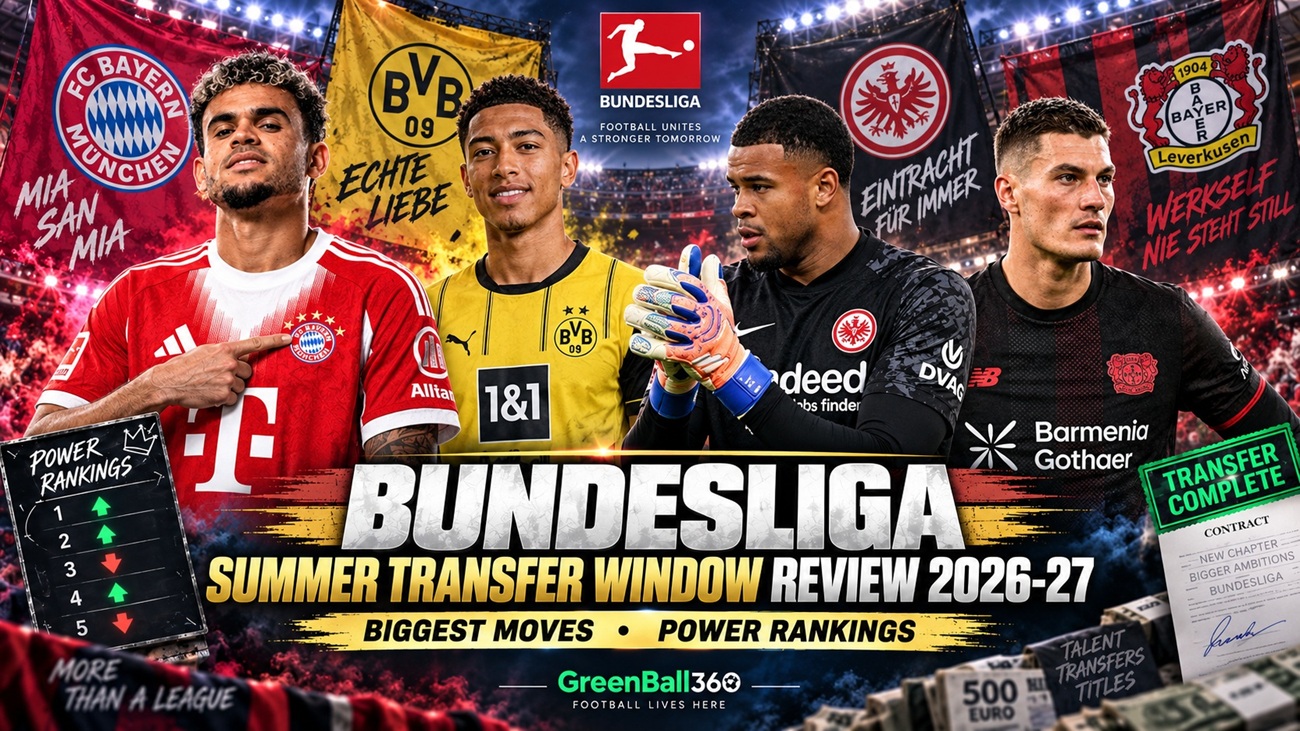
The 2026-27 Bundesliga summer transfer window produced several very different approaches to squad building. Bayern Munich largely resisted the temptation to overhaul a team that had dominated the previous season.
Borussia Dortmund went younger and more technical after losing several established attacking players. RB Leipzig carried out another substantial reset, while Bayer Leverkusen brought Moussa Diaby back to Germany as part of an attempt to climb back toward the Champions League places.
Further down the table, Hamburg and Cologne were ambitious; Werder Bremen brought Niclas Füllkrug back, and promoted Schalke immediately added several players with top-flight experience. The German summer transfer window closed at 8 pm CEST on September 1, 2026.
Last season provides important context for everything that follows. Bayern won the Bundesliga with 89 points after losing only once in 34 matches and scoring 122 goals. Dortmund finished second on 73 points, RB Leipzig third, Stuttgart fourth and Hoffenheim fifth, with Bayer Leverkusen dropping to sixth.
My rankings are therefore not based on transfer activity alone. I am starting with what each club achieved in 2025-26 and then adjusting for important arrivals, departures, depth, positional balance and how strong I think the overall squad looks after the window.
Read Also: 2026-27 La Liga Summer Transfer Window Review & Power Rankings
Bayern Munich Did Not Need a Revolution
There is often an expectation that Bayern must dominate the transfer market every summer. I do not think that was necessary this time. A team that finished 16 points clear of Dortmund and scored 122 league goals did not need to tear itself apart.
The priority was maintaining the strongest core in Germany while refreshing specific areas. Ismael Saibari arrived from PSV Eindhoven and is probably the most important addition. Nathaniel Brown joined from Eintracht Frankfurt, while Sacha Boey returned following his loan spell at Galatasaray.
Saibari particularly interests me because he adds another athletic and technically strong midfield option without requiring Bayern to reshape their entire attack. The Bundesliga itself identified him as Bayern's marquee addition after the window.
There were departures. Leon Goretzka moved to Aston Villa, João Palhinha joined Benfica, Raphaël Guerreiro left at the end of his contract, and Nicolas Jackson returned to Chelsea after his loan. Alexander Nübel also moved on. That removes considerable experience, particularly from midfield.
Even so, Bayern had enough depth to absorb some turnover. For me, their relatively quiet window should not be mistaken for weakness. They began the summer with by far the strongest team in Germany and still ended it with the squad everyone else has to catch.
Dortmund Chose a Younger, More Technical Rebuild
Borussia Dortmund's window was much more interesting. Karim Adeyemi joined Barcelona. Julian Brandt moved to Ajax. Yan Couto went to Como on loan, Julien Duranville left for Lyon, and Niklas Süle retired. That is a lot of creativity, speed, and experience leaving one squad.
Dortmund responded by recruiting players who could define their next cycle. Joey Veerman arrived from PSV, Konstantinos Karetsas joined from Genk, and Giannis Konstantelias came from PAOK. Ethan Nwaneri arrived on loan from Arsenal, while Joane Gadou and Kauã Prates strengthened the defensive options. Justin Lerma added another highly regarded young attacking talent.
I like the logic. Veerman gives Dortmund another midfielder capable of controlling possession and progressing the ball. Karetsas, Konstantelias and Nwaneri provide technical quality between midfield and attack.
There is obvious risk because several of those players are young and Dortmund have lost established Bundesliga production. But after finishing a distant second to Bayern, simply maintaining the same squad was unlikely to close the gap. Dortmund needed to raise their ceiling. I think they have tried to do exactly that.
Read Also: 2026-27 Premier League Summer Transfer Window Review: Biggest Moves, My Verdict and Power Rankings
Leipzig Rebuilt Again — but Nkunku Changes the Calculation
RB Leipzig finished third last season, yet their summer again involved substantial turnover. Yan Diomandé left for Real Madrid. Loïs Openda's move to Juventus became permanent. Xaver Schlager joined Nottingham Forest, Péter Gulácsi moved to Villarreal, and several other players departed either permanently or on loan.
Losing Diomandé and Openda from the attack alone would make me cautious about almost any team. Leipzig's response was ambitious. Christopher Nkunku returned on loan from AC Milan.
Marc Guiu arrived from Chelsea, Rocco Reitz joined from Borussia Mönchengladbach, and Neil El Aynaoui came from Roma. Maxime Estève strengthened central defence, Ørjan Nyland added experience in goal, and Brajan Gruda's loan from Brighton was extended.
Nkunku is the fascinating part. If Leipzig can get anything close to the version of Nkunku who previously became one of the Bundesliga's most dangerous attacking players, his return could transform the ceiling of this team.
Guiu gives them another centre-forward option, and Reitz should bring Bundesliga-proven energy into midfield. I still see considerable uncertainty because Leipzig replaced too many important players to call the squad unquestionably stronger. But the potential is obvious.
Leverkusen Brought Moussa Diaby Home
Bayer Leverkusen's sixth-place finish last season was disappointing by the standards they had established in previous campaigns. Their response was significant. Moussa Diaby returned from Al-Ittihad. Guéla Doué arrived from Strasbourg, Miguel Gutiérrez joined from Napoli, and Facundo Medina came from Marseille.
Kennet Eichhorn was another notable midfield addition, while Victor Boniface returned after his loan with Werder Bremen. Diaby's return immediately gives Leverkusen more speed and unpredictability in attack. Doué and Gutiérrez should provide energy from wide defensive positions, while Medina brings aggression and versatility to the back line.
However, the departures prevent me from describing this as a simple upgrade. Alejandro Grimaldo joined Atlético Madrid. Piero Hincapié completed his move to Arsenal, Exequiel Palacios left for Ipswich, and several younger players moved away.
Grimaldo in particular was difficult to replace because of how much creativity he provided from outside conventional attacking positions. I still think Leverkusen improved enough to challenge higher than sixth, but this is another squad going through meaningful change.
Stuttgart Strengthened Without Making Unnecessary Changes
Stuttgart finished fourth last season and did not need a dramatic rebuild. Their work was more targeted. Bilal El Khannouss' loan from Leicester became permanent, Grischa Prömel arrived from Hoffenheim, and Leo Sauer joined from Feyenoord.
Dženan Pejčinović was added from Wolfsburg, while Dennis Seimen and Leonidas Stergiou returned from loans. El Khannouss's remaining time is particularly important because he already understands the team's attacking structure.
Prömel provides additional experience in midfield, while Sauer gives Stuttgart another young wide attacker with development potential. Chema Andrés moved to Brighton and Alexander Nübel's spell ended, which creates some adjustment. But compared with several rivals around them, Stuttgart retained more continuity. I think that matters.
Hoffenheim's Fifth-Place Squad Was Tested by Departures
Hoffenheim were one of the surprise success stories of 2025-26, finishing fifth with 61 points. Their summer was more complicated. Patrick Wimmer arrived from Wolfsburg, Adam Daghim joined from Red Bull Salzburg, and Nathan De Cat came from Anderlecht.
Arthur Chaves also returned, with several younger players added throughout the squad. Those additions have upside. But Bazoumana Touré left for Newcastle United, Muhammed Damar joined Wolfsburg, and Grischa Prömel moved to Stuttgart. Kevin Akpoguma was another important departure.
Touré's departure particularly lowers the attacking ceiling. I still think Hoffenheim possesses enough talent to compete in the top half. Repeating fifth place may be more difficult.
Frankfurt Lost Too Much Quality for Me to Ignore
Eintracht Frankfurt had an unusually difficult window to assess. Raphael Onyedika arrived from Club Brugge, Lilian Brassier joined from Rennes, and Noah Atubolu came on loan from Freiburg. Malik Pimpong and Otávio were among the other additions.
Those are useful players. The outgoing list, however, is substantial. Nathaniel Brown joined Bayern. Hugo Larsson moved to Fulham on loan. Ellyes Skhiri joined Cologne. Arthur Theate went to Bologna on loan. Rasmus Kristensen left for Midtjylland, while Jean-Mattéo Bahoya and Elye Wahi also departed temporarily.
Frankfurt finished eighth last season. After this amount of turnover, I am not convinced the final squad is stronger. Onyedika could become an excellent midfield addition, but replacing Brown, Larsson and Skhiri in the same summer is a major task.
Hamburg Had One of My Favourite Windows
Hamburg finished 13th last season but recruited like a club determined to move comfortably away from the bottom half. Patson Daka arrived from Leicester, Terem Moffi joined from Nice, and Fábio Vieira's move became permanent. Zakaria El Ouahdi came from Genk, Albert Grønbæk stayed permanently, and David Møller Wolfe arrived on loan from Wolves.
Sebastiaan Bornauw added another experienced defensive option. That is a meaningful attacking improvement. Daka and Moffi offer different qualities at centre-forward, while Vieira provides technical creativity that many teams around Hamburg simply do not possess.
There were departures, including Robert Glatzel, Ransford-Yeboah Königsdörffer, and several loan players. But overall, I think Hamburg ended the summer clearly stronger. For me, they are one of the most realistic candidates to rise significantly from last season's finishing position.
Cologne Were More Ambitious Than Their League Position Suggested
Cologne finished 14th but also produced an unusually aggressive window. Thijs Dallinga arrived on loan from Bologna, Mikey Moore joined from Tottenham and Ellyes Skhiri returned from Frankfurt. Borna Sosa arrived on loan from Crystal Palace, while Jahmai Simpson-Pusey's move from Manchester City became permanent.
Gideon Mensah, Reigan Heskey and several younger players added further depth. I like the combination. Skhiri brings experience and familiarity. Dallinga offers a proper centre-forward option.
Moore raises the creative ceiling, and Sosa should give Cologne better delivery from wide areas. They also lost players, particularly Eric Martel and Denis Huseinbašić. Still, I think Cologne improved more than several teams that finished above them.
Werder Bremen Brought Füllkrug Back
Some transfers simply make sense. Niclas Füllkrug returning to Werder Bremen on loan from West Ham is one of them. Werder also added Youri Regeer on loan from Ajax, Arthur from Leverkusen, Eren Dinkçi from Freiburg and Chuki from Real Valladolid. Alexander Schlager strengthened the goalkeeping options.
The squad needed help after finishing 15th and scoring only 37 goals. Füllkrug immediately gives them a proven focal point. There were losses — Romano Schmid moved to Frosinone, Mio Backhaus joined Freiburg, and several loan players departed — but I think Werder now possess considerably more attacking variety. I would be surprised if they spend the entire season as close to relegation as they did last year.
Schalke Returned With Real Ambition
Schalke returned to the Bundesliga as 2. Bundesliga champions after three seasons outside the top flight. They did not approach promotion passively. Robin Gosens arrived on loan from Fiorentina. Hwang Hee-chan came on loan from Wolves, Maximilian Wöber joined from Leeds, and Junior Dina Ebimbe arrived from Frankfurt.
Junior Adamu came from Freiburg, while Satoshi Tanaka and goalkeeper Kevin Müller added further options. This is not a squad built entirely around players experiencing top-flight football for the first time.
Gosens, Hwang, Wöber and Ebimbe have considerable experience at high levels. That does not mean Schalke are suddenly European contenders. But compared with many promoted teams, I think they have given themselves a credible foundation for survival.
Elversberg's Rise Is Extraordinary — and Their Recruitment Fits the Project
Elversberg's presence in this article is remarkable in itself. They earned promotion to the Bundesliga for the first time in club history after finishing second in Bundesliga 2. The club had been playing fourth-tier football as recently as 2022.
Their recruitment reflects the development-focused approach that helped them climb so quickly. Cole Campbell arrived from Dortmund, Maurice Krattenmacher joined from Bayern, and Francis Onyeka came on loan from Leverkusen. Noah Darvich arrived on loan from Stuttgart, while Noel Futkeu joined temporarily from Frankfurt.
There are talented players there. The obvious question is experience. Elversberg are entering a league where almost every opponent possesses greater financial resources and deeper top-flight squads. Their recruitment gives them potential. Survival would still be an enormous achievement.
Paderborn Face the Hardest Promotion Challenge
Paderborn earned the final Bundesliga place by beating Wolfsburg in the relegation playoff. Their official Bundesliga season preview also acknowledged that the club lost important players including Mika Baur and Calvin Brackelmann during the summer.
The replacements included Rayan Philippe, Marvin Pieringer, Gabriel Vidović, Nahuel Noll, Luka Đurić and Laurin Ulrich. There are sensible additions. But compared with Schalke's experienced recruitment or Elversberg's collection of high-upside loanees, Paderborn's squad looks less convincing to me at Bundesliga level.
That does not make relegation inevitable. It simply means they begin with the smallest margin for error.
My Post-Transfer Window Bundesliga Power Rankings
These rankings are about overall squad strength after the transfer window, not which club made the most signings.
1. Bayern Munich
Bayern remain comfortably No. 1. They won the league by 16 points, lost only once, and scored 122 goals. Saibari and Brown strengthen a squad that already had the highest ceiling in Germany.
Goretzka and Palhinha leaving reduces midfield depth, but not enough for me to move Bayern from first. Everyone else is still chasing them.
2. Borussia Dortmund
Dortmund take second because they were already Bayern's closest challenger and their recruitment has enormous upside. Veerman should improve midfield control, while Karetsas, Konstantelias and Nwaneri give the attack a different technical profile.
Adeyemi and Brandt are important losses, so I am not assuming automatic improvement. But if the younger attackers develop quickly, Dortmund's ceiling may be higher than last season.
3. RB Leipzig
Leipzig remain third for me, although this is probably the most volatile team near the top. Losing Diomandé, Openda, Schlager and Gulácsi is substantial.
Bringing back Nkunku alongside Guiu, Reitz, El Aynaoui, Estève and Gruda gives them enough replacement quality to remain dangerous. If Nkunku returns to his previous Bundesliga level, this ranking may eventually look conservative.
4. VfB Stuttgart
Continuity gives Stuttgart an advantage over several competitors. They finished fourth and retained much of the structure responsible for that success, while keeping El Khannouss permanently and adding Prömel, Sauer and Pejčinović.
Their squad may not generate as many transfer headlines as Leipzig's or Leverkusen's. I still trust it.
5. Bayer Leverkusen
Leverkusen could easily finish above fifth. Diaby's return is significant, while Doué, Gutiérrez and Medina give the team new defensive and wide options.
My hesitation comes from losing Grimaldo, Hincapié and Palacios in the same summer. There is enough quality for a Champions League challenge, but also enough change to make immediate consistency uncertain.
6. Hoffenheim
Hoffenheim earned fifth place last season and deserve respect for that. Wimmer, Daghim and De Cat are interesting additions.
Losing Touré, Damar and Prömel makes the squad slightly less convincing to me, which is why they fall one place from their league finish.
7. Freiburg
Freiburg remain one of the Bundesliga's most stable teams. Mio Backhaus strengthens the goalkeeping options, while Yannik Engelhardt and Keisuke Gotō are useful additions.
Johan Manzambi and Merlin Röhl are significant departures, but Freiburg's structure repeatedly allows them to remain competitive despite turnover. I still see them around the European conversation.
8. Eintracht Frankfurt
Frankfurt have enough talent to remain in the top half, but I think their summer weakened some important areas. Onyedika is a signing I like, and Brassier strengthens the defence.
The departures of Brown, Larsson, Skhiri and Theate collectively are difficult to ignore. Eighth feels about right until the new midfield structure proves itself.
9. Hamburg
Hamburg are my biggest climbers. A team that finished 13th has added Daka, Moffi, El Ouahdi and Møller Wolfe while keeping Fábio Vieira permanently.
That is enough quality for me to expect a serious top-half challenge. European qualification may be too ambitious immediately, but Hamburg should be better.
10. Mainz
Mainz finished 10th and made several sensible additions. Eric Martel strengthens midfield, Ransford-Yeboah Königsdörffer gives them another attacking option, and Sheraldo Becker's move became permanent.
Stefan Posch also stayed permanently. The window lacks one transformative signing, but I think the overall squad remains competitive.
11. Cologne
Cologne's recruitment makes them another team I expect to improve. Dallinga, Moore, Skhiri, Sosa and Simpson-Pusey give them solutions across attack, midfield and defence.
Fourteenth last season was not good enough. I think this version of Cologne is capable of being comfortably better.
12. Werder Bremen
Füllkrug's return changes my assessment of Werder. They desperately needed more attacking authority after scoring only 37 times last season.
Regeer, Arthur and Dinkçi also give them better supporting options. The loss of Romano Schmid matters, but I think Werder have done enough to move away from 15th.
13. Borussia Mönchengladbach
Gladbach's window contained both interesting additions and painful departures. Nicolas Kühn and Isac Lidberg strengthen the attack, while Ko Itakura returned and Yukhym Konoplia adds another defensive option.
But Rocco Reitz, Nico Elvedi and Gio Reyna all left. That is too much established quality for me to call this an obvious improvement on the squad that finished 12th.
14. Augsburg
Augsburg added Juma Bah on loan, Calvin Brackelmann, Youngwoo Seol and Arijon Ibrahimović, while making Michael Gregoritsch and Rodrigo Ribeiro permanent.
There were numerous departures as well, including Keven Schlotterbeck. After finishing ninth, this ranking may look low. My concern is that several teams beneath Augsburg last season improved more aggressively.
15. Schalke
Schalke are the promoted club I trust most. Gosens, Hwang, Wöber, Ebimbe and Adamu give them players who already understand the demands of major European leagues.
They should still approach survival as the first target. But I think this squad has enough quality to finish above at least a few established Bundesliga teams.
16. Union Berlin
Union added Emmanuel Latte Lath, Michel Aebischer, Marvin Friedrich, Felix Uduokhai and Zeno Van Den Bosch. That is useful recruitment.
The concern is the defensive experience that left, particularly Danilho Doekhi and Diogo Leite. Union finished 11th last season. I think the squad looks more vulnerable now than that position suggests.
17. Elversberg
I like Elversberg's recruitment strategy more than this ranking might suggest. Campbell, Krattenmacher, Onyeka and Darvich are exactly the type of young players who could benefit from significant Bundesliga minutes.
The problem is the step in competition. Elversberg are the smallest club ever to reach the Bundesliga by the size of their home municipality, and their rise through the divisions has been extraordinary. Survival would be another remarkable achievement.
18. Paderborn
Paderborn start last in my power rankings. They deserved promotion and showed enough quality to defeat Wolfsburg in the playoff, but they also lost Baur and Brackelmann from an already young squad.
Philippe, Pieringer and Vidović improve the attacking options. I simply think the other promoted clubs constructed stronger squads for the level.
My Final Verdict on the 2026 Bundesliga Summer Transfer Window
The most important thing about this summer is that Bayern's rivals took different approaches to the same problem. How do you catch a team that won the Bundesliga by 16 points and scored 122 goals?
Bayern themselves chose evolution. Saibari and Brown strengthen specific areas without disturbing a championship-winning structure. Dortmund chose potential. Veerman adds experience, but Karetsas, Konstantelias, Nwaneri and Lerma make this a younger and more technically adventurous squad.
Leipzig accepted another major turnover cycle. Losing Diomandé and Openda hurts, but bringing Nkunku back gives them a player capable of changing the entire assessment if he can rediscover his best level.
Leverkusen tried to restore some of their previous attacking identity with Diaby while rebuilding important areas of the defence. For me, Bayern still finish the window with the strongest squad by a clear margin.
Dortmund remain the most credible challenger because they started from second place and have enough young talent to improve substantially. Leipzig, Stuttgart and Leverkusen form the next group, and I would not be surprised if the order between those three changes repeatedly.
Outside the Champions League battle, Hamburg had one of my favourite windows. Their attacking recruitment gives them a realistic opportunity to move from the lower half toward the European conversation.
Cologne and Werder also improved in ways that should matter immediately. At the bottom, Schalke's recruitment stands out. A promoted team adding Gosens, Hwang, Wöber and Ebimbe is not approaching the Bundesliga simply hoping to survive through momentum.
Elversberg are the opposite kind of story. Their squad is less proven, but their rise from the fourth tier to the Bundesliga in only a few years makes them one of the most interesting teams in Europe regardless of where they eventually finish.
Paderborn face the hardest challenge. That is my overall view of this window: the Bundesliga did not produce one challenger that obviously closed the entire gap to Bayern.
Instead, several clubs increased their own potential. Now Dortmund, Leipzig, Stuttgart and Leverkusen have to prove that potential can become enough consistency to make the title race genuinely competitive.